
Summary
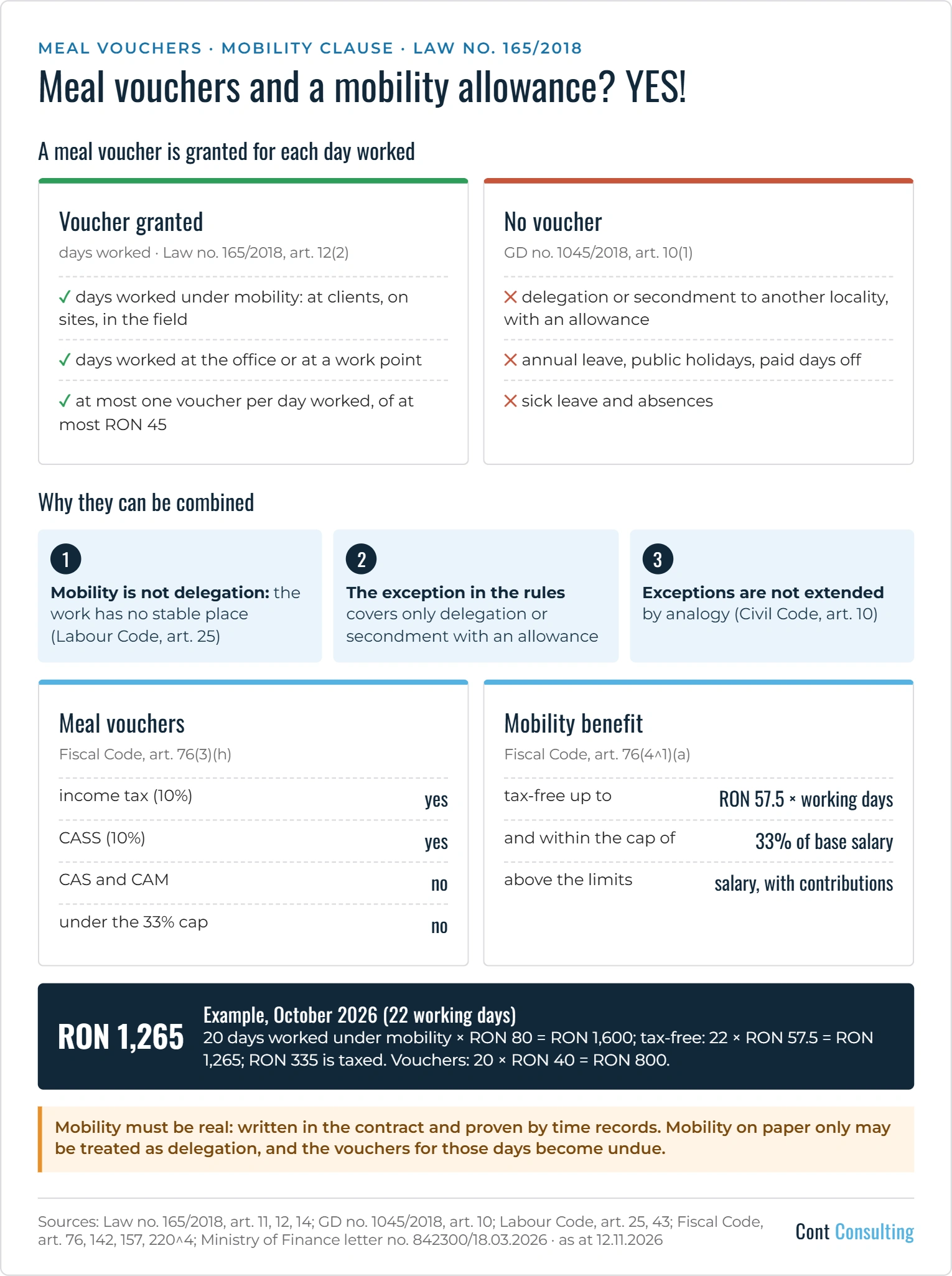
- Yes: employees with a mobility clause can receive meal vouchers for each day worked, on top of the mobility benefit set in the contract (often called a “mobility allowance”). No rule in force prohibits combining them.
- No meal vouchers are granted for days when the employee is on delegation or secondment outside the locality and receives a delegation or secondment allowance, nor for leave, public holidays, sick leave or absences.
- The number of vouchers in a month cannot exceed the number of days worked, and one voucher is worth at most RON 45.
- Meal vouchers are subject to 10% income tax and to the health contribution (CASS), but not to the social security contribution (CAS) or the work insurance contribution (CAM). The mobility benefit is tax-free up to RON 57.5 multiplied by the working days in the month, within the cap of 33% of the base salary.
- Combining them is safe only if mobility is real: set out in the contract and proven by time records and documents. Mobility that exists only on paper may be treated as delegation, and the vouchers for those days become undue.
Published on 12 November 2026.
Installation and service teams, sales agents or drivers do not work in a fixed office. For them, the employment contract includes a mobility clause and an additional benefit, which we explained in our article on the mobility clause. Employers often ask us whether these employees can also receive meal vouchers. The answer is yes, for the days worked, under a few conditions explained below.
Why meal vouchers can be combined with the mobility benefit
Meal vouchers are granted monthly as an individual food allowance (Law no. 165/2018, art. 11(1)), and in a month an employee may use at most as many vouchers as the days he or she worked (art. 12(2)). The law does not require a fixed place of work. A day on which a mobile employee works at clients’ premises or on construction sites is a day worked.
The implementing rules of the law (approved by Government Decision no. 1045/2018) list the periods that are not considered days worked (art. 10(1)): annual leave; paid days off, public holidays and other days off; days when the employee is on delegation or secondment outside the locality of his or her permanent place of work and receives a delegation or secondment allowance; sick leave, absences and other situations set by the employer together with the trade union or the employee representatives. The mobility clause is not on this list.
Mobility is not delegation. Delegation means the temporary performance, by order of the employer, of tasks outside the place of work (Labour Code, art. 43) and presupposes a place of work set in the contract, from which the employee is away for a period (art. 42). Under a mobility clause, the parties agree precisely that the work is not performed in a stable place (art. 25), and the additional benefits are owed for this usual way of working. The exception in the implementing rules requires three conditions at once: delegation or secondment under the law, outside the locality of the permanent place of work, with a delegation or secondment allowance. On ordinary mobility days, none of them is met.
The Fiscal Code also treats them separately: the benefits under a mobility clause are “other than” the delegation and secondment allowances (art. 76(4^1)(a)). In the same paragraph, the law expressly states that the relief for food provided by the employer does not apply to employees who receive meal vouchers (letter b), but it has no similar rule for the mobility benefit. And rules that derogate from the general rule apply only in the cases expressly provided, without extension by analogy (Civil Code, art. 10).
Our interpretation. We have not identified a rule that expressly regulates combining the two, nor a published official position on this point; the conclusion follows from the texts in force. To make it hard to challenge, the contract clause should show that the benefit compensates for continuous travel, not for meals.
When meal vouchers are not granted
- for days when the employee, mobile or not, is on delegation or secondment outside the locality of his or her permanent place of work and receives a delegation or secondment allowance (implementing rules, art. 10(1)(c));
- for annual leave, paid days off, public holidays, sick leave and absences (letters a, b and d);
- in other situations set by the employer together with the trade union or the employee representatives (letter d). If the internal regulations or the collective agreement do not exclude mobility days, they are days worked;
- for staff who receive a food allowance under Framework Law no. 153/2017 or food entitlements under GO no. 26/1994 (Law no. 165/2018, art. 31).
How many vouchers: at most one per day worked, without exceeding the number of working days in the month (implementing rules, art. 10(1) and (3)). For shifts longer than 8 hours, the number of days is calculated by dividing the hours worked by 8 (art. 10(5)). Vouchers received in excess are returned at the end of the month or deducted from the number due for the following month (Law no. 165/2018, art. 12(3); implementing rules, art. 17(1), (4) and (5)). An employee who uses more vouchers than the days worked commits a minor offence punished with 0.5 fine points, i.e. half the national gross minimum wage: RON 2,162.50 at the minimum wage of RON 4,325 (Law no. 165/2018, art. 28(1)(i), (2)(a) and (8)).
The value of one meal voucher cannot exceed RON 45 (art. 14). The cap remains in place from October 2026 as well, under Order no. 1254/1188/2026 of the Minister of Finance and the Minister of Labour. Meal vouchers can only be used in Romania (art. 8(5)).
By category of employees
| Employees | Meal vouchers | What to watch |
|---|---|---|
| Construction, installation and service teams (sites, call-outs at clients) | yes, for each day worked, including mobility days | delegation or secondment days with an allowance do not give a right to vouchers; also check the sector-level collective agreement, if it applies to you |
| Sales agents, commercial representatives, merchandisers | yes, for each day worked | the mobility benefit is tax-free only within the Fiscal Code limits; any excess is taxed |
| Drivers – domestic transport | yes, for days worked without a delegation allowance | if you pay daily benefits per trip instead of the delegation allowance, combining has a textual basis, but this is the area with the highest risk of interpretation |
| Drivers – international transport | only for days worked without per diem (delegation or secondment allowance, including the allowance specific to transnational posting) | meal vouchers can only be used in Romania |
For drivers, the Fiscal Code groups the additional benefits of mobile road transport workers with the delegation and secondment allowances (art. 76(2)(k)), and Government Decision no. 38/2008 includes the vehicle in the mobile worker’s place of work (art. 3(1)(d)). The rules on meal vouchers do not take over this assimilation, so, on the text, combining is allowed here as well. The risk arises when the employee in fact has a fixed base (depot, warehouse) from which he or she leaves on overnight trips: in an inspection, daily benefits per trip may be treated as delegation allowances. The prudent option is not to grant vouchers on days with daily trip benefits. In international transport, each trip qualifies as delegation or as transnational posting under the special rules for drivers in Law no. 16/2017, introduced by GO no. 12/2022.
How they are taxed
| Amount | Income tax (10%) | CAS (25%) | CASS (10%) | CAM | Notes |
|---|---|---|---|---|---|
| Meal vouchers | yes | no | yes | no | for profit tax, expenses with limited deductibility, if granted under the law |
| Mobility benefit, within the limits | no | no | no | no | limit: RON 57.5 × working days in the month and the cap of 33% of the base salary, shared with other benefits (food, accommodation, voluntary pensions, etc.) |
| Mobility benefit, above the limits | yes | yes | yes | yes | income assimilated to salaries |
| Delegation and secondment allowances, benefits of drivers under GD no. 38/2008, within the limits | no | no | no | no | in Romania, RON 57.5 per day; abroad, 2.5 × the per diem set by country in GD no. 518/1995; in both cases, at most 3 base salaries per month, pro rata to the days |
| The same amounts, above the cap | yes | yes | yes | yes | income assimilated to salaries |
Meal vouchers are salary income (Fiscal Code, art. 76(3)(h)), taxed at 10% (art. 64(1)(b)); they are included in the CASS base (art. 157(1)(ț) and (2), as amended by Law no. 296/2023, from 1 January 2024), but not in the CAS base (art. 142(r)) or the CAM base (art. 220^4(2)). They are not included in the 33% cap, which covers only the benefits listed in art. 76(4^1).
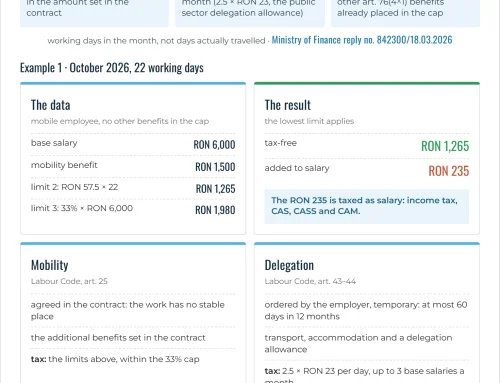
The mobility benefit is tax-free and exempt from contributions within the limits of art. 76(4^1)(a) (art. 142(aa^1) point 1, art. 157(2), art. 220^4(2)); the excess is income assimilated to salaries (art. 76(2)(k^1)) and is included in the CAS, CASS and CAM bases (art. 139(1)(t), art. 157(1)(u), art. 220^4(1)(n)). The Ministry of Finance explained, in its letter no. 842300/18.03.2026, that the RON 57.5 limit becomes a monthly cap based on the working days in the month, not on the actual days of travel. You will find details and examples in our article on the mobility clause.
Food in kind as an alternative. Food provided by the employer (for example, on a construction site) is tax-free up to the maximum value of one meal voucher per day, within the 33% cap, but not for employees who receive meal vouchers (art. 76(4^1)(b)).
Example: October 2026
An employee in an installation team has a base salary of RON 5,000 and a mobility clause with a benefit of RON 50 per day worked. He receives meal vouchers of RON 40. October 2026 has 22 working days; the employee worked 20 days under mobility and had 2 days of annual leave.
| Calculation | Treatment | |
|---|---|---|
| Meal vouchers | 20 × RON 40 = RON 800 (none for the 2 days of leave) | income tax and CASS; no CAS or CAM |
| Mobility benefit | 20 × RON 50 = RON 1,000; monthly limit: 22 × RON 57.5 = RON 1,265; 33% cap: RON 1,650 | fully tax-free and exempt from contributions, if there are no other benefits under the 33% cap |
| Variant: benefit of RON 80 per day | 20 × RON 80 = RON 1,600; tax-free part: RON 1,265 (the monthly limit, below the 33% cap) | RON 335 is added to the salary: income tax, CAS, CASS and CAM |
The example does not take into account other salary income or the personal deduction.
What to do as an employer
- The individual employment contract shows the absence of a fixed place of work and the work area (Labour Code, art. 17(3)(b)), the mobility clause and the amount of the benefit (art. 25). If they are missing, sign an addendum before the new terms apply (art. 17(5)).
- The internal regulations or the collective agreement provide that mobile employees receive meal vouchers and state which days are not considered worked (implementing rules, art. 7(3) and art. 10(1)). If the company applies a sector-level collective agreement (for example, in construction), also check what it provides for the mobility clause.
- Time records: agree in writing with mobile employees how working hours are recorded (Labour Code, art. 119(2)) and mark separately mobility days, delegation or secondment days and absences.
- One day, one meal cover: do not grant vouchers for days with a delegation or secondment allowance. Vouchers granted in excess are recovered at the end of the month or deducted from the following month.
- Drivers: in international transport, decide for each trip whether the employee is on delegation or secondment and do not grant vouchers for days with per diem. In domestic transport, choose between the prudent option and combining, depending on how the trips are organised.
- Check the tax limits every month: for mobility benefits, RON 57.5 × working days in the month and the 33% cap of the base salary; for delegation, secondment and drivers, the daily limit and the cap of 3 base salaries.
- Keep the supporting documents: travel orders, vehicle logbooks, activity reports, tachograph records and the employer’s own record of meal vouchers (implementing rules, art. 15).
The risk: mobility on paper only
If the employee in fact has a fixed place of work and “mobility” covers repeated delegations, the Labour Inspectorate may find, based on the employer’s documents, that this is delegation, and the tax authority (ANAF) may requalify the amounts (Law no. 72/2022, art. IV; procedure in Order no. 874/1429/2023). Those days may be treated as delegation days, and the meal vouchers granted for them become undue and must be recovered (Law no. 165/2018, art. 12(3); implementing rules, art. 17).
If you have mobile employees, our payroll and human resources team can check the contracts, internal regulations, time records and the monthly calculation of meal vouchers and caps. You can also book a meeting with us.
Legal basis
| Act | Provisions | What it regulates | Version in force on 12.11.2026 |
|---|---|---|---|
| Law no. 165/2018 on value vouchers | art. 8(5); art. 10(1); art. 11(1); art. 12; art. 14; art. 28; art. 31; art. 32 | granting of meal vouchers, their number and value, repayment, the offence, the excluded categories | art. 8, 11, 12 and 28 as amended by GEO no. 130/2021; art. 10(1) as amended by Law no. 87/2024; art. 14 as amended by Law no. 201/2025 (RON 45) |
| Order no. 1254/1188/2026 of the Minister of Finance and the Minister of Labour, Family, Youth and Social Solidarity | art. 1 and 2 | maximum value of a meal voucher from October 2026: RON 45 | Official Gazette no. 830 of 30.09.2026 |
| Implementing rules of Law no. 165/2018, approved by GD no. 1045/2018 | art. 3(2); art. 7(3); art. 10; art. 15; art. 17 | days not considered worked; clauses in the internal regulations; records and repayment | art. 10(1), art. 15 and 17 as amended by GD no. 931/2022 |
| Law no. 53/2003 – Labour Code, republished | art. 17(3)(b), (4) and (5); art. 25; art. 42–44; art. 46; art. 119 | place of work; mobility clause; delegation and secondment; working time records | art. 17(3)–(4) as amended by Law no. 283/2022; art. 119(2) as amended by Law no. 275/2022 |
| Law no. 227/2015 on the Fiscal Code | art. 25(3)(c); art. 64(1)(b); art. 76(2)(k) and (k^1), (3)(h), (4)(h), (4^1)(a) and (b); art. 139; art. 142; art. 157; art. 220^4 | tax, contributions and deductibility of meal vouchers and mobility benefits | consolidated version of 25.10.2026; art. 157(1)(ț) and (2) as amended by Law no. 296/2023; art. 76(2)(k) as amended by GEO no. 115/2023 |
| GD no. 38/2008 | art. 3(1)(d) and (e) | mobile road transport workers and their place of work | last amended by GD no. 1289/2011 |
| GD no. 714/2018; Order of the Minister of Finance no. 1235/2023 | annex | the RON 23 daily delegation allowance, basis of the RON 57.5 limit | RON 23 from 1.04.2023 |
| Law no. 16/2017; GO no. 12/2022 | special rules for drivers | transnational posting in road transport | Law no. 16/2017, last amended by GEO no. 66/2022 |
| Law no. 72/2022; Order of the Minister of Labour and Social Solidarity and of the Minister of Finance no. 874/1429/2023 | art. IV; procedure in the annex | tax requalification after a Labour Inspectorate inspection | in force, not amended |
| Law no. 287/2009 – Civil Code | art. 10 | no analogy for exception rules | not amended since entry into force, 1.10.2011 |
| Ministry of Finance letter no. 842300/18.03.2026 (in Romanian) | – | calculation of the monthly limit for the mobility benefit based on the working days in the month | official position, not a rule published in the Official Gazette (Fiscal Code, art. 5) |
Note: This text is valid at the date of publication, is for information purposes and represents the interpretation of Cont Consulting specialists. It does not replace the legal provisions in force or an analysis of a specific situation.
Sources: Law no. 165/2018 on value vouchers, art. 8, 10–12, 14, 28, 31 and 32; Order no. 1254/1188/2026 of the Minister of Finance and the Minister of Labour, Family, Youth and Social Solidarity; implementing rules approved by GD no. 1045/2018, art. 3, 7, 10, 15 and 17; Law no. 53/2003 – Labour Code, republished, art. 17, 25, 42–44, 46 and 119; Law no. 227/2015 on the Fiscal Code, art. 5, 25, 64, 76, 139, 142, 157 and 220^4; GD no. 38/2008, art. 3; GD no. 714/2018 and Order of the Minister of Finance no. 1235/2023; GD no. 518/1995; Law no. 16/2017 and GO no. 12/2022; Law no. 72/2022, art. IV; Order no. 874/1429/2023; Civil Code, art. 10; Ministry of Finance letter no. 842300/18.03.2026 in reply to the Chamber of Tax Consultants letter no. 12013/28.10.2025 – as in force on 12.11.2026.