
Summary
- The employment contract states the place of work or, if there is no fixed one, that the employee works in different places and who provides or reimburses the travel between them.
- The mobility clause is negotiated, but once the contract says that the work has no stable place, the employee is entitled to additional benefits, in cash or in kind, in the amount set in the contract.
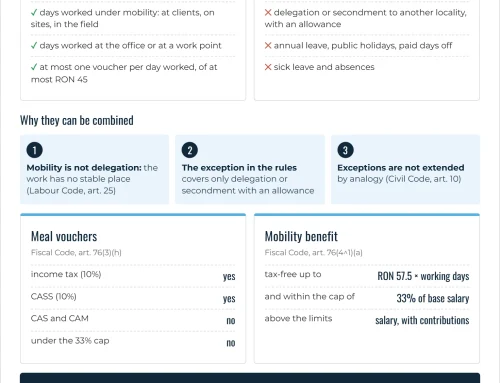
- Mobility is not delegation or secondment. Those are temporary measures ordered by the employer, with their own rules and rights.
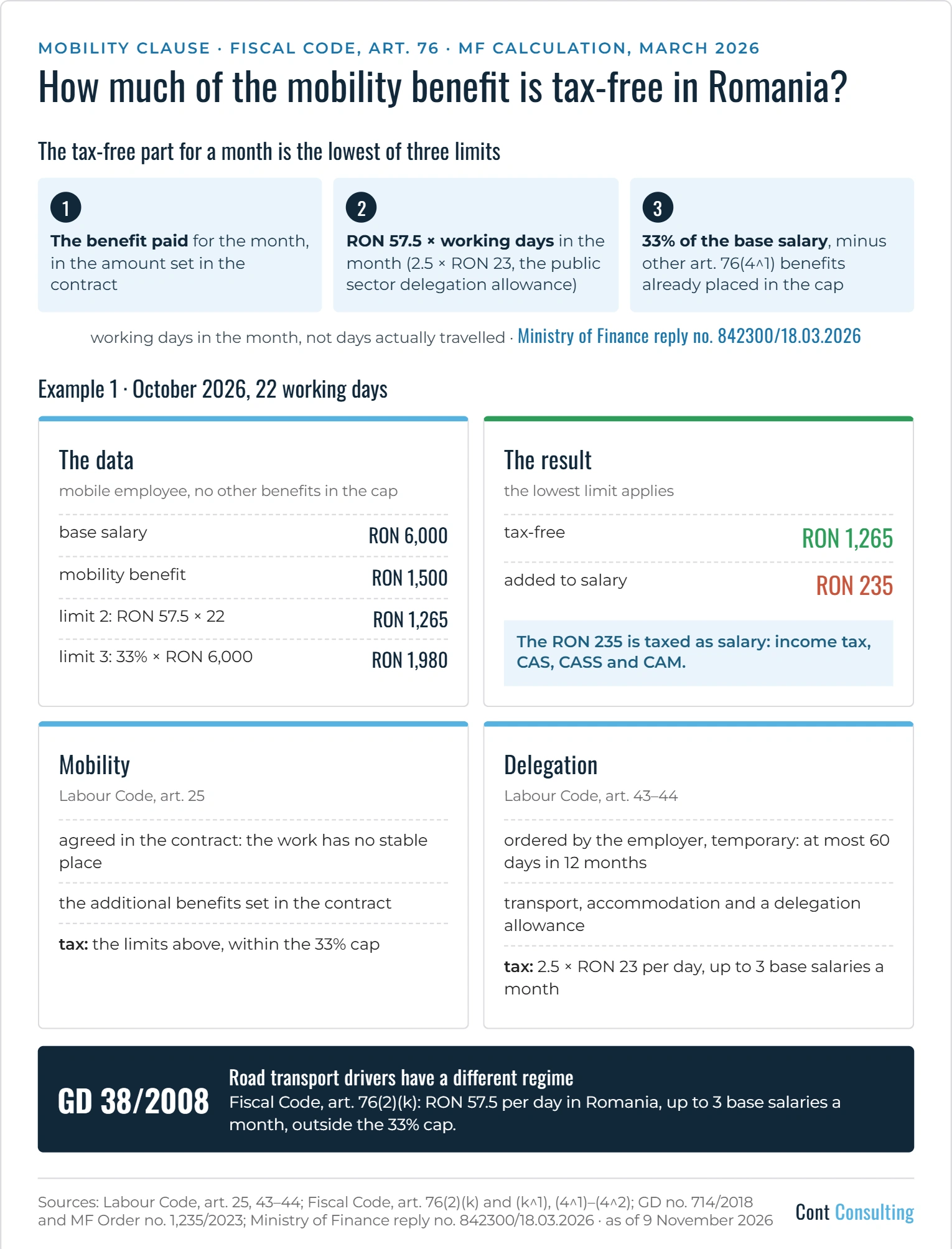
- The mobility benefit is tax-free up to RON 57.5 multiplied by the working days in the month, within the cap of 33% of the base salary shared with other benefits. This is how the Ministry of Finance explained it in March 2026.
- Road transport drivers covered by Government Decision no. 38/2008 have a different tax regime, outside the 33% cap.
- A mobility clause without benefits breaches the law and is fined. Amounts called “mobility” paid to employees who in fact have a fixed workplace may be requalified as salary after a Labour Inspectorate inspection.
Published on 12 November 2026.
Sales agents, service technicians, intervention teams and couriers usually have no office where they work every day. For them, the Romanian Labour Code provides the mobility clause, and the Fiscal Code a cap up to which the mobility benefit is not taxed. In March 2026, the Ministry of Finance clarified how this cap is calculated. Below you will find the rules, the calculation with examples and what to check in contracts and payroll.
The place of work in the contract: fixed or no stable place
Every individual employment contract must state the place of work or, in the absence of a fixed place, the possibility for the employee to work in different places and whether travel between them is provided or reimbursed by the employer (Labour Code, art. 17(3)(b) and (4)).
The mobility clause is one of the specific clauses the parties may negotiate (art. 20(2)(c)). Art. 25 gives its content: the parties agree that, given the specific nature of the work, the employee does not perform their duties in a stable place of work, and in that case the employee receives additional benefits in cash or in kind. The amount or form of these benefits is set in the contract (art. 25(2)).
In short: the law does not require the label “mobility clause”, but if the contract shows that the work is not done in a stable place, the additional benefits are a right of the employee, which the employee cannot waive (art. 38).
Mobility, delegation, secondment
| Mobility | Delegation | Secondment | |
|---|---|---|---|
| Legal basis (Labour Code) | art. 25 | art. 43–44 | art. 45–46 |
| Who decides | the parties, by contract or addendum | the employer, unilaterally | the employer, unilaterally |
| Where the work is done | no stable place, within the area set in the contract | outside the place of work, for the same employer | at another employer |
| Duration | as long as the contract provides | at most 60 calendar days in 12 months; extension only with the employee’s consent | at most one year; exceptional extension every 6 months, with the consent of both parties |
| What the employee receives | the additional benefits set in the contract | transport, accommodation and a delegation allowance | transport, accommodation and a secondment allowance |
| Tax regime (Fiscal Code) | art. 76(4^1)(a); drivers under GD no. 38/2008: art. 76(2)(k) | art. 76(2)(k) | art. 76(2)(k) |
Delegation and secondment change the place of work temporarily, and the employee keeps their position and the other rights under the contract (art. 42). Mobility describes the usual way the work is organised. As an element of the contract, introducing it later requires the employee’s consent and an addendum signed before the change (art. 41(1) and (3)(b), art. 17(5)).
Mobility does not exclude delegation. If a mobile employee is sent outside the area set in the contract, the delegation rules apply for those days: transport, accommodation and a delegation allowance (art. 44(2)). This is why the mobility area should be described clearly in the contract, for example by listing the counties where the employee works. We have written about the cap on the delegation allowance in our article on business trips and per diem, and about sending employees to another country in our article on posting workers in the EU.
When the work is actually mobile
The law gives no list of occupations and no duration threshold. What matters are the facts: does the employee have a stable place where the work is done?
- Usually mobility: sales agents who visit clients every day, service technicians working at clients’ premises, intervention teams, couriers.
- Usually a stable place: an employee who works for months at the same client or on the same construction site. That place can be written into the contract by addendum, and a mobility benefit risks being treated as salary.
- To be assessed case by case: work on several successive construction sites. If the employee moves often, with no stable base, the situation is closer to mobility; if the employee stays for long periods in the same place, it is closer to a stable place of work.
How much is tax-free: the Ministry of Finance calculation
The Fiscal Code treats the mobility benefit as follows (art. 76(4^1)(a)):
- it is tax-free up to 2.5 times the delegation allowance set for public institution staff. The allowance is RON 23 per day (Government Decision no. 714/2018, updated from 1 April 2023 by Order of the Minister of Finance no. 1,235/2023), so the reference level is RON 57.5;
- together with other benefits (meals, accommodation, holiday and treatment services, voluntary and occupational pension contributions, voluntary health insurance and medical subscriptions, sports subscriptions, nursery and kindergarten, preferential interest), it falls under a monthly cap of at most 33% of the base salary. The employer decides the order in which benefits enter the cap (art. 76(4^2)). From 1 January 2027, the same list also includes employer contributions to CEI-D savings and investment accounts (Law no. 202/2026).
The law does not say how the RON 57.5 becomes a monthly cap. The Chamber of Tax Advisers (CCF) asked for clarification, and the Ministry of Finance replied by letter no. 842300/18.03.2026 (PDF in Romanian, together with the CCF request):
- The cap is monthly and is calculated using the number of working days in the month, not the days actually spent travelling. The Ministry applied the rule “where the law does not distinguish, neither should the interpreter”.
- The conditions for delegation (for example, a minimum duration of the trip or travel to another locality) do not apply to the mobility benefit: the amount is compared only with the cap.
- Benefits received by drivers under GD no. 38/2008 have a separate regime, the one in art. 76(2)(k).
The tax-free part for a month is therefore the lowest of:
- the mobility benefit paid for the month;
- RON 57.5 × the working days in the month;
- 33% of the base salary, minus the other art. 76(4^1) benefits that the employer has already placed in the cap.
| October 2026 (22 working days) | Example 1 | Example 2 |
|---|---|---|
| Base salary | RON 6,000 | RON 4,500 |
| Mobility benefit under the contract | RON 1,500 | RON 1,300 |
| Monthly limit: RON 57.5 × 22 | RON 1,265 | RON 1,265 |
| 33% cap of the base salary | RON 1,980 | RON 1,485 |
| Other art. 76(4^1) benefits placed first in the cap | RON 0 | RON 400 |
| Remaining under the 33% cap | RON 1,980 | RON 1,085 |
| Tax-free | RON 1,265 | RON 1,085 |
| Added to the month’s salary | RON 235 | RON 215 |
The part within the cap is not taxed (art. 76(4^1)(a)) and is not included in the base for social contributions (Fiscal Code, art. 142(aa^1) point 1, art. 157(2) and art. 220^4(2)). Any excess is added to the month’s salary and taxed as such, with income tax (art. 76(2)(k^1)) and all contributions (for the pension contribution, CAS, art. 139(1)(t)).
The monthly cap does not turn any amount into a mobility benefit. If in a given month the employee did not actually work in a mobile way (for example, stayed at the office or was on leave), the nature of the amount may be challenged during an inspection. It is worth stating in the contract how the benefit is paid in such months.
How solid is the Ministry’s view? It does not have the force of a rule implementing the Fiscal Code: such rules are approved by Government decision or ministerial order and published in the Official Gazette (Fiscal Code, art. 5). It is, however, the official position of the ministry that drafts tax legislation, and it is supported by the rule that tax provisions which remain unclear are interpreted in favour of the taxpayer (Fiscal Procedure Code, art. 13(6)). Keep a copy of the reply in the payroll file.
What the Ministry did not clarify: how the mobility benefit and the delegation allowance combine in the same month for days spent outside the mobility area. Until this is clarified, we recommend caution: the same day should not be paid twice, and delegation days should be documented separately, with a travel order.
Road transport drivers: a different regime
For mobile workers under GD no. 38/2008, art. 76(2)(k) of the Fiscal Code applies. These are mainly drivers carrying out transport within the scope of Regulation (EC) No 561/2006: goods with vehicles over 3.5 tonnes (from 1 July 2026, also over 2.5 tonnes in international transport or cabotage) and passengers with vehicles for more than 9 persons, including the driver. For them:
- in Romania, the amount is tax-free up to 2.5 × RON 23 = RON 57.5 per day; abroad, up to 2.5 times the per diem set by Government decision for Romanian staff sent abroad on temporary missions (GD no. 518/1995);
- a limit of 3 base salaries per month applies, calculated in proportion to the days worked in another locality;
- the amounts do not count towards the 33% cap.
Risks
Labour law
- A clause stating that the work has no stable place but excluding the additional benefits breaches the law. It is null and void and is replaced by the legal provisions, and the employee is entitled to damages (art. 57(4) and art. 38). Including such a clause is fined RON 2,000 to 5,000 (art. 260(1)(d)). The fine concerns clauses contrary to law, not the mere absence of a mobility clause.
- The employee may ask for such a clause to be declared null at any time while the contract is in force (art. 268(1)(d)), and may claim unpaid amounts within 3 years (art. 268(1)(c)). The value of the right must be proven, because the law leaves the amount to the contract (art. 25(2)) and sets no minimum. In addition, the employee may claim delegation rights for travel outside the place of work stated in the contract (art. 44(2)) and damages for loss caused by the employer’s fault (art. 253(1)).
Tax
- If the benefits exceed the cap, the difference should have been taxed in the month of payment. During an inspection it is recalculated, with late-payment interest and penalties (Fiscal Procedure Code, art. 173(1)).
- If the employee in fact has a fixed workplace, amounts paid as “mobility” may be requalified as salary. ANAF does this after the Labour Inspectorate confirms, based on the employer’s documents, the nature of the amounts (Law no. 72/2022, art. IV; procedure in Order no. 874/1,429/2023).
Checklist for employers
- The contract clearly states the place of work or the absence of a fixed one, the area where the employee works and who provides or reimburses travel between places (art. 17(3)(b)).
- The mobility clause sets the amount of the benefit (a monthly amount or an amount per day worked) and what happens in months with leave or office work (art. 25(2)).
- Mobility introduced or changed during the contract has an addendum, signed in advance (art. 17(5)).
- There are documents showing the mobile work: activity reports, trip logs, client appointments, intervention reports.
- Days outside the mobility area are treated as delegation, with a travel order, without the same day being paid twice.
- Payroll checks the three limits every month: the benefit, RON 57.5 × working days and what is left under the 33% cap; the order of benefits within the cap is set in writing.
- Road transport drivers covered by GD no. 38/2008 are calculated under art. 76(2)(k), not under the 33% cap.
- The Ministry of Finance reply no. 842300/18.03.2026 is kept in the payroll file.
If you have employees without a fixed place of work, our payroll and human resources team can help you check the contracts and the monthly cap calculation. You can also book a meeting with us.
Legal basis
| Act | Provisions | What it regulates | Version in force on 9 November 2026 |
|---|---|---|---|
| Law no. 53/2003 – Labour Code, republished | art. 17(3)(b), (4) and (5); art. 20; art. 25 | the place of work in the contract; the mobility clause and the additional benefits | art. 17(3)(b) and (4) as worded by Law no. 283/2022; art. 17(5) as worded by GEO no. 53/2017; art. 20 and 25 unchanged since the 2011 republication |
| Law no. 53/2003 | art. 38; art. 41–46 | waiver of rights; amending the contract; delegation and secondment | unchanged since the 2011 republication |
| Law no. 53/2003 | art. 57(4); art. 253(1); art. 260(1)(d); art. 268(1)(c) and (d) | null clauses; damages; the fine; time limits for claims | the cited provisions unchanged since the 2011 republication |
| Law no. 227/2015 on the Fiscal Code | art. 76(2)(k) and (k^1); art. 76(4^1) and (4^2) | delegation, secondment and mobile road transport workers; the mobility cap and the 33% cap | (k) as worded by GEO no. 115/2023; (k^1), (4^1) and (4^2) introduced by GO no. 16/2022, from 1.01.2023; new item (k) in (4^1) from 1.01.2027 (Law no. 202/2026) |
| Law no. 227/2015 | art. 5; art. 139(1)(t); art. 142(aa^1) point 1; art. 157(2); art. 220^4(2) | implementing rules; social contributions | in force (consolidated version of 25.10.2026) |
| Law no. 207/2015 on the Fiscal Procedure Code | art. 13; art. 173(1) | interpretation of tax law; late-payment interest and penalties | unchanged since 2016 |
| Law no. 72/2022; Order of the Minister of Labour and Social Solidarity and of the Minister of Finance no. 874/1,429/2023 | art. IV; the procedure in the annex | tax requalification after a Labour Inspectorate inspection | in force, unchanged |
| GD no. 714/2018; Order of the Minister of Finance no. 1,235/2023 | annex, art. 1(1); art. 1(a) | the RON 23 daily delegation allowance for public institutions | RON 23 from 1.04.2023; the GD amended only by this order |
| GD no. 38/2008; Regulation (EC) No 561/2006 | art. 2 | mobile road transport workers | GD: last amended by GD no. 1289/2011; regulation: consolidated version of 31.12.2024 |
| Ministry of Finance reply no. 842300/18.03.2026 to CCF letter no. 12013/28.10.2025 (in Romanian) | – | the monthly cap based on the working days in the month | official view, not a rule published in the Official Gazette (Fiscal Code, art. 5) |
Note: This text is valid at the date of publication, is for information purposes and represents the interpretation of Cont Consulting specialists. It does not replace the legal provisions in force or an analysis of a specific situation.
Sources: Law no. 53/2003 – Labour Code, republished, art. 17, 20, 25, 38, 41–46, 57, 253, 260 and 268; Law no. 227/2015 on the Fiscal Code, art. 5, art. 76(2)(k) and (k^1), (4^1) and (4^2), art. 139, 142, 157 and 220^4; Law no. 202/2026; Law no. 207/2015 on the Fiscal Procedure Code, art. 13 and 173; Law no. 72/2022, art. IV; Order no. 874/1,429/2023; GD no. 714/2018 and Order of the Minister of Finance no. 1,235/2023; GD no. 38/2008; Regulation (EC) No 561/2006, art. 2; Ministry of Finance reply no. 842300/18.03.2026 to Chamber of Tax Advisers letter no. 12013/28.10.2025 – in the version in force on 9 November 2026.