
Three case studies: the psychologist, physiotherapy and home care
Summary
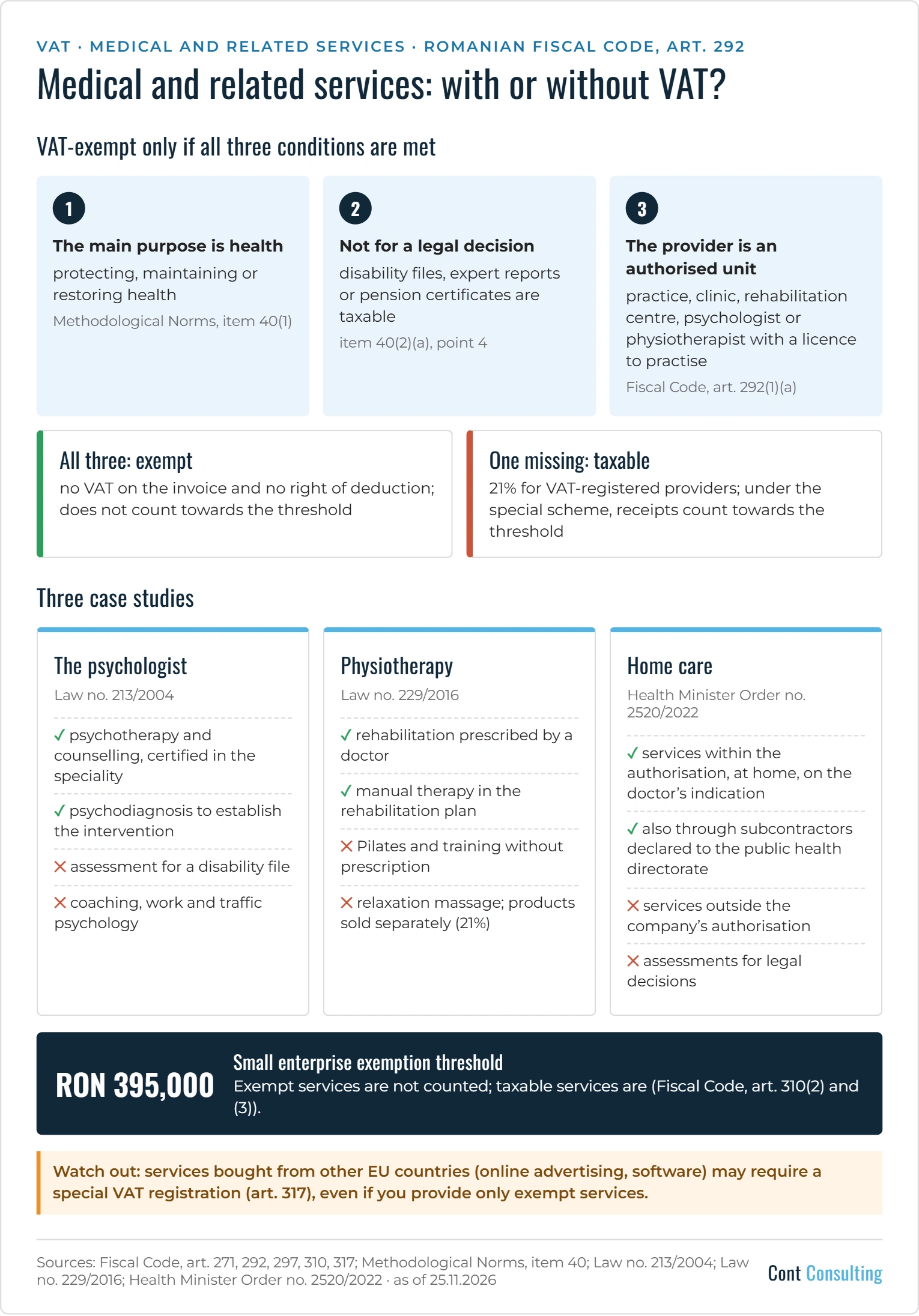
- In Romania, medical services are exempt from VAT only if two conditions are met together: the main purpose of the service is to protect, maintain or restore health, and the service is provided by an authorised unit (Fiscal Code, art. 292(1)(a), and Methodological Norms, item 40).
- What matters is the purpose, not the profession: assessments for disability files, expert reports and purely aesthetic or relaxation services are taxable, even when a psychologist, a doctor or a physiotherapist provides them.
- Psychotherapy, psychological counselling and rehabilitation physiotherapy prescribed by a doctor are, in principle, exempt when provided by a professional with a licence to practise.
- For a company authorised to provide home care, it does not matter whether an employee or a subcontractor performs the service, but whether the service falls within the activity for which the company itself is authorised.
- The exemption is mandatory and without the right of deduction: no VAT is charged on the invoice, and VAT paid on purchases is not recovered.
- Receipts from exempt services do not count towards the RON 395,000 threshold; receipts from taxable services do (Fiscal Code, art. 310(2) and (3)).
- If a company buys the services and invoices them to patients in its own name, the exemption is assessed at the company: the company itself must be an authorised unit.
Published on 25 November 2026.
A psychotherapy session and an assessment for a disability file can be carried out by the same psychologist, in the same practice. The first is, in principle, exempt from VAT; the second is not. For medical services, the Romanian Fiscal Code does not look at the diploma, but at the purpose of the service and at the authorisation of whoever sells it. Below you will find the rule, what remains taxable and three case studies: the psychologist, physiotherapy and a home care company that works with subcontractors.
The rule: when medical services are exempt from VAT
The Fiscal Code exempts from VAT “hospitalisation, medical care and the operations closely related to them, carried out by units authorised for such activities, regardless of their form of organisation” (art. 292(1)(a)). The text gives examples – hospitals, medical practices and laboratories, medical care and diagnostic centres, treatment and rehabilitation centres – and ends with an open category: “and other units authorised to carry out such activities”.
The Fiscal Code and the Methodological Norms set two conditions, and both must be met:
- The purpose of the service. The exemption covers services “whose main purpose is medical care, namely the protection, including the maintenance or restoration, of health” (Methodological Norms approved by GD no. 1/2016, title VII, item 40(1)(a)). This also includes medical examinations of individuals carried out for employers or insurers and the certification of a person’s state of health, for example for travel.
- The provider. The service must be carried out by a unit authorised for such activities. The form of organisation does not matter (individual practice, company, hospital); the authorisation does.
Operations closely related to medical care are also exempt when carried out by the same authorised unit: medicines, bandages, prostheses, orthopaedic products and similar goods supplied to patients during treatment, as well as food and accommodation during hospitalisation and medical care (item 40(1)(b)). Also exempt is the medical care of units authorised under GO no. 109/2000 (spa and rehabilitation medical care), together with accommodation and meals during treatment, if supplied by the same person (item 40(3)).
Separately, the Fiscal Code exempts the services of dentists and dental technicians, including the dental prostheses they supply (art. 292(1)(b)), “care and supervision services provided by medical and paramedical staff, in accordance with the applicable legal provisions” (letter (c)) and the transport of sick and injured persons in specially equipped vehicles by authorised entities (letter (d)).
Letter (c), a possible additional basis. For services provided by qualified professionals, letter (c) may support the exemption alongside letter (a). The Court of Justice of the European Union (CJEU) held that the exemption for care provided in the exercise of the medical and paramedical professions does not depend on the legal form of the provider and also applies to a company that provides therapeutic care, including home care, through qualified staff (judgment of 10 September 2002, Kügler, C-141/00). Law no. 229/2016 refers to “other paramedical professions” (art. 18(1)), and Law no. 487/2002 calls paramedical staff the members of the therapeutic team other than the doctor and the specialised nurse (art. 5(e)). This is an interpretation: the Romanian text of letter (c) speaks of “care and supervision”, so the main basis remains letter (a).
What the exemption means in practice
- It is mandatory. The Fiscal Code allows an option to tax only for certain real estate transactions (art. 292(3), which refers to paragraph (2)(e) and (f)). Exempt medical services cannot be taxed by choice.
- There is no right of deduction. VAT paid on purchases (equipment, rent, advertising) is not recovered: transactions exempt under art. 292(1) are not among those that give the right of deduction (art. 297(4)). A business with both taxable and exempt services deducts under the rules for mixed taxable persons (art. 300).
- It does not count towards the threshold. The turnover compared with the RON 395,000 threshold does not include transactions exempt under art. 292(1) (art. 310(2)), and a person who carries out only transactions exempt under art. 292 in a year is not considered to exceed the threshold (art. 310(3)).
- From a VAT standpoint, an invoice is not mandatory for transactions exempt without the right of deduction under art. 292 (art. 319(7)). Anyone who still issues an invoice (paragraph (11)) mentions the legal basis of the exemption (art. 319(20)(l)).
What remains taxable, even when a doctor or a therapist provides it
The Norms list expressly what is not exempt (item 40(2)):
- Services whose main purpose is not medical care, such as: services with a purely aesthetic purpose; collecting, testing and processing umbilical cord blood and storing the stem cells for possible future therapeutic use; the services of investigating doctors in clinical trials of medicinal products for human use; services that provide information needed for a decision with legal consequences – health certificates used to grant a pension, expert reports on liability for personal injury or on occupational medicine rules in disputes (and the examinations carried out for them), medical reports drawn up from medical files without an examination.
- Medical goods supplied outside treatment, for example by pharmacies, even if the pharmacy is located inside a hospital or a clinic (item 40(2)(b)).
- Veterinary services (item 40(2)(c)).
To these add any service, even a therapeutic one, provided by someone who is not an authorised unit: the second condition is not met.
The main purpose test. The same act can be exempt or taxable. A medical examination requested by an employer to protect the employee’s health is exempt (item 40(1)(a)); an examination carried out for an expert report in a dispute is not (item 40(2)(a), point 4). The list in point 4 begins with “such as”, so, in our opinion, it is illustrative: what matters is the main purpose of the service, not its name.
The distinction comes from CJEU case law: examinations for employers or insurers, samples taken on their behalf and certification of medical fitness (for example, to travel) are exempt when they are intended principally to protect the health of the person concerned; certificates for pension entitlement, examinations for expert reports in disputes and reports drawn up from medical notes without an examination are not (judgment of 20 November 2003, d’Ambrumenil, C-307/01).
How it is taxed. If the provider is registered for VAT, taxable services are invoiced at the standard rate of 21% (Fiscal Code, art. 291(1)). If the provider applies the special exemption scheme for small enterprises, it does not mention VAT on the invoice (art. 310(10)(b)), but receipts from taxable services count towards the RON 395,000 threshold (art. 310(2)).
Case study 1 – the psychologist: assessments for disability files and other services
The situation. A company that is not registered for VAT and applies the special scheme for small enterprises (turnover below RON 395,000) wants to work with a psychologist with a licence to practise. The psychologist will assess patients for the documentation of disability classification files and may also provide other psychological services under the same arrangement.
1. Assessments for disability files are taxable. Classification by degree and type of disability is a decision with legal consequences. For adults, it is made by the assessment committee on the basis of the complex assessment report (Law no. 448/2006, art. 87(1)(a)), certified by a certificate (art. 87(4)), and the benefits due are granted on the basis of that certificate (art. 87(1)(h)). The psychological assessment carried out for the file mainly provides the information on which the decision relies, so it falls under the exclusion in item 40(2)(a), point 4 of the Norms. The exclusion concerns the purpose, not the provider: it applies even when a certified psychologist or an authorised clinic performs the assessment, and even if the assessment benefits the patient. For children the classification procedure is different, but, in our opinion, the VAT conclusion is the same: point 4 covers any decision with legal consequences.
2. Therapeutic services are, in principle, exempt. The Mental Health Law classifies psychological counselling and psychotherapy as services “that provide mental health and psychiatric care” (Law no. 487/2002, art. 5(f)) and includes the psychologist in the therapeutic team (art. 5(d)). Psychodiagnosis and clinical assessment carried out to establish a therapeutic intervention, psychological counselling and psychotherapy aim to protect or restore health.
The condition relating to the provider: the psychologist obtains the certificate of free practice and is entered in the Single Register of psychologists with a licence to practise (Law no. 213/2004, art. 8(1)), practises in a form declared to the College of Psychologists and recorded in the Single Register (art. 13(1), art. 14(1) and (3)), and works within the limits of the certificate held (art. 16(a) and art. 17(c)). Clinical psychology, psychological counselling and psychotherapy are separately certified specialities (rules approved by GD no. 788/2005, art. 15(1)).
Our interpretation: a psychologist with a licence to practise, certified in clinical psychology, psychological counselling or psychotherapy, who works in a registered form of practice, is an “authorised unit” for the therapeutic services within that speciality. However, the Fiscal Code and the Norms do not expressly name psychology practices, so the tax authority may take a more restrictive view.
This interpretation is supported by CJEU case law: Member States may define the paramedical professions, but the exemption must cover the services of persons with the required professional qualifications, and excluding a profession, for example psychotherapists, is justified only by qualifications and in compliance with fiscal neutrality (judgment of 27 April 2006, Solleveld and van den Hout-van Eijnsbergen, joined cases C-443/04 and C-444/04).
3. Services without a therapeutic purpose are taxable. As a rule, this includes services in work and organisational psychology, traffic psychology and applied psychology in services (rules approved by GD no. 788/2005, art. 16), as well as coaching, personal development and training. Expert psychological reports requested in a dispute and assessments needed to obtain a right or an authorisation are taxable for the same reason as assessments for disability files (point 4).
4. Examinations requested by an employer: case by case. The Norms include in the exemption “medical examinations of individuals carried out for employers”. In our opinion, a psychological examination requested by an employer is exempt only if its main purpose is to protect the health of the person examined; if the main purpose is staff selection or a decision with legal consequences, it is not exempt.
| Service | VAT treatment | Legal basis |
|---|---|---|
| Assessment for a disability classification file | taxable | Methodological Norms, item 40(2)(a), point 4 |
| Psychodiagnosis and clinical assessment to establish the intervention | exempt* | Fiscal Code, art. 292(1)(a) |
| Psychological counselling, psychotherapy | exempt* | Fiscal Code, art. 292(1)(a) |
| Work, traffic and applied psychology in services; coaching; training | taxable | Methodological Norms, item 40(2)(a) |
| Expert reports; assessments to obtain a right or an authorisation | taxable | Methodological Norms, item 40(2)(a), point 4 |
| Examination requested by an employer | case by case | item 40(1)(a) or item 40(2)(a), depending on the purpose |
* if provided by a psychologist with a licence to practise, certified in the relevant speciality.
If the company re-invoices. The conditions for the exemption are checked for each supply. When the psychologist invoices patients directly, the analysis above applies to the psychologist’s services. When the company buys the services and invoices them to patients in its own name, the supplier to the patient is the company; even when it acts on behalf of the psychologist but in its own name, the company is deemed to have received and supplied the service itself (Fiscal Code, art. 271(2)). The exemption applies to the company’s invoices only if the company also meets both conditions, including being an authorised unit. Otherwise, the service invoiced by the company is taxable, even if the service received from the psychologist is exempt.
The nuance from CJEU case law. For a commission agent – a company acting in its own name but on behalf of the provider – the CJEU held that the law creates the fiction of two identical supplies, which also applies to exemptions (judgment of 14 July 2011, Henfling and Others, C-464/10, paragraphs 35–37). That judgment, however, concerned the exemption for betting. The medical exemption in letter (a) has an additional condition relating to the provider (an authorised unit), which, in our opinion, must also be met by whoever invoices the patient. Our recommendation therefore remains that a company that re-invoices should itself be authorised. Whether the company really acts in its own name is determined from the contracts and the circumstances as a whole (paragraphs 40 and 42 of the same judgment).
Case study 2 – physiotherapy: rehabilitation, massage, sport, products sold
Who is an “authorised unit” here. Under the law, a kinesiotherapist practises the profession of physiotherapist: a bachelor’s degree in kinesiotherapy is an official qualification in physiotherapy (Law no. 229/2016, art. 11(a)). A physiotherapist practises on the basis of a licence to practise issued by the College of Physiotherapists of Romania and endorsed annually (art. 14(1)). The physiotherapist may work independently, as owner or partner of an independent practice, or in collaboration with medical care providers, treatment centres, sports clubs and associations (art. 15). An independent practice requires at least 3 years of practice and the mandatory minimum equipment (rules approved by GD no. 934/2019, art. 8(2)). The College keeps the Single Register of physiotherapists, published on its website (art. 3(3) of the same rules).
What the law says about purpose. The physiotherapist profession aims at rehabilitation programmes that “improve or restore human motor functions, increase mobility, relieve pain and treat or prevent physical problems associated with injuries, diseases, conditions and other impairments” (Law no. 229/2016, art. 2). The physiotherapist carries out the specific activities “on medical prescription”, “on the basis of the clinical diagnosis established by the specialist doctor” (art. 4; art. 13). A medical prescription is therefore the best evidence of the therapeutic purpose.
The situation. Ana is a kinesiotherapist with a licence to practise endorsed for the current year and an independent practice. Here is what she sells and how it is treated:
| What Ana sells | VAT treatment | Why |
|---|---|---|
| Rehabilitation after knee surgery, prescribed by the orthopaedic surgeon | exempt* | the purpose is to restore health (Methodological Norms, item 40(1)(a)); Law no. 229/2016, art. 4 and 13 |
| The same rehabilitation, reimbursed by the health insurance fund | exempt* | who pays does not change the nature of the service; the Norms also exempt services paid by third parties, such as employers or insurers (item 40(1)(a)); reimbursement is provided for by Law no. 229/2016, art. 25 |
| Prescribed preventive physiotherapy (for example, for a posture problem) | exempt* | “the protection, including the maintenance” of health (item 40(1)(a)); “therapeutic and preventive assistance” (Law no. 229/2016, art. 13(c)) |
| Manual therapy included in the prescribed rehabilitation plan | exempt* | a specific physiotherapy activity (Law no. 229/2016, art. 13(e)) |
| Pilates, maintenance exercise, personal training, without prescription, for fitness | taxable** | the main purpose is not medical care (Methodological Norms, item 40(2)(a)) |
| Relaxation massage | taxable | the main purpose is not medical care (item 40(2)(a)) |
| Goods given to the patient as part of the treatment, during the treatment (for example, an orthosis) | exempt* | operations closely related to medical care (item 40(1)(b)) |
| Orthoses, elastic bands, exercise balls sold separately, to anyone | taxable, 21% | goods supplied outside treatment (item 40(2)(b)); not on the reduced-rate list (Fiscal Code, art. 291(2)) |
* if the provider is an authorised unit – here, Ana, with a valid licence to practise. ** our interpretation: the treatment depends on the main purpose, not on what the session is called.
Our interpretation: the Fiscal Code expressly names “treatment and rehabilitation centres”, but not physiotherapy practices. We consider that a physiotherapist with an endorsed licence to practise, working in a form provided for by Law no. 229/2016, is an “authorised unit” for prescribed physiotherapy services. As with psychologists, the tax authority may take a more restrictive view.
For physiotherapists, the CJEU held the same: excluding certain treatments performed by physiotherapists is justified only if they are not of equivalent quality to those that are exempt when doctors perform them (Solleveld, C-443/04).
When someone else sells. A gym or another company without an authorisation for medical activities, selling “physiotherapy packages” delivered by an employed or contracted kinesiotherapist, does not itself meet the provider condition in art. 292(1)(a). The letter (a) exemption does not apply to its sales, even if an authorised professional delivers the session. If, instead, the authorised kinesiotherapist invoices patients directly, or invoices a sports club for the rehabilitation of injured athletes on prescription, the analysis is made at the kinesiotherapist, and the service can be exempt.
Other exemptions – for example, for services closely linked to sport provided by non-profit organisations (art. 292(1)(l)) – have their own conditions and are not analysed here.
Case study 3 – a home care company working with subcontractors
The situation. A company (SRL) holds an operating authorisation from the public health directorate for home care services, issued on the basis of a self-declaration, for a home care dispatch centre, “through authorised staff”. In addition to home care, the company sells psychological counselling and treatment and other medical services, which it delivers through subcontractors – sole traders (PFA), individual medical practices or companies – each authorised in its own field. The company invoices the patients; the subcontractors invoice the company.
The question. Does the company apply the exemption only to the services it provides directly, with subcontracted services being taxable, or can it apply the exemption to all of them?
The short answer. The test is not “directly or through a subcontractor”, but whether the service sold falls within the activity for which the company itself is authorised and has a therapeutic purpose. Services within the authorisation can be exempt even when subcontractors perform them; services outside it are taxable at the company, even if the subcontractor invoices them to the company without VAT.
Why it is assessed at the company. The patient buys from the company. Even when it acts on behalf of the subcontractor but in its own name, the company is deemed to have received and supplied the service itself (Fiscal Code, art. 271(2)). The exemption in art. 292(1)(a) requires the service to be “carried out by units authorised for such activities”, so the authorisation that matters is the company’s, not the subcontractor’s.
What the company’s authorisation covers. The Rules on the operation and authorisation of home care services (Annex 1 to Order of the Minister of Health no. 2520/2022) define home care as “any medical care activity or activity related to the medical act, provided by specialised staff at the patient’s home” (art. 1), carried out “only on the doctor’s indication” (art. 2), for persons with acute or chronic conditions, with a certain level of dependency and a limited ability to travel to a healthcare facility (art. 4). The services a provider may offer are listed in art. 8; among them: physiotherapy (only procedures that can be carried out at home), individual speech therapy, “psychological examination and assessment” and “other services recommended by the specialist doctor or the family doctor, within the competence of the home care provider” (points 8–11).
Subcontracting does not take the service outside the authorisation. The Rules expressly accept staff under service contracts: the authorisation file includes “the list of staff employed in the home care service (+ copy of REVISAL or copies of employment/service contracts)”, together with the staff’s licences to practise (art. 11(j) and (k)). The Methodological Norms to the Fiscal Code also accept that authorised spa and rehabilitation treatment centres supply treatment services “with their own resources or resources purchased from third parties” (item 40(3)).
CJEU case law points the same way. The exemption for medical and paramedical care does not depend on the legal form of the provider and applies to a company that provides therapeutic care, including home care, through qualified staff. It does not, however, apply to general care and domestic help, which may at most fall under social assistance (Kügler, C-141/00; in the Fiscal Code, art. 292(1)(i), subject to its conditions).
| Service sold by the company | VAT treatment at the company | Why |
|---|---|---|
| Care listed in art. 8, at home, on the doctor’s indication, through declared staff (employed or subcontracted) | exempt | the company is an authorised unit for these activities (Fiscal Code, art. 292(1)(a); art. 1, 2, 8 and 11 of the Rules approved by Order no. 2520/2022) |
| Psychological examination and assessment at home, with a therapeutic purpose | exempt | art. 8, point 10 of the same Rules |
| Counselling and psychotherapy at home, recommended by a doctor, by a psychologist certified in the speciality | exempt* | art. 8, point 11 of the same Rules |
| Counselling, psychotherapy or other medical services provided at the subcontractor’s practice, not at home | taxable at the company** | this is not home care, so it is outside the company’s authorisation |
| Assessments for disability files or other decisions with legal consequences | taxable | Methodological Norms to the Fiscal Code, item 40(2)(a), point 4, whoever provides them |
* our interpretation: counselling and psychotherapy are not named expressly in art. 8; we place them under point 11 if they are recommended by a doctor and declared among the services provided at home (point 3 of the self-declaration, Annex 4 to the order). ** unless the company also holds another authorisation for those activities (for example, as a medical unit for outpatient services).
The subcontractor. Its invoice to the company remains exempt if it meets the conditions itself (it is authorised and the service has a therapeutic purpose): the conditions are checked for each supply. Hence the situation in row 4: the company receives the service without VAT but resells it with 21% VAT if it is registered for VAT; if it applies the special scheme, the receipt counts towards the RON 395,000 threshold (Fiscal Code, art. 310(2)).
The risk. The tax authority could argue that the company merely resells services performed by others. The counter-arguments are those above: the company is the supplier (art. 271(2)), it is authorised for the activity “through authorised staff”, and the Rules accept staff under service contracts. They hold only if the documents support them.
What the company should do:
- declare to the public health directorate the services it provides at home (point 3 of the self-declaration) and its subcontracted staff, with the contracts and licences to practise (art. 11(j) and (k) of the Rules);
- check what it has actually declared: if point 2 of the declaration lists only doctors and nurses and point 3 lists no psychological services, counselling and psychotherapy are not covered by the authorisation until the declaration is updated; if the internal organisation and operating rules also change, the authorisation is amended on request (the note in Annex 2 to the order);
- make clear in the contracts with patients that it sells the service in its own name and does not act as an intermediary: in the European classification NACE Rev. 2.1, code 86.97 (CAEN 8697) is “intermediation service activities for medical, dental and other human health services” (Delegated Regulation (EU) 2023/137). If the company only intermediates, in the name and on behalf of the subcontractor, the supplier to the patient is the subcontractor and the company’s commission is analysed separately (Fiscal Code, art. 271(3)(e)); art. 292(1) contains no separate exemption for intermediation;
- keep the doctor’s indication for each patient (art. 2 of the Rules) and the register recording the doctor who indicated the care, the services provided, the person who provided them, the date and the time (Annex 5 to the order);
- separate exempt and taxable services in invoices and records, and deduct VAT on purchases used for both under the rules for mixed taxable persons (Fiscal Code, art. 300);
- if subcontracted services account for a large share, consider an advance tax ruling (Fiscal Procedure Code, art. 52).
The RON 395,000 threshold, deduction and re-invoicing
For the provider (psychologist, physiotherapist, practice)
- Receipts from exempt services do not count towards the threshold; receipts from taxable services – assessments for files, Pilates, products sold – do (Fiscal Code, art. 310(2)). A person who has only services exempt under art. 292 in a year is not considered to exceed the threshold, however much it collects (art. 310(3)).
- When taxable receipts exceed RON 395,000, VAT registration must be requested at the latest on the date the threshold is exceeded, and the normal VAT regime applies from the transaction that leads to exceeding it (art. 310(6)). From then on, taxable services are invoiced with 21% VAT, exempt services remain exempt, and deduction follows the rules for mixed taxable persons (art. 300).
- If registration is not requested, or is requested late, the tax authority registers the person ex officio from the date the threshold was exceeded and establishes the VAT payable for the period in which the normal regime should have applied (art. 310(6^1)).
For a company not registered for VAT that works with a psychologist or a physiotherapist
- If the provider is registered for VAT, taxable services come with 21% VAT on the invoice, which the company cannot deduct (art. 310(10)(a)): VAT becomes a cost of the arrangement. Exempt services come without VAT. If the provider also applies the special scheme, its invoices carry no VAT, whatever the service (art. 310(10)(b)).
- What the company invoices to patients in its own name counts towards its threshold if it is taxable (art. 310(2)). The re-invoiced service is exempt only if the company itself is an authorised unit (see case study 1).
- Example: a company with RON 300,000 of taxable receipts from other activities that adds RON 120,000 from re-invoiced assessments for files exceeds the threshold (RON 420,000 > RON 395,000) at the transaction that crosses it and must request registration by then at the latest.
Watch out for services bought from other EU countries. A person who provides only exempt services remains a taxable person (Fiscal Code, art. 269(1)). For services received from providers established in other Member States – for example, online advertising or software subscriptions – the place of supply is Romania (art. 278(2)), and VAT is payable by the customer (art. 307(2)). A person not registered for VAT must request a special VAT registration before receiving these services (art. 317(1)(c)) and file the special VAT return by the 25th of the month following the month in which the VAT becomes chargeable (art. 324(1)(d) and (2)). This VAT is not deductible, because exempt services give no right of deduction (art. 297(4)).
A short note: medical goods and VAT rates
- Since 1 August 2025 (Law no. 141/2025), the reduced rate of 11% applies, among medical goods, only to medicinal products for human use (Fiscal Code, art. 291(2)(a)).
- Goods that are not on the reduced-rate list – for example, orthoses and other orthopaedic products – are taxed at the standard rate of 21% (art. 291(1)), unless exempt.
- Goods that an authorised unit supplies to patients during treatment, as part of it, are exempt (Methodological Norms, item 40(1)(b)), and so are dental prostheses supplied by dentists and dental technicians (art. 292(1)(b)).
- Separate sales – for example, in a pharmacy or in the practice’s shop – are not exempt (item 40(2)(b)).
Our recommendations – a checklist
For psychologists, physiotherapists and practices
- Check that your certificate or licence to practise is valid – for physiotherapists, endorsed for the current year – and covers the service: the speciality and the registered form of practice.
- Split your services into categories – therapeutic, assessments for decisions with legal consequences, wellness and training, products – in your price list, contracts and documents.
- Keep evidence of the therapeutic purpose: the doctor’s prescription or referral, the intervention plan, the patient’s file.
- Monitor receipts from taxable services every month: they count towards the RON 395,000 threshold.
- If you issue an invoice for an exempt service, mention the legal basis of the exemption (Fiscal Code, art. 319(20)(l)).
- Check services bought from other EU countries (online advertising, software): they may require a special VAT registration and a special VAT return (art. 317 and art. 324).
For companies working with them
- Before signing, check the provider’s certificate in the profession’s single register and the provider’s VAT status.
- Set out in the contract the categories of services, separate fees, whether fees include VAT and what happens if the provider’s VAT status changes.
- If you re-invoice the services in your own name, check whether your company is itself an authorised unit; otherwise, the re-invoiced service is taxable and counts towards the threshold.
- If services treated as exempt account for a large share and their classification is uncertain, you can ask the central tax authority for an advance tax ruling (Fiscal Procedure Code, art. 52(1)). The fee is EUR 3,000 (EUR 5,000 for large taxpayers and non-residents), and the authority has up to 6 months to decide (art. 52(16) and (12)).
Have a similar situation? Write to us for an analysis of your case: Tax consulting.
Legal basis
| Act | Provisions | What it regulates | Version checked |
|---|---|---|---|
| Law no. 227/2015 on the Fiscal Code | art. 269(1); art. 271(2) and (3)(e); art. 278(2); art. 291(1) and (2); art. 292(1)(a)–(d), (i), (l) and (3); art. 297(4); art. 300; art. 307(2); art. 310(1)–(3), (6), (6^1) and (10); art. 317(1)(c); art. 319(7), (11) and (20)(l); art. 324(1)(d) and (2) | exemption of medical services, rates, deduction, threshold, invoicing, special registration | consolidated version of 25.10.2026; rates as amended by Law no. 141/2025 (from 1.08.2025); art. 310 as amended by GO no. 22/2025 (from 1.09.2025) |
| Methodological Norms to the Fiscal Code, approved by GD no. 1/2016 | title VII, item 40 | what medical care means, what is excluded, closely related operations | consolidated version of 31.03.2026; item 40 unchanged since publication |
| Law no. 213/2004 on practising as a psychologist with a licence to practise | art. 8, 13, 14, 16 and 17 | certificate of free practice, forms of practice, limits of the certificate | last amended by Law no. 211/2023 |
| Rules implementing Law no. 213/2004, approved by GD no. 788/2005 | art. 15 and 16 | certified specialities | in force |
| Law no. 487/2002 on mental health, republished | art. 5(d)–(f) | therapeutic team, paramedical staff, mental health services | consolidated version of 13.12.2024 |
| Law no. 448/2006 on the protection and promotion of the rights of persons with disabilities, republished | art. 87(1)(a) and (h), (4) | disability classification and the certificate | letter (h) added by Law no. 233/2025, from 19.12.2025 |
| Law no. 229/2016 on the organisation and practice of the physiotherapist profession | art. 2, 4, 11, 13, 14, 15, 18 and 25 | the physiotherapist profession, medical prescription, licence to practise | consolidated version of 12.08.2019, the only one since publication |
| Rules implementing Law no. 229/2016, approved by GD no. 934/2019 | art. 3 and 8 | Single Register of physiotherapists, independent practice | in force |
| Order of the Minister of Health no. 2520/2022 and the Rules on the operation and authorisation of home care services | Rules: art. 1, 2, 4, 8 and 11; Annexes 2, 4 and 5 to the order | home care, services, staff, authorisation | consolidated version of 23.03.2026 (last amended by Order no. 717/2026) |
| Law no. 207/2015 on the Fiscal Procedure Code | art. 52(1), (12) and (16) | advance tax ruling | consolidated version of 08.08.2026 |
| Delegated Regulation (EU) 2023/137 (NACE Rev. 2.1) | classes 86.93 and 86.97 | activities of psychologists; intermediation of health services | Official Journal L 19 of 20.1.2023 |
| Judgments of the Court of Justice of the European Union | C-141/00 Kügler (10.09.2002); C-307/01 d’Ambrumenil (20.11.2003); C-443/04 and C-444/04 Solleveld and van den Hout-van Eijnsbergen (27.04.2006); C-464/10 Henfling and Others (14.07.2011) | legal form of the provider; main purpose; paramedical professions; commission agent | texts on EUR-Lex |
Note: This text is valid at the date of publication, is for information purposes and represents the interpretation of Cont Consulting specialists. It does not replace the legal provisions in force or an analysis of a specific situation.
Sources: Law no. 227/2015 on the Fiscal Code, art. 269, 271, 278, 291, 292, 297, 300, 307, 310, 317, 319 and 324; Methodological Norms to the Fiscal Code approved by GD no. 1/2016, title VII, item 40; Law no. 213/2004, art. 8, 13, 14, 16 and 17; GD no. 788/2005, art. 15 and 16; Law no. 487/2002, republished, art. 5; Law no. 448/2006, republished, art. 87; Law no. 229/2016, art. 2, 4, 11, 13, 14, 15, 18 and 25; GD no. 934/2019, art. 3 and 8; Order of the Minister of Health no. 2520/2022 and the rules it approves; Law no. 207/2015 on the Fiscal Procedure Code, art. 52; Delegated Regulation (EU) 2023/137; CJEU judgments in cases C-141/00, C-307/01, C-443/04 and C-444/04 and C-464/10 – as in force on 25.11.2026.