
Summary
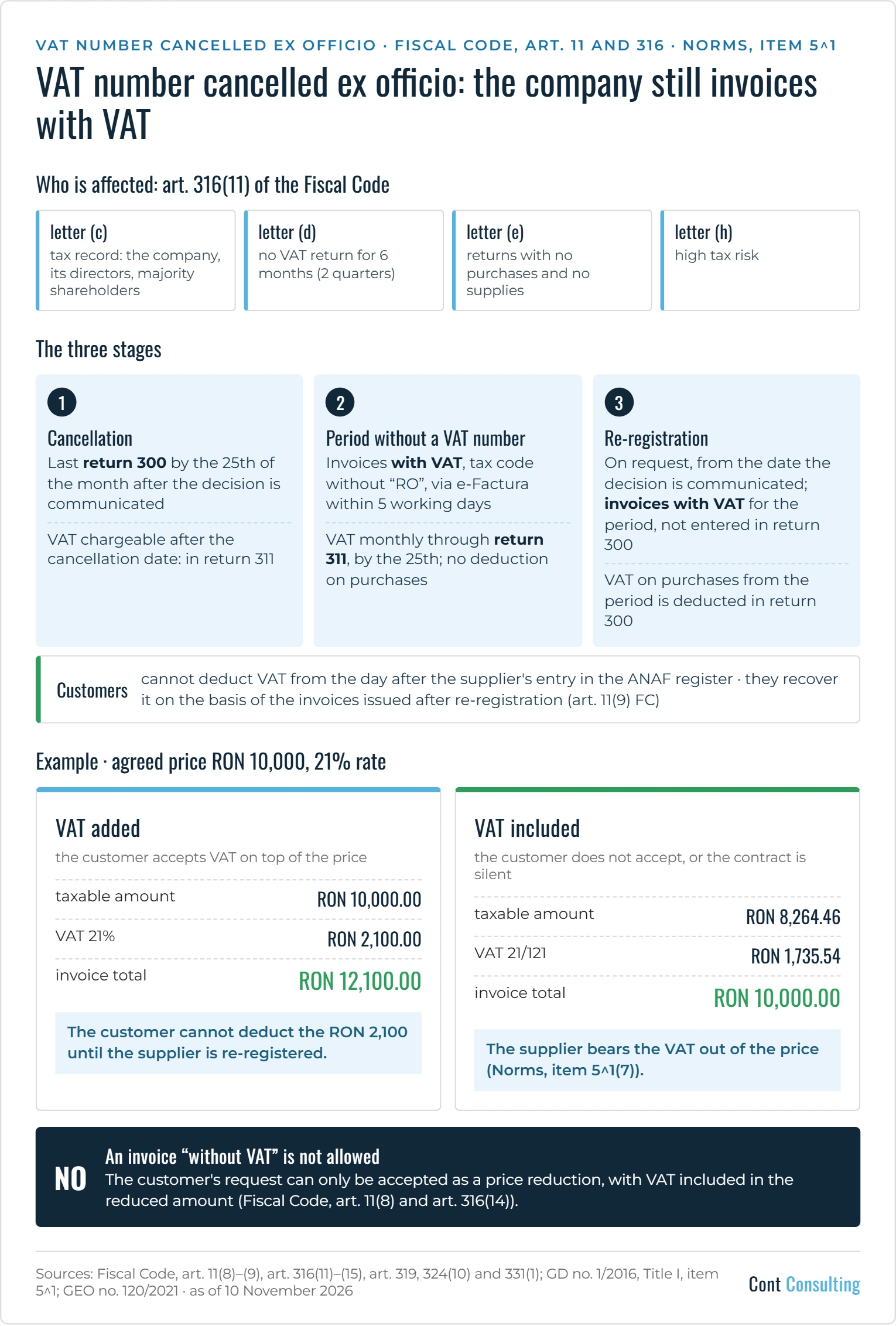
- A cancelled VAT number does not switch VAT off: the company remains a taxable person, collects and pays VAT on its taxable supplies, but cannot deduct VAT on purchases until it is re-registered (Fiscal Code, art. 11(8)).
- Invoices are still issued, showing the tax identification code without the “RO” prefix, and are sent through RO e-Factura within 5 working days.
- If the customer does not accept VAT on top of the price, or the contract says nothing about VAT, the agreed price is deemed to include VAT and the tax is worked out by gross-up (21/121).
- VAT for the period without a VAT number is declared and paid monthly through return 311, by the 25th of the following month. Transactions from before the cancellation go into the last VAT return 300.
- Customers cannot deduct VAT on purchases made after the company appears in ANAF’s register of cancelled VAT registrations. They recover it after the supplier is re-registered, on the basis of the invoices the supplier issues after re-registration.
- An invoice “without VAT” is not allowed: the customer’s request can only be accepted as a price reduction, with VAT included in the reduced amount.
Published on 10 November 2026.
The Romanian tax authority (ANAF) can cancel a company’s VAT registration ex officio, for example when the director or the majority shareholder has entries in the tax record (cazier fiscal) or when the company does not file its VAT returns. Many business owners believe that from that moment they invoice without VAT. They do not. Below we explain, on the basis of the Fiscal Code and its Methodological Norms, how to invoice, what to file and what happens after re-registration.
Who these rules apply to
The rules concern companies established in Romania whose VAT registration ANAF has cancelled ex officio for one of the reasons in art. 316(11) of the Fiscal Code:
- letter (c) – the company or its directors or, for limited liability companies (SRL), the majority shareholders or the sole shareholder have offences or other acts provided by law entered in the tax record;
- letter (d) – the company has not filed any VAT return for 6 consecutive months (2 consecutive quarters, if its tax period is the quarter);
- letter (e) – the returns for the same period showed neither purchases nor supplies;
- letter (h) – the company presents a high tax risk.
In these cases art. 11(8) of the Fiscal Code applies. If the company has been declared inactive (art. 316(11)(a)), the VAT rules are broadly the same, but the company also loses the right to deduct its expenses (art. 11(6)). We have written about inactivity in My company has been declared inactive in Romania. What do I do?
What the cancellation means in practice
- The company remains a taxable person. It owes VAT on its taxable supplies made during the period without a VAT number and cannot deduct VAT on purchases (art. 11(8)).
- It cannot apply the small business exemption scheme, even if its turnover is below the threshold, until it is re-registered (art. 316(14)).
- The period without a VAT number starts on the date stated in the cancellation decision: for the tax record, the date the decision is communicated; for returns not filed or showing no transactions, the first day of the month after the filing deadline of the sixth monthly return (the second, for quarterly returns). It ends on the date the re-registration decision is communicated (art. 316(11), (12) and (15)).
- For customers, the effects start on the day after the company is entered in the Register of taxable persons whose VAT registration has been cancelled, published on the ANAF website. The entry is made within 3 days of the decision being communicated (art. 316(15)).
The Fiscal Code does not speak of a “suspended” VAT number: the decision cancels the registration, and the effect is temporary only if the company obtains re-registration.
The last VAT return 300 and return 311
The last VAT return (form 300) is filed by the 25th of the month following the one in which the cancellation decision was communicated, whatever the company’s tax period (art. 316(13)). The line between return 300 and return 311 is drawn by the chargeability of VAT (art. 282), not by the invoice date: VAT that becomes chargeable during the period without a VAT number is declared in return 311 (art. 324(10)).
| Situation at the date of cancellation | Where the VAT is declared |
|---|---|
| Supply made before the cancellation, invoiced after it | last return 300 – VAT became chargeable on supply (art. 282(1)) |
| Invoice issued before the cancellation for a supply made after it | return 300 – VAT became chargeable when the invoice was issued (art. 282(2)(a)) |
| Advance received before the cancellation, supply after it | the advance stays in return 300; only the difference is declared in return 311 (interpretation) |
| Invoices issued earlier under the cash accounting scheme, collected after the cancellation | return 311 (art. 324(10)(b)) |
| Supplies whose VAT becomes chargeable during the period without a VAT number | return 311 (art. 324(10)(a)) |
How to issue the invoice
- The obligation to invoice remains: the invoice is issued for supplies of goods and services and for advances, no later than the 15th of the following month (art. 319(6) and (16)).
- The company identifies itself by its tax identification code, without the “RO” prefix (art. 319(20)(d)). Where VAT is shown, the rate and the amount of tax in lei are stated (letter (j)).
- Reverse charge does not apply, because it requires both parties to be registered for VAT (art. 331(1)). Goods and services on the domestic reverse charge list are invoiced with VAT.
- The cash accounting scheme no longer applies; invoices no longer carry the mentions “taxare inversă” (reverse charge) or “TVA la încasare” (cash accounting).
- Invoices are sent through RO e-Factura, to businesses and to individuals, within 5 working days of issue, but no later than 5 working days after the issuing deadline (Government Emergency Ordinance no. 120/2021, art. 10(1) and (7), art. 10^1(2) and (2^1)). For individuals, the law expressly says the obligation applies “whether or not they are registered for VAT”.
- Retail sales and services to consumers for which a fiscal receipt is issued require an invoice only if the customer asks for one (art. 319(10)(a)), but the VAT on them is declared in return 311.
We recommend an informative note on the invoice, which is not mandatory: “The supplier’s VAT registration has been cancelled under art. 316(11)(…) of the Fiscal Code. VAT is due under art. 11(8) of the Fiscal Code and is declared on form 311.”
VAT on top of the price or VAT included
The Methodological Norms for the application of the Fiscal Code (Title I, item 5^1(7)) accept two options, both correct:
- VAT added to the price, if the customer agrees to pay VAT on top of the agreed price;
- VAT included in the price, if the customer does not agree: the price is deemed to include the VAT owed by the supplier, and the tax is worked out by gross-up.
If there is no contract, or the contract says the price includes VAT or says nothing about VAT, the supplier owes VAT calculated from the value of the supply, by gross-up (same Norms, example no. 1, point 2).
| Agreed price: RON 10,000 | VAT added | VAT included |
|---|---|---|
| Taxable amount | RON 10,000.00 | RON 8,264.46 |
| VAT at 21% | RON 2,100.00 | RON 1,735.54 (10,000 × 21/121) |
| Invoice total | RON 12,100.00 | RON 10,000.00 |
| In return 311 | base 10,000.00; VAT 2,100.00 | base 8,264.46; VAT 1,735.54 |
| Effect during the period | the customer pays RON 2,100 VAT it cannot deduct until the supplier is re-registered | the customer pays the agreed price; the supplier bears the VAT out of the price |
The examples in the Norms use the 20% rate in force when they were written. The calculation uses the rate in force when VAT becomes chargeable: 21% or, for the goods and services in art. 291(2), 11% (gross-up 11/111).
Choosing an option is a commercial decision and is worth recording in writing. In both options we recommend that the invoice show the taxable amount and the VAT separately: it reconciles directly with return 311 and makes the correction invoices after re-registration easier.
The customer asks for an invoice “without VAT”
Suppose the company invoiced RON 10,000 plus RON 2,100 VAT, and the customer, who cannot deduct the VAT, asks for a reversal and an invoice of RON 10,000 “without VAT”. The request can only be accepted as a price reduction to RON 10,000, VAT included: taxable amount RON 8,264.46 and VAT RON 1,735.54. An invoice treating the supply as not subject to VAT is not allowed (art. 11(8) and art. 316(14)).
- If the contract does not provide for “price + VAT”, the original invoice did not match the agreed price and is corrected: an invoice with negative amounts and a new invoice of RON 10,000, VAT included (art. 330(1)(b)). If return 311 was filed with RON 2,100, it is amended.
- If the contract expressly provides for “price + VAT”, the supplier was entitled to RON 12,100; accepting the request is a price reduction (art. 287(b) or (c), as the case may be), borne by the supplier. For adjustments during the period without a VAT number, the Fiscal Code refers to the Norms (art. 11(10)), which do not say expressly in which return the adjustment is reflected – we recommend clarifying this with the tax authority beforehand.
A compromise, built on the examples in the Norms: the customer pays RON 10,000 now (VAT included RON 1,735.54), and the parties agree in writing that, after the supplier’s re-registration, the invoice will be corrected to RON 10,000 plus RON 2,100 VAT. The customer then pays another RON 2,100 and deducts the RON 2,100 VAT on the corrected invoice, while the supplier enters only the difference in return 300: taxable amount RON 1,735.54 and VAT RON 364.46. The end result is the one in the original contract, without the customer bearing non-deductible VAT (Norms, item 5^1(3), (6) and (7), example no. 1).
The company’s purchases during the period without a VAT number
- Suppliers invoice with VAT (no reverse charge), and the company cannot deduct it during the period (art. 11(8)).
- After re-registration, the VAT on purchases made during the period is deducted in the first return 300 filed after re-registration or in a later one, even if the invoice does not show the company’s VAT number, within the limits and conditions of art. 297–302 (art. 11(8); Norms, item 5^1(1)).
- For purchases where the company is the person liable to pay VAT, the tax is declared and paid through return 311 (art. 324(10)(a)).
We recommend keeping the purchase invoices from the period in a separate register, “VAT to deduct after re-registration”.
Return 311: deadline, payment, corrections
- It is filed for each month in which VAT became chargeable, by the 25th of the following month inclusive (art. 324(10)), and the tax is paid by the same deadline (art. 326(1)).
- Errors are corrected through an amending return, for each month (Order of the ANAF President no. 188/2018, amended by Order no. 779/2024).
- If the return is not filed, ANAF assesses the VAT due ex officio (Order of the ANAF President no. 1,399/2024). Late payment interest and penalties are due on VAT not collected on time (Norms, item 5^1(2)(c)–(d); Fiscal Procedure Code, art. 173 and 181).
Re-registration and the invoices issued afterwards
ANAF re-registers the company at its request (art. 316(12)), from the date the registration decision is communicated, if:
| Reason for the cancellation | Condition for re-registration |
|---|---|
| tax record (letter (c)) | the situation that led to the cancellation has ended; for SRLs and the other companies under Law no. 31/1990, the request may also be made if the shareholders who caused the cancellation are no longer majority shareholders |
| returns not filed (letter (d)) | filing the missing returns and a reasoned request committing to file them on time |
| returns with no transactions (letter (e)) | a sworn statement that the company will carry on economic activities |
| high tax risk (letter (h)) | the company no longer presents a high tax risk |
After re-registration, the company issues invoices showing separately the VAT collected during the period without a VAT number. These invoices are not entered in return 300 (art. 11(8); Norms, item 5^1(2)):
| What the company did during the period | What it issues after re-registration | Where it is declared |
|---|---|---|
| declared VAT in return 311, no invoices | invoices with all the mandatory details, including the VAT from the period | not in return 300, if there are no differences |
| declared VAT in return 311 and issued invoices | correction invoices (art. 330(1)(b)) | not in return 300, if there are no differences |
| did not declare VAT, but issued invoices | correction invoices | in return 311, with late payment interest and penalties |
| did not declare VAT and issued no invoices | invoices | in return 311, with late payment interest and penalties |
If there are differences between the VAT declared during the period and the VAT on the new invoices, only the differences go into return 300 (Norms, item 5^1(3)). The rules do not apply to transactions for which the company was not required to issue invoices, such as sales with a fiscal receipt (item 5^1(5)). The re-registration request is worth filing as soon as the conditions are met: each month of delay extends the period in which customers cannot deduct VAT.
What it means for customers
- Customers cannot deduct VAT on purchases made from the day after the supplier is entered in ANAF’s register of cancelled VAT registrations (art. 11(9) and art. 316(15)). Goods bought in enforcement proceedings and goods bought from companies in bankruptcy are the exception.
- After the supplier’s re-registration, customers deduct VAT on the basis of the invoices it issues after re-registration, in the first return 300 or a later one (art. 11(9); Norms, item 5^1(6)).
- Purchases made before the entry in the register are not affected by this restriction (interpretation of art. 316(15)).
It is worth checking the ANAF register before large payments. For suppliers declared inactive, the rules are explained in VAT deduction for purchases from inactive suppliers.
What needs separate analysis
- Intra-Community supplies: the exemption does not apply if the supplier does not file the recapitulative statement (art. 294(2^1)), which is filed by persons registered for VAT (art. 325(1)). We recommend avoiding them or analysing them beforehand.
- Intra-Community acquisitions and services received from suppliers in other countries have their own registration and reporting rules.
- Price reductions, refusals and returns during the period: art. 11(10) refers to the Norms, which do not say expressly in which return the adjustment is reflected.
- The technical side: generating the XML invoice for an issuer without a VAT number and configuring the cash register should be checked with the software provider and with the authorised distributor, respectively.
Checklist
- Note the cancellation date in the decision and the date of entry in the ANAF register.
- File the last return 300 by the 25th of the month after the decision was communicated.
- Set up invoicing: tax identification code without “RO”, no “reverse charge” or “cash accounting” mentions, VAT calculated.
- Inform your customers in writing and agree with each of them whether the price includes VAT or is plus VAT.
- Send the invoices through RO e-Factura within 5 working days.
- File return 311 and pay the VAT monthly, by the 25th.
- Keep the purchase invoices with VAT to deduct after re-registration separately.
- Request re-registration as soon as the reason for the cancellation has gone, then issue the invoices and correction invoices for the period.
If your company or an important supplier has a cancelled VAT number, we can help with tax consultancy and bookkeeping during this period. You can also book a meeting with us.
Legal basis
| Act | Provisions | What it regulates | Version in force on 10 November 2026 |
|---|---|---|---|
| Law no. 227/2015 on the Fiscal Code | art. 11(6)–(10) | effects of a cancelled VAT number and of inactivity, for the company and for its customers; adjustments | paras. (6)–(9) as amended by GEO no. 84/2016, from 1 January 2017; para. (10) unchanged |
| Law no. 227/2015 | art. 316(11)–(15) | ex officio cancellation, re-registration, the last return, the ANAF register | para. (12) introductory part and letter (e) as amended by Law no. 177/2017; letter (a) as amended by GEO no. 84/2016; the other provisions cited unchanged |
| Law no. 227/2015 | art. 282(1)–(2); art. 287(b)–(c); art. 291(1)–(2) | chargeability; price reductions; VAT rates | art. 287(c) as amended by Law no. 33/2024; the 21% and 11% rates as amended by Law no. 141/2025, from 1 August 2025 |
| Law no. 227/2015 | art. 319(6), (10), (16) and (20) | invoicing | para. (10)(a) as amended by Law no. 317/2024; the other provisions cited unchanged |
| Law no. 227/2015 | art. 324(10); art. 326(1); art. 330(1); art. 331(1) | return 311 and payment; correction invoices; reverse charge | unchanged |
| Law no. 227/2015 | art. 294(2^1); art. 325(1) | intra-Community supplies; the recapitulative statement | art. 294(2^1) introduced by GO no. 6/2020; art. 325(1) introductory part as amended by GEO no. 70/2024 |
| Methodological Norms for the application of the Fiscal Code (Government Decision no. 1/2016) | Title I, item 5^1(1)–(7) | deduction after re-registration; invoices for the period without a VAT number; VAT included or added | introduced by GD no. 284/2017; unchanged |
| Government Emergency Ordinance no. 120/2021 | art. 10(1) and (7); art. 10^1(2) and (2^1) | RO e-Factura | para. (7) and art. 10^1(2^1) as amended by GEO no. 89/2025, from 1 January 2026; the provisions cited were not changed by Law no. 88/2026 |
| Order of the ANAF President no. 188/2018; Order of the ANAF President no. 1,399/2024 | – | form 311; ex officio assessment of the VAT due | Order no. 188/2018 amended by Order no. 779/2024; Order no. 1,399/2024 unchanged |
| Law no. 207/2015 on the Fiscal Procedure Code | art. 173 and 181 | late payment interest and penalties | art. 181 as amended by GEO no. 188/2022 |
Note: This text is valid at the date of publication, is for information purposes and represents the interpretation of Cont Consulting specialists. It does not replace the legal provisions in force or an analysis of a specific situation.
Sources: Law no. 227/2015 on the Fiscal Code, art. 11(6)–(10), art. 282, 287, 291, 294, 316(11)–(15), art. 319, 324, 325, 326, 330 and 331; Methodological Norms for the application of the Fiscal Code, approved by Government Decision no. 1/2016, Title I, item 5^1; Government Emergency Ordinance no. 120/2021, art. 10 and 10^1; Order of the ANAF President no. 188/2018; Order of the ANAF President no. 1,399/2024; Law no. 207/2015 on the Fiscal Procedure Code, art. 173 and 181 – as in force on 10 November 2026.