
Summary
- Transactions between affiliated persons – for example, between a company and a shareholder holding at least 25% of it, or between two companies of the same shareholder – must be carried out at market value (Fiscal Code, art. 11(4)).
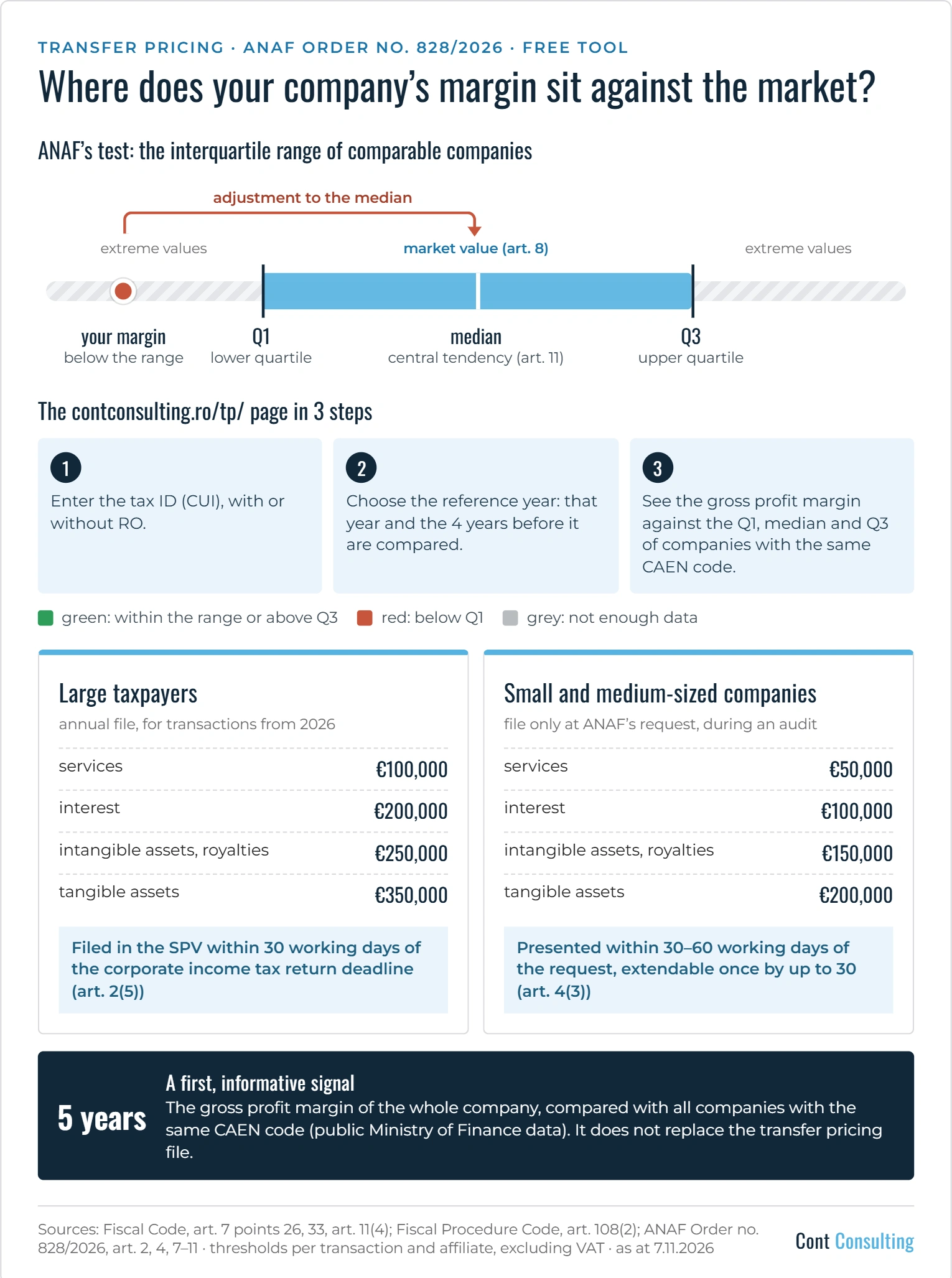
- In a tax audit, ANAF compares the transaction’s profitability indicator with the interquartile range of comparable independent companies; if it falls outside the range, ANAF adjusts it to the median (Order of the ANAF President no. 828/2026, art. 8 and 11).
- Small and medium-sized companies prepare the transfer pricing file only at ANAF’s request, during a tax audit, within 30–60 working days.
- The free page contconsulting.ro/tp/ shows, over 5 years, where a company’s gross profit margin sits against companies with the same CAEN code, based on public Ministry of Finance data.
- The result is a first, informative signal; it does not replace the transfer pricing file.
Published on 9 November 2026.
If your company buys services from a shareholder’s company, receives a loan from a company in the same group or sells goods to a sister company, the prices of these transactions are transfer prices. In a tax audit, ANAF checks whether they match the market, and the first question in any analysis is how profitable the company is compared with similar companies. For a first answer, quick and free, we built the page contconsulting.ro/tp/ (in Romanian).
When transfer pricing applies
Affiliated persons are defined in the Fiscal Code, art. 7 point 26. In short:
- spouses and relatives up to the third degree inclusive (letter a);
- an individual and a company in which the individual holds, directly or indirectly, including through affiliated persons, at least 25% of the shares or voting rights, or which the individual effectively controls (letter b);
- two companies, if one holds at least 25% of the other in this way or effectively controls it (letter c), or if the same person holds at least 25% in both or effectively controls them (letter d).
The price at which tangible or intangible goods are transferred or services are provided between affiliated persons is a transfer price (art. 7 point 26, last sentence).
The rule is the arm’s length principle: where the conditions agreed between affiliates differ from those that would exist between independent persons, the profit a company did not make because of those conditions may be included in its profit and taxed (art. 7 point 33). The tax authorities may adjust the income or expense where the principle is not observed, or estimate it where the company does not provide the necessary data, based on the central tendency of the market (art. 11(4)).
Typical situations: management or consultancy services invoiced between group companies, recharged costs, loans between companies, royalties for trademarks and licences, sales of goods or equipment between affiliated companies.
What ANAF Order no. 828/2026 provides
Order of the ANAF President no. 828/2026, published in the Official Gazette no. 543 of 2 July 2026, sets the thresholds, the deadlines, the content of the transfer pricing file and the adjustment procedure. The basic obligation is in the Fiscal Procedure Code, art. 108(2): a company that carries out transactions with affiliated persons prepares the file and presents it at ANAF’s request.
| Large taxpayers | Small and medium-sized taxpayers | |
|---|---|---|
| When the file is prepared | annually, by the deadline of the annual corporate income tax return (art. 2(1)–(2)) | only at ANAF’s request, during a tax audit (art. 2(7)) |
| Threshold – services | €100,000 | €50,000 |
| Threshold – interest (financing) | €200,000 | €100,000 |
| Threshold – intangible assets and royalties | €250,000 | €150,000 |
| Threshold – tangible assets | €350,000 | €200,000 |
| Deadline | filed in the SPV (ANAF’s online portal) within 30 working days of the corporate income tax return deadline (art. 2(5)); if not filed in the SPV, presented within at most 5 working days of the request (art. 4(1)) | 30–60 working days from the request, extendable once by up to 30 (art. 4(3)) |
- The thresholds apply to each transaction with each affiliated person, excluding VAT, at the National Bank of Romania exchange rate for the last day of the fiscal year (art. 2(3) and (8)).
- Below the thresholds the file is not mandatory (art. 2(10)), but ANAF may request it in a tax audit, for certain transactions, if its risk analysis justifies it; the deadline is at least 30 working days (art. 2(11)).
- The annual file of large taxpayers covers transactions from 2026 onwards (art. 15(1)). The order applies to procedures started after 1 January 2027; those started earlier continue under the rules in force when they started, so far ANAF Order no. 442/2016 (art. 15(2)–(3)).
How ANAF tests the market value
- A transaction is considered to be at market value if its profitability indicator falls within the interquartile range (art. 8 of the order).
- The range is calculated from the profitability indicators of comparable independent companies: the values are divided into 4 equal segments, and the first and the last, considered extreme values, are eliminated (art. 10(3)–(5)). What remains is the range between the lower quartile (Q1) and the upper quartile (Q3).
- Comparables are searched for first in Romania; if there are not enough, in the European Union (including the United Kingdom), then in the Europe, Middle East and Africa region and, finally, internationally (art. 9(1)(a)).
- If the indicator falls outside the range, ANAF adjusts the transfer prices to the central tendency of the market, i.e. the median of the range (art. 7(1), art. 11(1)–(2)). If the file is not presented on time or is incomplete, the prices may be estimated (art. 7(3)–(5)).
Hypothetical example. The market range is 4%–12%, with a median of 7%, and the margin of the company’s transaction is 2%. As the margin is below the range, it is adjusted up to 7%, and the difference increases the taxable base.
What we built: the /tp/ page
The page contconsulting.ro/tp/ compares a company’s gross profit margin with the market range (Q1–Q3) of companies with the same CAEN code, for the chosen year and the 4 years before it. The page is in Romanian. You use it in three steps:
- enter the tax identification code (CUI), with or without the RO prefix;
- choose the reference financial year;
- press “Calculează” (Calculate).
For each year you see the company’s margin, Q1, the median, Q3 and the classification, by colour:
- green – the margin is within the range or above Q3;
- red – the margin is below Q1;
- grey – no verdict: no balance sheet, zero turnover or fewer than 10 comparable companies in that year.
The page also shows the average over the years with a verdict and the aggregate margin of the sector (total gross profit divided by total turnover of the companies in the group), which is less distorted by companies with very small turnover than the simple average of the margins.
How to read the result
- Red in several years, for a company with affiliated-party transactions: the intra-group prices and their documentation are worth checking. In an adjustment to the median, the taxable base increases, and so does the tax due.
- Green: the margin is at least at the level of the group’s lower quartile. The page also shows margins above Q3 in green; the test in the order, however, uses the Q1–Q3 range (art. 8), so a margin above Q3 is also outside it.
- Grey: there is not enough data for that year.
What the page does not replace
The page is for information only. A transfer pricing file analyses each transaction with affiliates: the description of the transactions and the contracts, the functional analysis, the justification of the method, the comparability analysis and the financial data used (art. 7(4) and annex no. 2 to the order). The differences from the page:
- the page uses the gross profit margin of the whole company; the public data do not include operating profit, so the operating margin cannot be calculated;
- the comparison group includes all companies with the same CAEN code, not independent companies identified as comparable (art. 10(3)–(4) of the order);
- the latest year may be incomplete, because the Ministry of Finance republishes the files as balance sheets are filed, and companies that have not filed a balance sheet do not appear;
- the CAEN code in the balance sheet may differ from the one in the trade register.
When a discussion is worthwhile
If your company has transactions with affiliated persons and the page shows red in several years, or if you have received a request to present the transfer pricing file, book a discussion with us. For large multinational groups, see also our article on country-by-country reporting in Romania.
Legal basis
| Act | Provisions | What it regulates | Version in force on 7.11.2026 |
|---|---|---|---|
| Law no. 227/2015 on the Fiscal Code | art. 7 point 26 | affiliated persons; the transfer price | letter d) as amended by Law no. 296/2020; the rest of the point unchanged since 2016 |
| Law no. 227/2015 | art. 7 point 33 | the arm’s length principle | unchanged since 2016 |
| Law no. 227/2015 | art. 11(4) | adjustment and estimation based on the central tendency of the market; the methods; the OECD Guidelines | unchanged since 2016 (Government Emergency Ordinance no. 84/2016 amended only paragraphs (6)–(9)) |
| Law no. 207/2015 on the Fiscal Procedure Code | art. 108(2) | the obligation to prepare the transfer pricing file and to present it on request | no amendments since its entry into force |
| Order of the ANAF President no. 828/2026 (Official Gazette no. 543 of 2.07.2026) | art. 2, 4, 7–11, 15; annex no. 2 | thresholds, deadlines, content of the file, the interquartile range, adjustment to the median, application in time | in force, no amendments |
| Order of the ANAF President no. 442/2016 | – | procedures started before 1.01.2027 (art. 15(3) of Order no. 828/2026) | in force; Order no. 828/2026 does not expressly repeal it |
Note: This text is valid at the date of publication, is for information purposes and represents the interpretation of Cont Consulting specialists. It does not replace the legal provisions in force or an analysis of a specific situation.
Sources: Law no. 227/2015 on the Fiscal Code, art. 7 points 26 and 33, art. 11(4); Law no. 207/2015 on the Fiscal Procedure Code, art. 108(2); Order of the ANAF President no. 828/2026, art. 2, 4, 7–11 and 15, annex no. 2; the contconsulting.ro/tp/ page – in the version in force on 7 November 2026.