
Summary
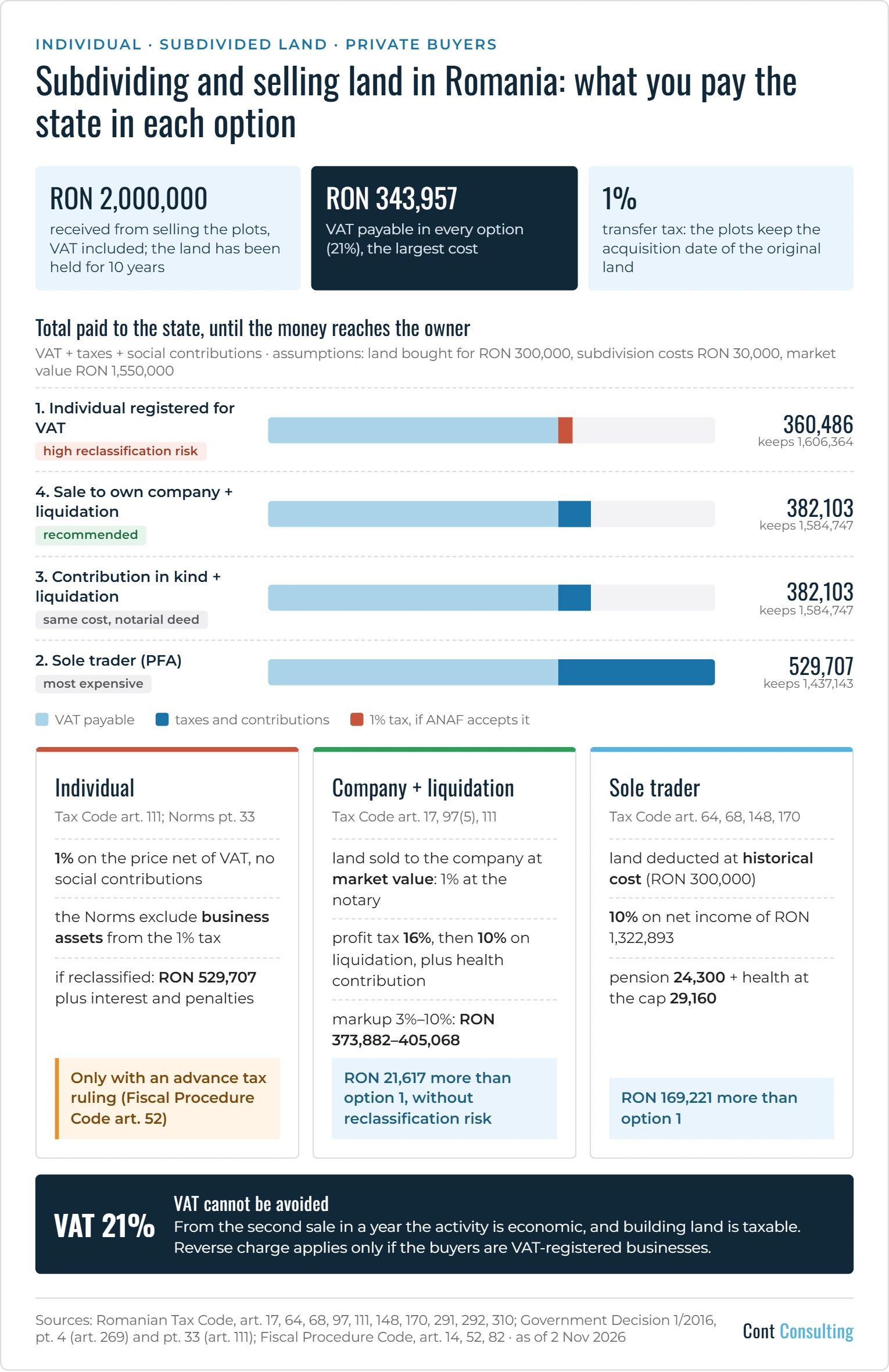
- VAT is the largest cost. The buyers are individuals, so the market price includes VAT. Of the RON 2,000,000 received, RON 347,107 is VAT. The subdivision costs bring only RON 3,150 of deductible VAT. RON 343,957 remains payable.
- VAT cannot be avoided if the land is subdivided and sold within a single year, whoever sells it: the individual, a sole trader (PFA) or a company (SRL).
- The individual registered for VAT comes out cheapest, but with a high risk of reclassification: RON 343,957 VAT + RON 16,529 tax at 1%. Total RON 360,486, with no social contributions. However, the Norms exclude business assets from the 1% tax. If ANAF reclassifies the income as self-employment income, the cost rises to the sole-trader level, plus interest and penalties.
- A company (purchase or contribution in kind, then liquidation) costs RON 382,103, only RON 21,617 more, but without reclassification risk. This is the option we recommend. On liquidation, the profit is taxed at 10%, not at 16% as dividends.
- The sole trader (PFA) is the most expensive: RON 529,707.
Published on 2 November 2026.
An individual owns a plot of land that he wants to subdivide and sell plot by plot. We compare four options on the same figures and count every amount paid to the Romanian state, including VAT, until the money reaches the owner.
The situation and the assumptions
An individual has owned a buildable plot of land within a town’s built-up area (intravilan) for 10 years. He subdivides it and sells the plots in the same year, to individuals. He builds nothing: he sells land only. It is his only business: after the last sale he closes the sole trader or the company and cancels his tax registrations.
We look for the option in which the owner pays the state the least, counting everything: VAT, income tax or transfer tax, the company’s tax, the tax on taking the money out, and the pension (CAS) and health (CASS) contributions.
| Item | Value |
|---|---|
| The land, bought 10 years ago | RON 300,000 |
| Total paid by buyers for the plots | RON 2,000,000 |
| Subdivision costs (architect, surveyor, project, fees, notary), excluding VAT | RON 30,000 |
| – of which subject to VAT | RON 15,000 (VAT RON 3,150) |
| Market value of the whole land, ready for subdivision (valuation report) | RON 1,550,000 |
| Minimum wage used for the CAS and CASS bases | RON 4,050 |
- The price includes VAT. The buyers are individuals and pay the market price, whether or not the seller charges VAT. Where VAT is due, it comes out of the RON 2,000,000.
- The value of the whole land is the price paid by the company in option 4 and the value of the contribution in option 3. It means a markup of about 5% for the company.
- Minimum wage. 2026 had two values: RON 4,050 until 30 June and RON 4,325 from 1 July (Government Decision no. 146/2026). For the CAS and CASS bases, the value in force on 25 May of the year applies (art. 135¹(3) of the Tax Code).
- The company pays profit tax, because its revenue exceeds the equivalent of EUR 100,000 (art. 47 and art. 52(1)).
- Contributions are not deducted from the income tax base.
VAT: why it becomes a cost and how much it is
When the buyers are individuals, the VAT charged comes out of the price the seller would have received anyway. If output VAT exceeds deductible VAT, the difference is a tax actually paid.
Why VAT is due:
- An individual may make one occasional sale a year without VAT. From the second sale in the same year, the activity is continuous (pt. 4(5) of the Norms to art. 269 of the Tax Code).
- Building land is taxable; the exemption for land does not apply to it (art. 292(2)(f)). The rate is 21% (art. 291(1)).
- Above RON 395,000 a year, VAT registration is mandatory, at the latest on the date the threshold is exceeded (art. 310(1) and (6), as amended by Government Ordinance no. 22/2025).
How much:
| Item | Calculation | Amount |
|---|---|---|
| Output VAT | 2,000,000 × 21/121 | RON 347,107 |
| Price net of VAT | 2,000,000 – 347,107 | RON 1,652,893 |
| Deductible VAT on subdivision costs | 21% × 15,000 | RON 3,150 |
| VAT payable | 347,107 – 3,150 | RON 343,957 |
The amount is the same in all four options, because in each of them someone sells the plots with VAT.
If the buyers are VAT-registered businesses, the reverse charge applies (art. 331(2)(g)). VAT is then no longer a cost for the seller.
Option 1: individual registered for VAT – efficient, but with a high risk of reclassification
Total: RON 360,486. Money in the owner’s pocket: RON 1,606,364, if ANAF accepts the 1% tax.
| Payment | Calculation | Amount |
|---|---|---|
| VAT payable | see above | RON 343,957 |
| Transfer tax (art. 111) | 1% × 1,652,893 | RON 16,529 |
| CAS, CASS | not due | 0 |
| Total | RON 360,486 |
The tax is 1%, not 10%. Income from transferring real estate from personal property is taxed at 1% for property held for more than 3 years (art. 111(1)(b) of the Tax Code). VAT registration does not change this. The Norms to art. 111 state that the tax base does not include VAT, “where VAT applies to the transaction” (as amended by Government Decision no. 1336/2023). The plots do not get a new acquisition date, even though they receive new land-register entries. The Norms provide that, for properties resulting from division or separation, the acquisition date is that of the original property. The rule has existed since 2007 (Government Decisions no. 1195/2007, 1/2016 and 1336/2023). The plots are therefore held for 10 years and the rate is 1%. The purpose for which the land was bought (“for resale”) matters only for VAT, not for income tax.
CAS and CASS are not due. Apart from salaries, CAS is due on self-employment income and on intellectual property income (art. 148(3)). The incomes added up for CASS (art. 170(4)) do not include income from transferring real estate from personal property.
The main risk: reclassification of the income. The risk is high, for four reasons:
- The individual becomes an economic operator. Subdividing land and selling it repeatedly is an economic activity. The individual must register for tax purposes within 30 days of starting the activity (art. 82(1)(c) and (6)(c) of the Fiscal Procedure Code). He must also register for VAT (art. 316 of the Tax Code) and be authorised as a sole trader or individual enterprise (Government Emergency Ordinance no. 44/2008, art. 7(1)).
- The Norms expressly exclude business assets from the 1% tax. Transfers of property forming part of the business assets are not taxed at 1%–3%. The income is included in the net income determined from the accounting records (pt. 33(2) of the Norms to art. 111, as amended by Government Decision no. 284/2017). Self-employment income is taxed at 10% (art. 64 and 67 of the Tax Code), plus CAS and CASS.
- Income is taxed according to its nature, not the form chosen. Income is subject to tax law even if the documents do not comply with other legal provisions (art. 14(1) of the Fiscal Procedure Code). The tax authority judges by economic substance (art. 14(2) of the same code; art. 11(1) of the Tax Code).
- ANAF has made such reclassifications before, and Law no. 29/2018 cancelled them only for periods up to 1 June 2017. Details in the section “What practice shows”.
If reclassified, the cost rises to RON 529,707, as in option 2: RON 169,221 more, plus interest and penalties.
The risk does not show at the notary. The notary applies the self-employment regime only if the seller presents the registration certificate and the land-register extract showing that the land is part of the business assets (same pt. 33(2)). Otherwise the notary withholds 1%, and the reclassification comes later, during a tax inspection.
Two other risk factors:
- Liability. The individual is liable with all his assets (art. 2324(1) of the Civil Code).
- No authorisation. VAT registration does not replace the authorisation required by Government Emergency Ordinance no. 44/2008.
The reclassification risk can only be removed by an advance tax ruling (soluție fiscală individuală anticipată), requested before the first sale (art. 52(1) of the Fiscal Procedure Code).
A possible saving, to be checked. Once the threshold is exceeded, the normal VAT regime applies “starting with the transaction that leads to exceeding the threshold” (art. 310(6)). If the individual does not register in advance, the first sales, up to RON 395,000, would remain without VAT. The saving would be at most about RON 68,500. The Norms support this rule: an unregistered individual who starts an economic activity applies the special exemption scheme, and registration becomes mandatory by the deadline in art. 310 (pt. 4(5), last sentence). Out of prudence, the calculation above does not include this saving.
Option 2: sole trader (PFA) with the land in the business assets
Total: RON 529,707. Money in the owner’s pocket: RON 1,437,143.
Land transferred to the business assets (patrimoniu de afectațiune) remains the property of the same person (Government Emergency Ordinance no. 44/2008, art. 2(j)), so the art. 111 tax is not paid on entry. A contribution in kind to the activity is not gross income (art. 68(3)(a) of the Tax Code).
On sale, however, the sole trader pays tax on net income, and the land is deducted at historical cost. For non-depreciable assets, the deductible amount is the purchase price or the value from an expert valuation at the acquisition date (art. 68(4)(k)). The increase in value over the last 10 years becomes taxable income.
| Payment | Calculation | Amount |
|---|---|---|
| VAT payable | as in option 1 | RON 343,957 |
| Net income | 1,652,893 – 30,000 – 300,000 | RON 1,322,893 |
| Income tax, 10% (art. 64) | 10% × 1,322,893 | RON 132,289 |
| CAS, 25% (art. 138(a), 148) | 25% × 24 × 4,050 | RON 24,300 |
| CASS, 10% (art. 156, 170(1)) | 10% × 72 × 4,050 (cap) | RON 29,160 |
| Total | RON 529,707 |
The sole trader solves the authorisation issue, but costs RON 169,221 more than option 1. The owner is liable first with the business assets and then with his other assets (Government Emergency Ordinance no. 44/2008, art. 20(1)).
Option 3: company (SRL) with the land contributed in kind, then liquidation
Total: RON 382,103. Money in the owner’s pocket: RON 1,584,747.
The contribution
A contribution of real estate is a taxable transfer, and the taxpayer is the individual (Norms to art. 111, as amended by Government Decision no. 1336/2023). The deed must be notarised, because the contribution includes real estate (art. 5(6) of Law no. 31/1990). Tax: 1% × 1,550,000 = RON 15,500.
The company
The company subdivides and sells, charging VAT (RON 343,957 payable). The profit is 1,652,893 – 1,550,000 – 30,000 = RON 72,893. Profit tax, 16% (art. 17): RON 11,663. RON 61,230 remains.
The liquidation
After the last sale, the shareholder decides on simultaneous dissolution and liquidation (art. 227(1)(d) and art. 235 of Law no. 31/1990). The money in the company reaches him as follows:
- The value of the contribution (RON 1,550,000) is returned tax-free. On liquidation, the Tax Code taxes only what exceeds the return of contributions (art. 97(5) of the Tax Code).
- The remaining profit (RON 61,230) is taxed at 10%, as liquidation income (art. 91(e) and art. 97(5), as amended by Government Emergency Ordinance no. 79/2017): RON 6,123. The company withholds the tax, and proof of payment is attached to the deregistration request (art. 235(2) of Law no. 31/1990).
- CASS. Liquidation income is investment income and counts towards the CASS thresholds (art. 155(1), art. 170(2)–(4)). RON 61,230 lies between 12 and 24 minimum wages, so the base is 12 minimum wages: 10% × 48,600 = RON 4,860.
If the profit were taken out earlier as dividends, the tax would be 16% (art. 97(7)), i.e. RON 9,797 instead of RON 6,123.
| Payment | Amount |
|---|---|
| VAT payable | RON 343,957 |
| Tax on the contribution (1%) | RON 15,500 |
| Profit tax (16%) | RON 11,663 |
| Tax on liquidation income (10%) | RON 6,123 |
| CASS | RON 4,860 |
| Total | RON 382,103 |
Option 4: the company buys the land, subdivides it and sells it, then liquidation
Total: RON 382,103, the same as the contribution. Money in the owner’s pocket: RON 1,584,747.
For tax purposes, purchase and contribution give the same result. The difference is practical: with a purchase, the price of the land goes directly to the individual, in instalments, from the proceeds of the plots. The company’s share capital can be the minimum.
The steps
- The individual sets up the company.
- An authorised valuer sets the market value of the whole land, ready for subdivision: RON 1,550,000.
- The individual sells the land to the company in a single notarised contract. It is his only supply in the year, so it is occasional and without VAT (pt. 4(5) of the Norms). He pays 1% at the notary: RON 15,500.
- The company carries out the division and sells the plots with VAT.
- The company pays the price of the land and is then liquidated. The remaining profit is taxed as in option 3: 16% profit tax, 10% on liquidation, CASS.
The conditions
- The individual does not subdivide before the sale. Otherwise he sells several properties and may lose the occasional-sale treatment.
- He is not already a taxable person, for example through rentals, and makes no other property sales that year (pt. 4(3) and (6) of the Norms).
- The price is the market price. A shareholder holding at least 25% is affiliated with the company (art. 7 pt. 26(b)). Between affiliated persons, the tax authority may adjust a price that does not reflect market value (art. 11(4)). The price cannot be below the notaries’ valuation study (art. 111(4¹)).
How the cost varies with the company’s markup
A small markup assumes that the valuer recognises the land’s subdivision potential. If the tax authority considers the price too high, it adjusts it downwards: the company’s profit and taxes increase.
| Company markup, on cost | Price paid to the individual | Company profit | Total paid to the state (with VAT) |
|---|---|---|---|
| 3% | RON 1,574,750 | RON 48,143 | RON 373,882 |
| 5% | RON 1,544,183 | RON 78,709 | RON 383,464 |
| 10% | RON 1,472,630 | RON 150,263 | RON 405,068 |
With a 3% markup, the company costs only RON 13,396 more than option 1.
The final comparison
In a single transaction, option 1 leaves the most money in the owner’s pocket. The company comes right after, RON 21,617 behind. All amounts are in RON.
| Option | VAT payable | Individual’s tax | Company tax | Tax on taking the money out | CAS | CASS | Total paid to the state | Money in the pocket |
|---|---|---|---|---|---|---|---|---|
| 1. Individual with VAT | 343,957 | 16,529 | – | – | – | – | 360,486 | 1,606,364 |
| 4. Sale to company + liquidation | 343,957 | 15,500 | 11,663 | 6,123 | – | 4,860 | 382,103 | 1,584,747 |
| 3. Contribution to company + liquidation | 343,957 | 15,500 | 11,663 | 6,123 | – | 4,860 | 382,103 | 1,584,747 |
| 2. Sole trader (PFA) | 343,957 | 132,289 | – | – | 24,300 | 29,160 | 529,707 | 1,437,143 |
“Money in the pocket” means RON 2,000,000 received, minus the subdivision costs including VAT (RON 33,150), minus everything paid to the state.
What practice shows
For VAT, practice is clear: whoever subdivides and sells repeatedly becomes a taxable person. For income tax on the sale of land plots, we found no ruling settling 1% versus 10%. What exists, however, shows the risk.
Income tax
- Law no. 29/2018 on the cancellation of certain tax liabilities. It cancelled the income tax, contributions and interest and penalties assessed by reclassifying, as self-employment income, income from transferring properties “forming part of the business assets”, for periods up to 1 June 2017 (art. 1(1)). For the same periods it prohibited new reclassifications (art. 1(2)). The law says nothing about periods after 1 June 2017.
- Constitutional Court, Decision no. 565/2023 (Official Gazette no. 45 of 18.01.2024). It notes that the law was adopted because tax authorities taxed the same income of individuals acting “as a real estate developer” inconsistently: either with the transfer tax or as self-employment income.
- ANAF’s June 2017 campaign. Individuals acting as real estate developers were invited to declare, by 30 July 2017, their income from selling properties forming part of the business assets, under the threat of tax inspections.
- Bucharest Court of Appeal, judgment no. 1516 of 29.03.2018. It held that art. 1(2) of Law no. 29/2018 does not apply to tax inspections already completed and that the law does not cancel VAT.
VAT
- CJEU, joined cases C-180/10 and C-181/10, Słaby (15.09.2011). An individual selling land in the course of managing private assets is not a taxable person. He becomes one if he takes active steps to market the land, using means similar to those of a producer, trader or service provider.
- High Court of Cassation and Justice, Decision no. 4878 of 08.04.2013. An individual with 210 land transactions in 2005–2009 was held to be a taxable person. The number of transactions alone is not enough, but active steps, such as bringing the land into the built-up area, counted. The VAT and interest and penalties were upheld.
- ANAF, Timișoara Regional Directorate, Decision no. 479/234 of 18.03.2014. Land brought into the built-up area through a zoning plan (PUZ) was divided into 14 plots, sold in 2008. VAT was assessed, and the tax decision was annulled for re-examination.
Interest and penalties
- High Court of Cassation and Justice, Decision no. 86/2018 (preliminary ruling, Official Gazette no. 104 of 11.02.2019). Late-payment surcharges for 2007 – 1 July 2010 are tax penalties, to which the principle of proportionality applies (case C-183/14 Salomie and Oltean). Interest after Government Emergency Ordinance no. 39/2010 is not a penalty.
Conclusion
Option 1 is the cheapest only if ANAF accepts the 1% tax. The individual registered for VAT pays RON 360,486, of which RON 343,957 is VAT, with no social contributions.
The advantage over the company is small: RON 21,617 at a 5% markup, RON 13,396 at a 3% markup. The risk is high. The Norms to art. 111 exclude business assets from the 1% tax, and ANAF has reclassified such income before. If reclassified, the cost rises to RON 529,707: RON 169,221 more, plus interest and penalties.
Our recommendation:
- Option 4: selling the land to your own company, at the market value of the land ready for subdivision, followed by liquidation of the company. It costs between RON 373,882 and RON 405,068, depending on the markup, without reclassification risk. On liquidation, the profit is taxed at 10%, not at 16% as dividends.
- Option 1 only with an advance tax ruling confirming the 1% tax, obtained before the first sale. The authorisation requirement under Government Emergency Ordinance no. 44/2008 and liability with all assets remain.
- The contribution in kind (option 3) costs the same as option 4, but requires a notarised contribution deed. It brings no advantage.
- The sole trader (option 2) is the most expensive and we do not recommend it.
Before deciding, check: the date and manner of acquiring the land; the zoning status (buildable or not); whether the individual has other economic activities, including rentals; what other property sales he has made in the current year; who the buyers are (individuals or VAT-registered businesses).
For a calculation based on your situation and for an advance tax ruling request, see our tax consultancy services. On the 2026 VAT rates, read also VAT rates in Romania in 2026.
Legal provisions checked
As in force on 2 November 2026.
| Act | Articles | Last relevant amendment |
|---|---|---|
| Tax Code (Law no. 227/2015) | art. 111(1), (4¹) | Government Ordinance no. 16/2022 (rates); Government Emergency Ordinance no. 138/2024 |
| Tax Code | art. 269, 291(1), 292(2)(f), 297, 310(1) and (6), 331(2)(g) | Law no. 141/2025 (21%); Government Ordinance no. 22/2025 (threshold) |
| Tax Code | art. 64, 67(1), 68(3)(a) and (4)(k) | – |
| Tax Code | art. 135¹(3), 138(a), 148, 155, 156, 170 | Government Emergency Ordinance no. 115/2023 (art. 135¹); Law no. 239/2025 (art. 148, 170) |
| Tax Code | art. 7 pt. 26(b); art. 11(1) and (4); art. 17; art. 47; art. 52(1); art. 91(e); art. 97(5) and (7) | Government Emergency Ordinance no. 79/2017 (art. 97(5)); Law no. 141/2025 (art. 97(7)); Government Emergency Ordinance no. 8/2026 (art. 47, 52) |
| Methodological Norms (Government Decision no. 1/2016) | pt. 4 of the Norms to art. 269; pt. 33(1) and (2) of the Norms to art. 111 (acquisition date on division; exception for business assets) | Government Decisions no. 864/2020, 284/2017, 1336/2023 |
| Government Decision no. 146/2026 | minimum wage of RON 4,325 from 1.07.2026 | – |
| Fiscal Procedure Code (Law no. 207/2015) | art. 14(1) and (2); art. 52(1); art. 82(1)(c) and (6)(c) | Government Ordinance no. 11/2025 (art. 52) |
| Government Emergency Ordinance no. 44/2008 | art. 2(a) and (j); art. 7(1); art. 20(1) | Law no. 182/2016 |
| Law no. 31/1990 | art. 5(6), 227(1)(d), 235 | Law no. 222/2023 (art. 235) |
| Civil Code | art. 2324(1) | – |
Note: This text is valid at the date of publication, is for information purposes and represents the interpretation of Cont Consulting specialists. It does not replace the legal provisions in force or an analysis of a specific situation.
Sources: Law no. 227/2015 on the Tax Code and the Methodological Norms approved by Government Decision no. 1/2016; Law no. 207/2015 on the Fiscal Procedure Code; Government Emergency Ordinance no. 44/2008; Law no. 31/1990; Civil Code; Law no. 29/2018; Constitutional Court, Decision no. 565/2023; Bucharest Court of Appeal, judgment no. 1516/29.03.2018; CJEU, cases C-180/10 and C-181/10 Słaby; High Court of Cassation and Justice, Decisions no. 4878/2013 and no. 86/2018; ANAF, Timișoara Regional Directorate, Decision no. 479/234/18.03.2014 – as in force on 2 November 2026.