
Updated on 27 October 2026.
Since 1 August 2025, Romania has two VAT rates: 21%, the standard rate, and 11%, a single reduced rate that replaced the former 5% and 9% rates (art. 291(1) and (2) of the Fiscal Code, as amended by Law no. 141/2025). Below you will find the supplies taxed at the reduced rate, the rules for housing, the rules that apply when a rate changes and the checklist we recommend for any rate change.
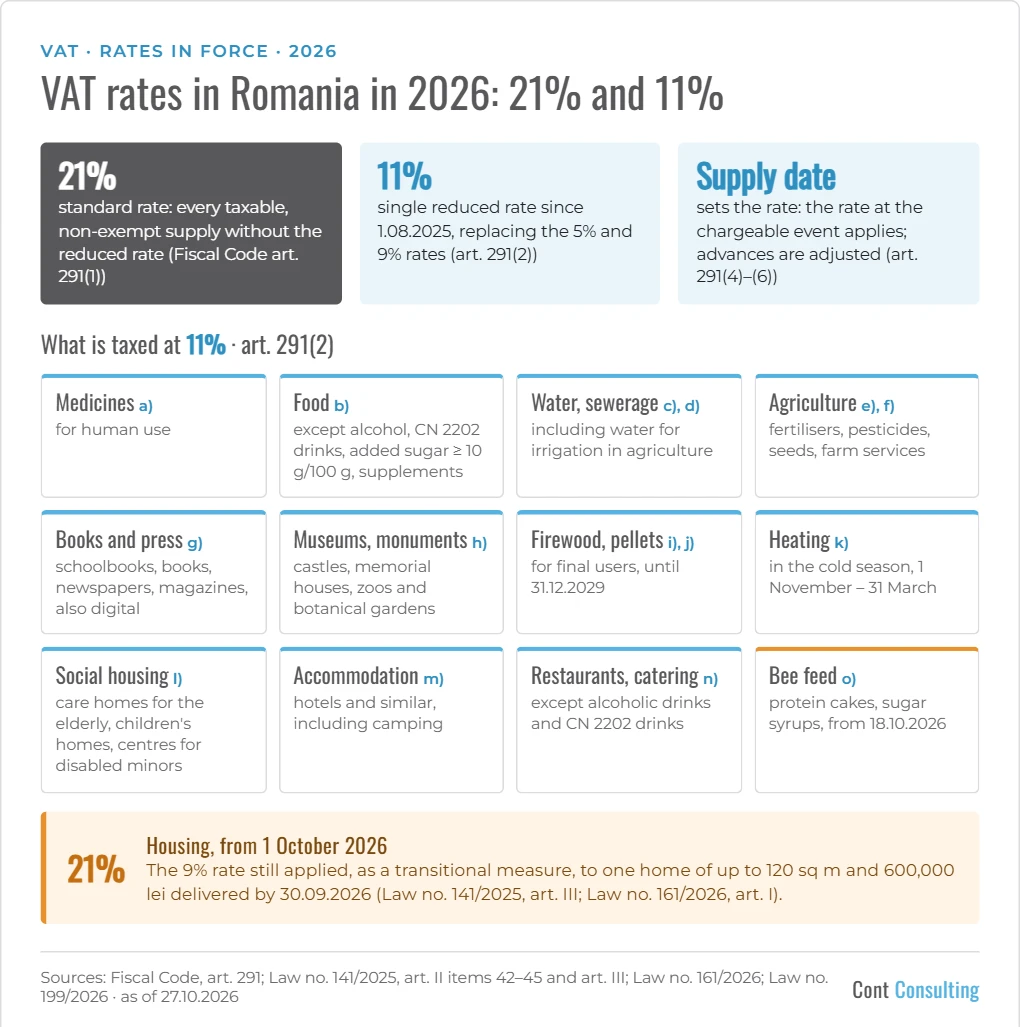
What is taxed at 11%
The reduced rate applies only to the supplies listed in art. 291(2) of the Fiscal Code:
| Letter | Supplies |
|---|---|
| a) | medicines for human use |
| b) | food, including drinks, for human and animal consumption, live domestic animals and poultry, except: alcoholic drinks; non-alcoholic drinks under CN code 2202; food with added sugar and a total sugar content of at least 10 g/100 g (other than powdered milk for newborns, infants and young children); food supplements |
| c), d) | water supply and sewerage services; water for irrigation in agriculture |
| e), f) | fertilisers, pesticides, seeds and services of the kind normally used in agricultural production, as listed in a joint order of the finance and agriculture ministers (letter f), for chemical fertilisers and pesticides, applies until 31 December 2031) |
| g) | schoolbooks, books, newspapers and magazines, printed or electronic, except those consisting wholly or mainly of video or audio music content and those intended mainly for advertising |
| h) | admission to castles, museums, memorial houses, historical, architectural and archaeological monuments, zoos and botanical gardens |
| i), j) | firewood, wood pellets, briquettes and wood residues for heating, supplied to individuals or entities as final users (until 31 December 2029) |
| k) | heating in the cold season (1 November – 31 March) for households, hospitals, schools, NGOs, religious units and accredited social service providers |
| l) | housing supplied as part of social policy: buildings used as care homes for the elderly and pensioners, children’s homes and rehabilitation centres for disabled minors, including the land they stand on |
| m) | accommodation in the hotel sector or similar sectors, including the rental of camping sites |
| n) | restaurant and catering services, except alcoholic drinks and non-alcoholic drinks under CN code 2202 |
| o) | protein cakes, sugar-based syrups or mixtures with a total sugar content above 10 g/100 g, intended as bee feed (from 18 October 2026, Law no. 199/2026) |
Any other taxable supply that is not exempt is taxed at 21%.
Housing
The reduced rate for housing was removed from the Fiscal Code on 1 August 2025 (Law no. 141/2025). The 9% rate continued to apply only as a transitional measure, to one home of up to 120 sq m of usable area and 600,000 lei excluding VAT, bought by an individual under an advance-payment contract signed by 1 August 2025 (for contracts signed between 3 and 31 July 2025, a 20% advance had to be paid by 31 July 2025): first for deliveries until 31 July 2026 (art. III of Law no. 141/2025), then for deliveries until 30 September 2026 (art. I of Law no. 161/2026).
Individuals who bought such a home at 21% between 1 August 2026 and the entry into force of Law no. 161/2026 (7 August 2026) may claim, from 1 October 2026, a refund of the difference between 21% and 9% for one home, under a procedure approved by order of the president of ANAF, the Romanian tax authority (art. II of Law no. 161/2026).
From 1 October 2026, the supply of housing is taxed at 21%. Only buildings supplied as part of social policy remain at 11%: care homes for the elderly and pensioners, children’s homes and rehabilitation centres for disabled minors (art. 291(2)(l)).
Which rate applies when the rate changes
- The rate in force on the date of the chargeable event applies, that is, the date the goods are delivered or the services are performed, not the invoice date (art. 291(4)).
- For advance payments and invoices issued before delivery, VAT becomes chargeable earlier, at the rate in force at that time; on delivery, the rate is adjusted to the one in force on the delivery date. In practice, the advance invoice is reversed and the supply is invoiced at the new rate (art. 291(4) and (6)).
- Under the cash accounting scheme, the rate at the chargeable event also applies, except for invoices issued and advances received before delivery, which take the rate in force on the invoice or payment date; these are also adjusted when the rate changes (art. 291(5) and (6)).
- Imports take the rate that applies to the supply of the same goods in Romania (art. 291(7)), and intra-Community acquisitions take the same rate, in force on the date VAT becomes chargeable (art. 291(8)).
Checklist for any rate change
- Cash registers. Programme and certify the new rates early; service companies are busy around the date of the change. Ideally, have a cash register ready with the new rates and switch to it on the day of the change.
- Displayed prices. If shelf prices include VAT, update the labels in time. Electronic labels save a lot of work.
- Documents for supplies made before the change. Supplies made before the change keep the old rate, even if the documents are issued later. Issue invoices and supporting documents on time, so that your records match the law.
- Advance payments. Adjust advance invoices issued at the old rate for supplies made after the change. If you keep the total amount invoiced initially, the taxable base decreases and the VAT increases.
- Stock recorded at selling price. Draw up price-change reports and adjust the value of the stock on the date of the change.
- Accounting and inventory software. Check that it has been updated. We have seen software without automatic updates that kept using the old rates; talk to your providers early.
- Reverse charge. For intra-Community acquisitions and services bought from abroad, VAT does not appear on the invoice, but it must be recorded in the accounts at the correct rate.
We can help you check the VAT rates you apply and adjust advance invoices: see our accounting services.
Note: This text is valid on the date of its update, is for information only and reflects the interpretation of Cont Consulting specialists. It does not replace the legal provisions in force.
Sources: Romanian Fiscal Code (Law no. 227/2015), art. 291, as in force on 27.10.2026; Law no. 141/2025, art. II items 42–45 and art. III; Law no. 161/2026 on certain fiscal and budgetary measures, art. I and II (Official Gazette no. 642 of 4 August 2026); Law no. 199/2026 (Official Gazette no. 865 of 15 October 2026).