
Updated on 26 October 2026.
Since 1 January 2023, restaurants and bars in Romania must show tips on the bill and on the fiscal receipt, record them as a liability and pass them on in full to their employees. The rules are in art. 23 of Government Emergency Ordinance (GEO) no. 28/1999 on electronic cash registers, added by Law no. 376/2022 and unchanged since.
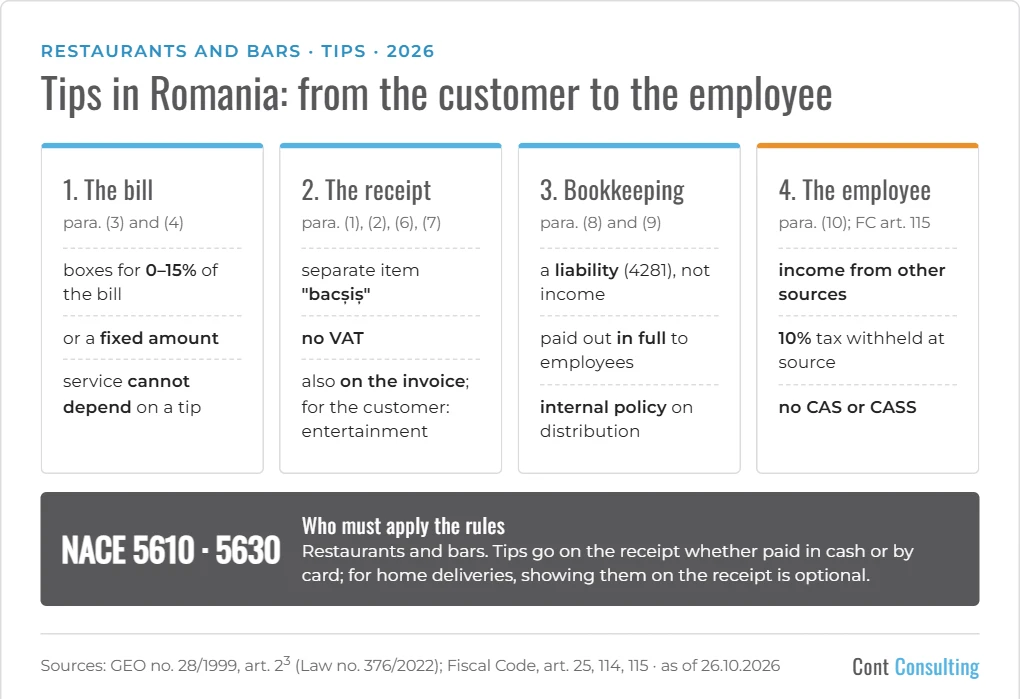
Who must apply the rules
The obligations apply to businesses with NACE (CAEN) codes 5610 – Restaurants and 5630 – Bars and other beverage serving activities. A tip is any amount the customer gives voluntarily on top of the price of what was consumed (art. 23(1)).
The bill and the fiscal receipt
- Before the fiscal receipt is issued, the customer receives a bill with boxes for a tip of 0% to 15% of the bill and a box for a fixed amount, if they prefer (para. (3)).
- The tip is shown separately on the same fiscal receipt, as an item called “bacșiș”, whether paid in cash or by card (para. (2) and (6)).
- If the customer asks for an invoice, the tip is shown separately on it too (para. (7)).
- For home deliveries, showing the tip on the receipt is optional; if the business does so, all the rules above apply (para. (5) and (11)).
- Service cannot be made conditional on a tip (para. (4)).
One remark: the law caps only the percentage option at 15%; for a fixed amount it does not expressly say the tip cannot exceed 15%. We recommend a prudent reading: whichever option is used, the tip should not exceed 15% of the bill.
VAT
For VAT purposes, a tip is not a supply of goods or services (para. (1)), so no VAT is charged on it.
Bookkeeping at the restaurant or bar
Tips are not income of the business, and paying them out is not an expense (para. (9)). Income and expense accounts (for example 7588 / 6588) are not used. The amounts are recorded in liability accounts, with a separate sub-account, and are paid out in full to employees, based on a nominal record. The distribution procedure is set in an internal policy (para. (8)).
The entries we recommend (Romanian chart of accounts):
| Transaction | Entry |
|---|---|
| Tips collected | 5311 / 5121 = 4281.tips |
| Tax withheld on distribution | 4281.tips = 446.tax on tips |
| Net amount paid to employees | 4281.tips = 5311 / 5121 |
| Tax paid to the state budget | 446.tax on tips = 5121 |
Taxation of employees
For employees, tips are income from other sources. They cannot be requalified as salary income and no social contributions (CAS, CASS) are due, because Title V of the Fiscal Code does not apply to them (para. (10)). Income tax is withheld at source by the business on distribution and paid to the budget by the 25th of the following month (art. 115(3) of the Fiscal Code).
Since 2026, the Fiscal Code no longer sets the rate for tips expressly: art. 115(1) lists the other-source incomes taxed at 10% and at 16%, and tips are not named. In practice, tax is still withheld at 10%, the rate that applied to all income from other sources until 31 December 2025.
For a business customer asking for an invoice
When a company pays a tip and receives an invoice, the amount is recorded as an entertainment (protocol) expense (para. (7)). For corporate income tax, entertainment expenses are deductible up to 2% of the accounting profit plus corporate income tax and entertainment expenses (art. 25(3)(a) of the Fiscal Code).
The author’s personal note
The word “bacșiș” comes from Turkish, and the system chosen by the Romanian legislator is not a local invention. I have seen it, for example, at the terraces on the Galata Bridge in Istanbul: the waiter brings the bill, asks how much you want to tip, and only then issues the receipt with the total.
Transparency has a price: time. Paying now takes two steps, the bill and then the receipt, in a sector where speed of service matters.
We can help with the internal distribution policy, bookkeeping and tax on tips: see our accounting services.
Note: This text is valid at the date of the update, is for information purposes and represents the interpretation of Cont Consulting’s specialists. It does not replace the legal provisions in force.
Author: Sorin Adrian BÂSCĂ – Managing partner Cont Consulting
Sources: GEO no. 28/1999 on the obligation of businesses to use electronic fiscal cash registers, art. 23 (added by Law no. 376/2022); Fiscal Code (Law no. 227/2015), art. 25(3)(a), art. 114 and 115, as in force on 26.10.2026 and on 31.12.2025.