
Summary
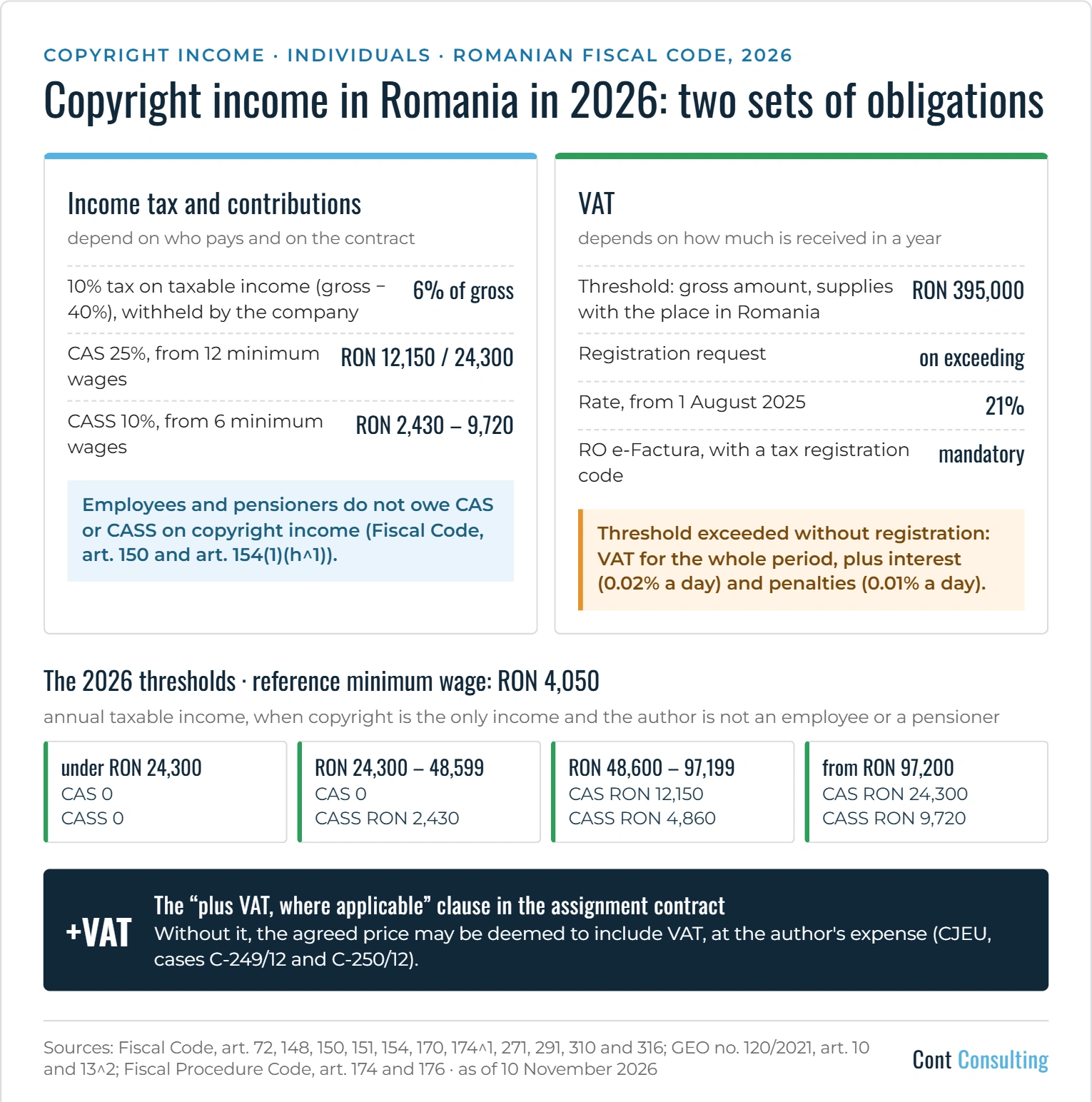
- Income tax is 10% of the taxable income (the gross amount minus the 40% flat-rate expense allowance), i.e. 6% of the gross amount. The paying company withholds it as a final tax; the author keeps no accounting records and files no return for the tax.
- CAS (pension contribution, 25%) is due only when the annual taxable income reaches 12 minimum wages (RON 48,600 in 2026), and it is a fixed amount: RON 12,150 or RON 24,300 a year. Employees and pensioners do not owe it.
- CASS (health contribution, 10%) is due when the taxable income from copyright, added to rents, dividends and interest, reaches 6 minimum wages (RON 24,300); it is at most RON 9,720 a year. Employees and pensioners do not owe it on copyright income.
- VAT: the assignment of copyright is a supply of services. Above RON 395,000 a year (gross amount, only supplies whose place is in Romania), the author must register for VAT, at the latest on the date the threshold is exceeded.
- After registration, 21% VAT is added to the price if the contract says so. The author issues the invoice by the 15th of the month following the supply, through RO e-Factura if he or she has a tax registration code, and files the VAT return, monthly or quarterly, by the 25th of the month following the period.
- Exceeding the threshold without registering means VAT for the whole period in which the normal regime should have applied, plus interest and penalties.
- Returns: the company reports what it withholds in return 112; the author files the Single Tax Return (Declarația unică) by 25 May for anything that was not withheld.
Published on 10 November 2026.
Programmers, designers, architects, translators, photographers and content creators often receive copyright income under assignment contracts, without registering as a sole proprietor (PFA). The same contract creates two sets of obligations, which are checked separately. Income tax and social contributions (Titles IV–V of the Fiscal Code) depend on who pays; VAT (Title VII) depends on how much is received in a year. Below we go through them one by one, with the 2026 amounts and examples.
What counts as copyright income
- The tax definition. Income from the exploitation, in any form, of intellectual property rights: copyright and related rights (including monumental artworks), patents, designs and models, trademarks, geographical indications, semiconductor topographies and the like (Fiscal Code, art. 70).
- Romanian-source income is only income received from a payer in Romania or from a non-resident through its permanent establishment in Romania (art. 71). Royalties paid directly by a foreign client follow the rules for foreign-source income and are analysed separately.
- For VAT, a taxable person is anyone who independently carries out an economic activity, including the exploitation of tangible or intangible property to obtain income on a continuing basis (art. 269(1)–(2)). An author who assigns rights periodically usually falls into this category.
- The exception: employees do not act independently of their employer (art. 269(4)). A one-off assignment, without continuity, may stay outside VAT; this is judged case by case, on the contract and the payment history.
Income tax: 6% of the gross amount
When a Romanian company pays, the tax is 10% of the taxable income, i.e. of the gross amount minus the 40% flat-rate expense allowance: in effect, 6% of the gross amount. The Fiscal Code calls this base “venit net” (net income; art. 72(2) and (4)); here we call it taxable income, so that it is not confused with the amount left after tax. The company withholds the tax on payment and pays it over by the 25th of the following month; the tax is final (art. 64(1)(a^1) and art. 72(2), (4) and (5)).
| Who pays | Taxable income | Tax | Who calculates and pays it | Legal basis |
|---|---|---|---|---|
| Company or other entity that keeps accounting records | gross minus the 40% flat-rate expenses | 10% of the taxable income, final tax | the payer, on payment; paid over by the 25th of the following month | art. 72(2), (4), (5) |
| Heirs; resale right; private copying remuneration | gross minus the amounts due to collective management organisations, without the 40% allowance | 10% | the payer | art. 72(3) |
| Payer without accounting records (e.g. an individual) | gross minus 40% | 10% of the annual taxable income | the author, through the Single Tax Return | art. 72^1(1) and (4); art. 122 |
| Option for the actual-expenses system | income minus deductible expenses | 10% | the author, through the Single Tax Return | art. 73 and art. 68 |
Example. Gross RON 10,000; flat-rate expenses RON 4,000; taxable income RON 6,000; tax RON 600. The author receives RON 9,400, before any contributions withheld under the contract.
- No accounting. When the company withholds the tax, the author does not keep the tax register or accounting records (art. 72(7)) and does not file the Single Tax Return for the tax (art. 122(6)(a)).
- The actual-expenses system only makes sense if actual expenses exceed 40% of income. The option is made through the Single Tax Return and binds the author for 2 consecutive tax years (art. 73(2)).
Pension contribution (CAS): 25%, from 12 minimum wages
Copyright income is within the scope of CAS (art. 137(1)(b^1)), but the contribution is not calculated on actual income. It is due only if the cumulative annual taxable income reaches 12 minimum wages, and the base is fixed: 12 or 24 minimum wages (art. 148(1)–(2)). The rate is 25% (art. 138(a)).
| Cumulative annual taxable income (2026) | Gross equivalent, company payer | CAS base | CAS per year |
|---|---|---|---|
| under RON 48,600 | under RON 81,000 | not due (payment is optional) | 0 |
| RON 48,600 – 97,199 | RON 81,000 – 161,999 | RON 48,600 (12 minimum wages) | RON 12,150 |
| from RON 97,200 | from RON 162,000 | RON 97,200 (24 minimum wages) | RON 24,300 |
The base in the table is the minimum; the author may choose a higher income (art. 148(2)).
- The reference minimum wage is the one in force on 1 January of the year in which the income is earned (art. 135^1(3)). For 2026 it is RON 4,050; the increase to RON 4,325 from 1 July 2026 (Government Decision no. 146/2026) does not change the 2026 thresholds.
- Who does not owe CAS on copyright income: employees (art. 150(2)), pensioners and people insured in their own schemes (art. 150(1)). Someone who becomes an employee or a pensioner during the year measures the threshold only against the months before (art. 151(3)).
- What counts towards the threshold: taxable income from copyright, income from independent activities (for example, from a PFA) and income from sports activity contracts (art. 148(3), as amended by Law no. 239/2025, for 2026 income).
- Withholding at source. With a single payer and an estimated annual taxable income of at least 12 minimum wages, the payer calculates, withholds and pays CAS; the contract states the obligation and the chosen income (art. 151(6)). With several payers, the contract designates the one from whom the income alone reaches the threshold (para. (7)). If none reaches it alone but together they exceed it, nothing is withheld and the author files the Single Tax Return (para. (10)). The payer reports CAS in return 112 and pays it by the 25th of the following month (para. (8)).
- Without withholding at source, the author determines CAS in the Single Tax Return and pays it by 25 May of the following year (art. 151(1)).
- Regularisation. If the payer withheld CAS on 12 minimum wages and the cumulative income reached 24, the author declares the difference (art. 151(9)).
- Below the threshold, payment is optional (art. 148(4)); the amount is not refunded but counts towards the pension (art. 151(4)).
Example. An author without an employment contract receives RON 150,000 gross in a year from a single company. The taxable income is RON 90,000 (RON 150,000 minus the 40% flat-rate allowance), between 12 and 24 minimum wages: CAS is RON 12,150 (25% × RON 48,600). If the author were an employee, CAS on these amounts would be zero.
Health contribution (CASS): 10%, from 6 minimum wages
CASS is due if the taxable income from copyright, added to income from rents, investments (dividends, interest), associations with legal persons, agriculture and other sources, reaches 6 minimum wages (art. 170(2) and (4)). The rate is 10% (art. 156), and the base is again fixed: 6, 12 or 24 minimum wages (art. 170(3)).
| Cumulative income (2026) | Gross equivalent, if the only income is copyright paid by a company | CASS base | CASS per year |
|---|---|---|---|
| under RON 24,300 | under RON 40,500 | – | 0 |
| RON 24,300 – 48,599 | RON 40,500 – 80,999 | RON 24,300 (6 minimum wages) | RON 2,430 |
| RON 48,600 – 97,199 | RON 81,000 – 161,999 | RON 48,600 (12 minimum wages) | RON 4,860 |
| from RON 97,200 | from RON 162,000 | RON 97,200 (24 minimum wages) | RON 9,720 |
- The cap. Above 24 minimum wages CASS does not increase: for copyright income of RON 1 million, the contribution is still RON 9,720 a year.
- Employees and pensioners do not owe CASS on copyright income (art. 154(1)(h^1)). They do owe it on the other income in the list (rents, dividends and the like) if that income reaches the threshold (art. 154(2)).
- What counts towards the threshold: taxable income from copyright (after the 40% allowance or under the actual-expenses system), income from associations, rental income (determined under art. 84–85), dividends and interest received (net of the tax withheld), agricultural income and income from other sources (art. 170(4)). Non-taxable income is excluded (para. (5)); salary and PFA income are not part of this total.
- Withholding at source. With a single payer and an estimated taxable income of at least 6 minimum wages, the payer withholds CASS if the contract provides for it (art. 174^1(3)); with several payers, one is designated (para. (4)). The payer reports it in return 112 and pays it by the 25th of the following month (para. (5)).
- A Single Tax Return for CASS is filed when nothing was withheld and the income exceeds the threshold (para. (2)), when it was withheld on a lower base (para. (6)), when each source is below 6 minimum wages but together they exceed it (para. (8)), or when there is other income from the list (para. (9)). CASS is paid by 25 May (art. 174(15), applicable through art. 174^1(12)).
Example (continued). The author without a salary, with RON 150,000 gross, has a taxable income of RON 90,000, so the CASS base is 12 minimum wages: RON 4,860. If in the same year he or she also receives RON 20,000 in dividends, after the tax withheld, the total reaches RON 110,000 and CASS rises to RON 9,720. Without dividends, the total is RON 26,010 (tax 9,000 + CAS 12,150 + CASS 4,860), about 17.3% of the gross amount. An employed author would pay only the RON 9,000 tax on the same amount.
Who files what: the company and the author
Rule of thumb: what the company withholds, the company reports; what is not withheld at source, the author declares in the Single Tax Return.
The company paying the royalties
- Withholds the tax on each payment and pays it over by the 25th of the following month (art. 72(4)–(5)).
- Reports the tax in return 112, not in the annual information return (art. 132(2)). It also reports CAS and CASS in return 112, if it withholds them (art. 151(8) and art. 174^1(5)).
- At the author’s request, provides a statement of the CAS and CASS withheld (art. 151(11) and art. 174^1(7)).
The author
- Files the Single Tax Return by 25 May of the following year inclusive (art. 122(3)) and pays, by the same deadline, the CAS and CASS determined in it (art. 151(1) and art. 174(15)).
- Files nothing for the tax if it was withheld as a final tax (art. 122(6)(a)). Files when the payer keeps no accounting records (art. 72^1) or when he or she opted for the actual-expenses system (art. 73).
- For contributions, files whenever CAS or CASS is owed and was not fully withheld (art. 122(7)).
- The Single Tax Return is itself a tax assessment (art. 122(9)): the amount declared becomes a debt without a separate ANAF decision.
| The author’s situation | 10% tax | CAS | CASS | Single Tax Return |
|---|---|---|---|---|
| Paid by a company; the author also has a salary or pension | withheld by the company | not due | not due on copyright income | only if CASS is owed on other income (rents, dividends and the like) |
| Paid by a company; no salary or pension; contract with withholding of contributions | withheld | withheld | withheld | no, if the withholdings fully cover the contributions |
| Paid by a company; contract without withholding of contributions | withheld | through the return, from 12 minimum wages | through the return, from 6 minimum wages | yes, for contributions |
| Paid by a person without accounting records | through the return | through the return (if no salary or pension) | through the return (if no salary or pension) | yes |
| Option for the actual-expenses system | through the return | through the return (if no salary or pension) | through the return (if no salary or pension) | yes |
VAT obligations are separate: no withholding by the company and no Single Tax Return covers VAT.
VAT: when the author becomes liable for VAT
For VAT, the assignment of copyright is a supply of services: the Fiscal Code expressly lists the transfer and/or assignment of copyright (art. 271(3)(b)). An author receiving income on a continuing basis is a taxable person, but does not charge VAT as long as his or her annual turnover does not exceed the small-business exemption threshold (art. 310(1)).
The threshold is calculated on the gross amount in the contract, before the tax and contributions withheld, not on the amount received in the bank account. The taxable amount includes everything the supplier obtains from the customer (art. 286(1)(a)), and the tax withheld by the company is paid on the author’s behalf.
| When the threshold was exceeded | Annual threshold | What has to be done | Legal basis |
|---|---|---|---|
| before 1 August 2025 | RON 300,000, reached or exceeded | registration request within 10 days; the date of exceeding is the first day of the following month; registration valid from the first day of the month after the request | art. 310(6) as then in force, applicable through art. III(5) of Government Ordinance no. 22/2025; ANAF Order no. 239/2021, art. 3(2) |
| August 2025 (transitional) | RON 395,000 | exceeding only RON 300,000 no longer required registration; if RON 395,000 was also exceeded in August: request by 10 September 2025, registration valid from 10 September 2025 | art. III(1) of Government Ordinance no. 22/2025 |
| from 1 September 2025 | RON 395,000, exceeded | request at the latest on the date of exceeding; the normal regime applies from the transaction that causes the threshold to be exceeded; registration valid from the date of exceeding | art. 310(6); art. 316(1)(b) and (1^1)(b) |
- What counts towards the threshold from 1 September 2025: the value excluding VAT of the supplies of goods and services in the calendar year that are taxable, or would be taxable if not made by a small business, with the place of supply in Romania (art. 310(2)).
- An interpretation trap. Art. 310(2) excludes from turnover the assignment or transfer of intangible assets made by the taxable person. Read in isolation, the sentence would remove copyright itself from the threshold. We do not recommend this reading: the exception speaks of assets, next to tangible fixed assets, i.e. the business’s capital goods, while the author’s ongoing assignments concern intangible property (art. 271(3)(b)). Until an official clarification, assignments that are the author’s actual activity are included in the threshold.
Foreign clients
- If the customer is a foreign taxable person, the place of supply is where the customer is established (art. 278(2)). From 1 September 2025, these amounts do not count towards the RON 395,000 threshold (art. 310(2)).
- If the customer is in another EU Member State and accounts for the VAT (reverse charge), the unregistered author requests a special VAT code before the supply (art. 317(1)(b)) and reports the services in recapitulative statement 390 (art. 325(1)(c)). The special code does not make the author liable for VAT on Romanian transactions.
After VAT registration
- Rate: 21% for supplies with the chargeable event from 1 August 2025 and 19% before; the rate in force on the date of the chargeable event applies (art. 291(1) and (4), as amended by Law no. 141/2025). We wrote about the change to 21% in VAT rates in Romania in 2026.
- The VAT return (form 300) is filed by the 25th of the month following the tax period (art. 323(1)). The tax period is the month; the quarter applies if turnover does not exceed EUR 100,000. In the year of registration and the following year, the relevant figure is the turnover recalculated for a full year (art. 322(4)–(5)); afterwards, the previous year’s turnover (para. (2)).
Invoicing and RO e-Factura
In business-to-business (B2B) relations, RO e-Factura applies to taxable persons established in Romania, whether or not they are registered for VAT (art. 10(1) of Government Emergency Ordinance no. 120/2021). For the author, the difference lies in how he or she is identified for tax purposes: by personal numeric code (CNP) or by tax registration code.
| The author’s situation | Invoices with VAT? | RO e-Factura | Legal basis |
|---|---|---|---|
| under the exemption scheme, identified by CNP | no | optional; if chosen, the author is entered in the optional RO e-Factura Register from the 1st of the following month | Fiscal Code, art. 310(1); GEO no. 120/2021, art. 10^10, as amended by Law no. 88/2026, from 1 June 2026 |
| registered for VAT, with a tax registration code | yes, 21% | mandatory for invoices to companies in Romania | GEO no. 120/2021, art. 10(1) and (7) |
- The tax code after registration. An individual carrying out an economic activity independently is identified by the tax registration code assigned by ANAF (Fiscal Procedure Code, art. 82(1)(c)); the CNP remains the identifier for income tax and contributions (art. 82(2)). In practice, check the VAT registration certificate: if identification stays on the CNP, RO e-Factura is optional; if ANAF has assigned a tax registration code, it is mandatory.
- Invoicing deadline: by the 15th of the month following the chargeable event (Fiscal Code, art. 319(16)). Supplies made in the same month to the same customer can go on one summary invoice (art. 319(17)).
- Deadline for sending to RO e-Factura: 5 working days from issue, but no later than 5 working days from the invoicing deadline (art. 10(7) of GEO no. 120/2021, as in force from 1 January 2026).
- The fine for an invoice outside the system. If the author has a tax registration code and the invoice does not go through RO e-Factura, the fine is 15% of the total invoice value, both for the author, as issuer, and for the company that receives and records it (art. 13^2(1)(a)–(b) and (2) of GEO no. 120/2021). After the author registers, the company should ask for the invoice through the system before paying.
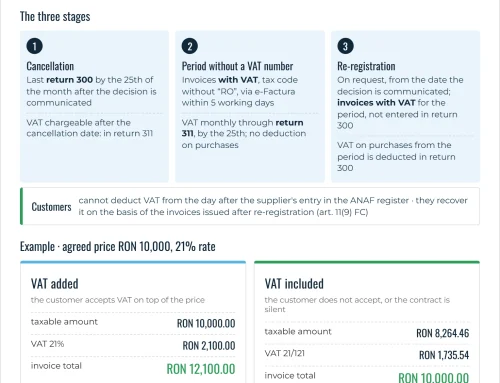
- The price and VAT. The company continues to withhold the tax and contributions after the author registers, and VAT is calculated on the gross amount in the contract (art. 286(1)(a)). If the price was set without any mention of VAT and the author cannot recover it from the customer, the agreed price is deemed to include VAT (CJEU, joined cases C-249/12 and C-250/12, Tulică and Plavoșin, judgment of 7 November 2013; the case concerned supplies of goods, but it interprets Article 73 of the VAT Directive, which also applies to services). That is why the assignment contract should expressly say “plus VAT, where applicable”.
VAT threshold exceeded without registration
Anyone who exceeded the threshold and did not register owes VAT for the period in which the normal regime should have applied, plus interest and penalties. The rules differ according to the date the threshold was exceeded.
Threshold exceeded from 1 September 2025 (new regime)
- The author requests registration from the date of exceeding, calculates the difference between the VAT that should have been collected and the deductible VAT, and enters it in the first VAT return filed after registration (art. 310(6^2)–(6^3) and art. 316(1^1)(b)). No returns are filed for past periods (art. 323(4)).
- For these transactions, the author may issue correction invoices to customers, and they deduct the VAT shown on them (art. 330(3^1)).
- If ANAF finds the situation first, it registers the author ex officio from the date of exceeding and assesses the VAT payable (art. 310(6^1)), plus interest and penalties.
Threshold exceeded before 1 August 2025 (old regime)
The registration rules of that time apply (art. III(5) of Government Ordinance no. 22/2025): the request had to be filed within 10 days of the date of exceeding, deemed to be the first day of the following month, and the exemption applied until registration. In case of delay, ANAF assesses VAT from the date on which the author would have been registered had the request been filed on time (art. 310(6) as then in force), i.e. from the first day of the month following the request (ANAF Order no. 239/2021, art. 3(2)).
Case study (anonymised). An author, employed by another company, assigns rights to a single Romanian company. In 2025, the company records gross royalties of RON 330,000 in February and RON 165,000 a month in March–December: RON 1,980,000 in total. The company withholds only the tax (6% of gross), and the author has not registered for VAT.
| Step | Result | Legal basis |
|---|---|---|
| Threshold exceeded | February 2025 (RON 330,000, above RON 300,000), so the old regime | art. 310(1) and (6) as then in force; art. III(5) of Government Ordinance no. 22/2025 |
| Date of exceeding and deadline for the request | 1 March 2025; request within 10 days | art. 310(6) as then in force |
| Date from which the author would have been registered | 1 April 2025 | ANAF Order no. 239/2021, art. 3(2) |
| February–March 2025 | remain exempt: the special scheme applied until registration | art. 310(6) as then in force |
| VAT April–July 2025 | 660,000 × 19% = RON 125,400 | art. 291(1) and (4) |
| VAT August–December 2025 | 825,000 × 21% = RON 173,250 | art. 291(1), as amended by Law no. 141/2025 |
| Total VAT | RON 298,650 | – |
| Late-payment interest and penalties, if paid on 25 January 2027 | interest ≈ RON 28,913 (0.02% a day) and penalties ≈ RON 14,456 (0.01% a day), from the original due dates | Fiscal Procedure Code, art. 174(5) and art. 176(2) |
| 2025 contributions | CAS 0 and CASS 0, because the author is an employee | art. 150(2) and art. 154(1)(h^1) |
Regularisation steps, in order
- The VAT registration request, as soon as possible, referring to art. III(5) of Government Ordinance no. 22/2025.
- The addendum. The company and the author record in writing that VAT is added to the price. Without this agreement, the price paid may be deemed to include VAT, and the VAT would come out of the amounts already received, at the author’s expense.
- The invoices. After registration, the author issues one invoice for each month from April to December 2025, through RO e-Factura: the taxable amount is the gross amount already paid, VAT at the rate for the month of supply, and only the VAT remains to be paid. Summary invoices are only allowed within the same month (art. 319(17)).
- The author’s return. All the VAT (RON 298,650) is declared in the first return filed after registration, under adjustments, following the logic of art. 310(6^3).
- Deduction at the company, on the basis of the invoices (art. 297–302 and art. 299(1)(a)), following the logic of art. 330(3^1).
- Payment. VAT is paid with the return; late-payment interest and penalties run from the original due dates (the 25th of the month following each month) until payment. The non-declaration penalty of 0.08% a day concerns obligations assessed by ANAF through a tax decision, not those declared voluntarily (Fiscal Procedure Code, art. 181(1)).
An interpretation we assume. Art. 310(6^2)–(6^3) and art. 330(3^1), which allow declaration in the first return and correction invoices with a right of deduction for the customer, concern the new regime. Applying them to a threshold exceeded before 1 August 2025 is done by analogy. The company’s right of deduction rests in any case on the general rules (art. 297–302), and exercising it requires the invoice (art. 299(1)(a)). For large amounts, an analysis of the specific case before filing is worthwhile.
Calendar of obligations
| When | Who | What | Legal basis |
|---|---|---|---|
| when the contract is signed | the author and the company | the clauses on CAS/CASS withholding and the chosen income; the “plus VAT, where applicable” clause | art. 151(6), art. 174^1(3) |
| on each payment | the company | withholds the tax (and CAS/CASS, if agreed) | art. 72(4), art. 151(6), art. 174^1(3) |
| by the 25th of the month after payment | the company | pays over the amounts withheld and files return 112 | art. 72(5), art. 132(2), art. 151(8), art. 174^1(5) |
| monthly | the author | monitors the cumulative gross turnover for the calendar year against RON 395,000 | art. 310(1)–(2) |
| at the latest on the date the threshold is exceeded | the author | the VAT registration request | art. 310(6), art. 316(1)(b) |
| before the first supply to an EU client (if not registered) | the author | the special VAT code | art. 317(1)(b) |
| by the 15th of the month after the supply | the registered author | issues the invoice | art. 319(16) |
| within 5 working days of issue | the author with a tax registration code | sends the invoice to RO e-Factura | GEO no. 120/2021, art. 10(7) |
| by the 25th of the month after the tax period | the registered author | the VAT return (300) | art. 323(1) |
| monthly, for services to EU clients | the author with a VAT code | the recapitulative statement (390) | art. 325(1)(c) |
| by 25 May of the following year | the author | the Single Tax Return for CAS/CASS not withheld and, where applicable, for the tax | art. 122(3), art. 151(1), art. 174^1(2) |
| 1 January | everyone | the minimum wage for the year’s CAS/CASS thresholds is fixed; the VAT threshold is counted again | art. 135^1(3), art. 310(1) |
Common mistakes
- Counting the VAT threshold on the amount received in the bank account. It is calculated on the gross amount in the contract, before withholdings.
- “The company withholds everything.” Withholding at source covers the tax and, only if agreed, the contributions. VAT is never covered.
- A contract without “plus VAT”. Once the threshold is exceeded, the price may be deemed to include VAT, at the author’s expense.
- CAS or CASS withheld from an employee or a pensioner. They owe neither CAS nor CASS on copyright income (art. 150 and art. 154(1)(h^1)).
- Forgotten dividends and rents. For an author without a salary or pension, they are added to copyright income for the CASS threshold of 6, 12 or 24 minimum wages.
- The wrong minimum wage. For the 2026 thresholds, RON 4,050 is used (the one in force on 1 January 2026), not RON 4,325.
- “Intangible assets” in art. 310(2). The exception does not remove copyright from the VAT threshold (our interpretation, explained above).
- EU clients without a special VAT code and without return 390.
- One invoice for several months. A summary invoice is only allowed within a single month.
- Invoices outside RO e-Factura after registration. When the author has a tax registration code, the 15% fine on the total invoice value applies both to the author, as issuer, and to the company that records the invoice.
Frequently asked questions
Do I need to register a PFA to receive copyright income? No. Income from intellectual property rights is a separate category (art. 70), and when a company pays, the tax is withheld at source (art. 72). VAT registration, where needed, can also be done as an individual. If you do choose a PFA, see single-entry bookkeeping for PFA, II and IF.
I am an employee. Do I pay CAS and CASS on copyright income? No. Employees owe neither CAS (art. 150(2)) nor CASS (art. 154(1)(h^1)) on copyright income; they pay only the tax withheld by the company. On rents, dividends or interest they may owe CASS under the usual rules (art. 154(2) and art. 170).
I received RON 50,000 gross from a company in 2026 and have no other income. What do I owe? The taxable income is RON 30,000 (RON 50,000 minus the 40% flat-rate allowance), and the company withholds the RON 3,000 tax (art. 72). CAS is not due: the taxable income is below 12 minimum wages (RON 48,600). CASS is RON 2,430 (10% of 6 minimum wages), withheld by the company if the contract provides for it, otherwise declared and paid by the author by 25 May 2027; for an employee or a pensioner it is zero. For VAT, the amount is well below the RON 395,000 threshold.
Is the VAT threshold calculated on what I receive in my account? No. It is calculated on the value of the services in the calendar year, excluding VAT, i.e. on the gross amount in the contract (art. 310(2) and art. 286(1)(a)).
If I exceed the threshold in November, do I pay VAT for the whole year? No. From 1 September 2025, the normal regime applies from the transaction that causes the threshold to be exceeded; earlier transactions remain exempt, except those on the same day, for which the author may opt (art. 310(6)).
What happens if I do not request registration? ANAF registers you ex officio from the date of exceeding and assesses the VAT due (art. 310(6^1)). In addition to interest, the non-declaration penalty of 0.08% a day is then due (reduced by 75% if you pay by the deadline in the decision), instead of the 0.01% late-payment penalty (Fiscal Procedure Code, art. 176(4) and art. 181(1)–(2)). Voluntary regularisation costs less.
I work for a company in Germany. Does it count towards the VAT threshold? No. The place of supply is Germany (art. 278(2)), and the threshold only covers transactions with the place of supply in Romania (art. 310(2)). You do, however, need a special VAT code before the supply (art. 317(1)(b)) and the recapitulative statement 390 (art. 325). For income tax, the income is not from Romania (art. 71) and follows the rules for foreign-source income.
I am a company paying royalties. What is my risk? After the author registers for VAT, paying VAT without an invoice received through RO e-Factura: deduction requires an invoice (art. 299(1)(a)), and a B2B invoice received outside the system is fined 15% of its total value (art. 13^2 of GEO no. 120/2021). Then, withholding CAS or CASS from an author who is an employee or a pensioner and does not owe them. The “plus VAT, where applicable” clause protects both parties.
How we can help
We review assignment contracts (the VAT clause and the withholding of contributions), monitor the VAT threshold, prepare the VAT registration, invoicing through RO e-Factura and, where needed, the regularisation of past periods. See our tax consultancy services or book a meeting with us.
Legal basis
| Act | Provisions | What it regulates | Version in force on 10 November 2026 |
|---|---|---|---|
| Law no. 227/2015 on the Fiscal Code | art. 64(1)(a^1); art. 68; art. 70–71; art. 72(1)–(5) and (7); art. 72^1(1) and (4); art. 73 | income tax: the 10% rate; definition and source of the income; the 40% flat-rate allowance; final tax withheld at source; payers without accounting records; the actual-expenses system | art. 70–73 (Chapter II^1) and art. 64(1)(a^1) introduced by GEO no. 18/2018, from 23 March 2018; in art. 72 only paras. (8)–(12) were later repealed |
| Law no. 227/2015 | art. 122(3), (6)(a), (7) and (9); art. 132(2) | the Single Tax Return; return 112 | art. 122 as amended by GEO no. 128/2024, from 1 January 2025; art. 132(2) as amended by GEO no. 130/2021 |
| Law no. 227/2015 | art. 135^1(3); art. 137(1)(b^1); art. 138(a); art. 148(1)–(4); art. 150(1)–(2); art. 151(1), (3), (4) and (6)–(11) | CAS: reference minimum wage, the 25% rate, the threshold and base of 12 or 24 minimum wages, exemptions, withholding at source | art. 148 and 151 as amended by GEO no. 128/2024, from 1 January 2025; art. 148(3) as amended by Law no. 239/2025, for 2026 income; art. 150 as amended by GEO no. 18/2018; art. 135^1 as amended by Law no. 296/2020 |
| Law no. 227/2015 | art. 154(1)(h^1) and (2); art. 155(1)(c); art. 156; art. 170(2)–(5); art. 174(15); art. 174^1(2)–(9) and (12) | CASS: exemption of employees and pensioners, the 10% rate, the threshold and base of 6, 12 or 24 minimum wages, withholding at source, declaration and payment | art. 154(1)(h^1) as amended by Law no. 141/2025, from 1 August 2025; art. 170, 174 and 174^1 as amended by GEO no. 128/2024; art. 170(4)(c) as amended by Law no. 239/2025, from 1 January 2026 |
| Law no. 227/2015 | art. 269(1), (2) and (4); art. 271(3)(b); art. 278(2); art. 286(1)(a); art. 291(1) and (4); art. 297–302, including art. 299(1)(a) | VAT: taxable person, the assignment as a supply of services, place of supply, taxable amount, rates, deduction | art. 291(1) as amended by Law no. 141/2025, from 1 August 2025; art. 269, 271, 278(2), 286(1)(a) and 299(1)(a) unchanged |
| Law no. 227/2015 | art. 310(1), (2), (6) and (6^1)–(6^3); art. 316(1)(b) and (1^1)(b); art. 317(1)(b); art. 319(16)–(17); art. 322(1)–(5); art. 323(1) and (4); art. 325(1)(c); art. 330(3^1) | the RON 395,000 threshold; registration and regularisation; the special code; the invoice; the tax period; the VAT return; return 390; correction invoices | art. 310, 316(1), 317(1), 323(4) and 330(3^1) as amended by Government Ordinance no. 22/2025, from 1 September 2025; art. 325(1) introductory part as amended by GEO no. 70/2024; art. 319(16)–(17) and art. 322 unchanged |
| Law no. 227/2015, as in force before 1 September 2025; Order of the ANAF President no. 239/2021 | art. 310(6); art. 3(2) of the order | the old regime: request within 10 days, date of exceeding, registration valid from the first day of the month after the request | art. 310 identical in the consolidated versions of 4 February 2025 and 1 August 2025; the order unchanged, used here only for the old regime |
| Government Ordinance no. 22/2025 | art. II; art. III(1) and (5) | the new regime from 1 September 2025; the August 2025 transition; the old rules for thresholds exceeded before 1 August 2025 | approved without amendments by Law no. 204/2026 (Official Gazette no. 886 of 22 October 2026) |
| Government Emergency Ordinance no. 120/2021 | art. 10(1) and (7); art. 10^10; art. 13^2(1)(a)–(b) and (2) | RO e-Factura: the B2B obligation, the 5-working-day deadline, the regime for those identified by CNP, the 15% fine on the total invoice value | art. 10(1) as amended by GEO no. 138/2024; para. (7) as amended by GEO no. 89/2025, from 1 January 2026; art. 10^10 as amended by Law no. 88/2026, from 1 June 2026; art. 13^2(2) unchanged |
| Law no. 207/2015 on the Fiscal Procedure Code | art. 82(1)(c) and (2); art. 174(5); art. 176(2) and (4); art. 181(1)–(2) | the tax identification code; interest of 0.02% a day; late-payment penalty of 0.01% a day; non-declaration penalty of 0.08% a day and its 75% reduction | art. 82(2) and art. 176(4) as amended by Government Ordinance no. 30/2017; art. 181(1)–(2) as amended by Law no. 295/2020; art. 174(5) unchanged |
| Government Decision no. 1,506/2024; Government Decision no. 146/2026 | art. 1 | the gross minimum wage: RON 4,050 from 1 January 2025; RON 4,325 from 1 July 2026 | GD no. 1,506/2024 repealed by GD no. 146/2026 from 1 July 2026; for the 2026 thresholds RON 4,050 remains (Fiscal Code, art. 135^1(3)) |
| CJEU, judgment of 7 November 2013, joined cases C-249/12 and C-250/12, Tulică and Plavoșin | the operative part | a price set without any mention of VAT includes it, if the seller cannot recover the VAT from the buyer | interprets Articles 73 and 78 of Directive 2006/112/EC; the case concerned supplies of goods, and Article 73 also covers supplies of services |
Note: This text is valid at the date of publication, is for information purposes and represents the interpretation of Cont Consulting specialists. It does not replace the legal provisions in force or an analysis of a specific situation.
Sources: Law no. 227/2015 on the Fiscal Code, art. 64, 68, 70–73, 122, 132, 135^1, 137, 138, 148, 150, 151, 154–156, 170, 174, 174^1, 269, 271, 278, 286, 291, 297–302, 310, 316, 317, 319, 322, 323, 325 and 330; Government Ordinance no. 22/2025, art. II–III; Government Emergency Ordinance no. 120/2021, art. 10, 10^10 and 13^2; Law no. 207/2015 on the Fiscal Procedure Code, art. 82, 174, 176 and 181; Order of the ANAF President no. 239/2021, art. 3; Government Decision no. 1,506/2024; Government Decision no. 146/2026; CJEU, joined cases C-249/12 and C-250/12 – as in force on 10 November 2026.