

Summary
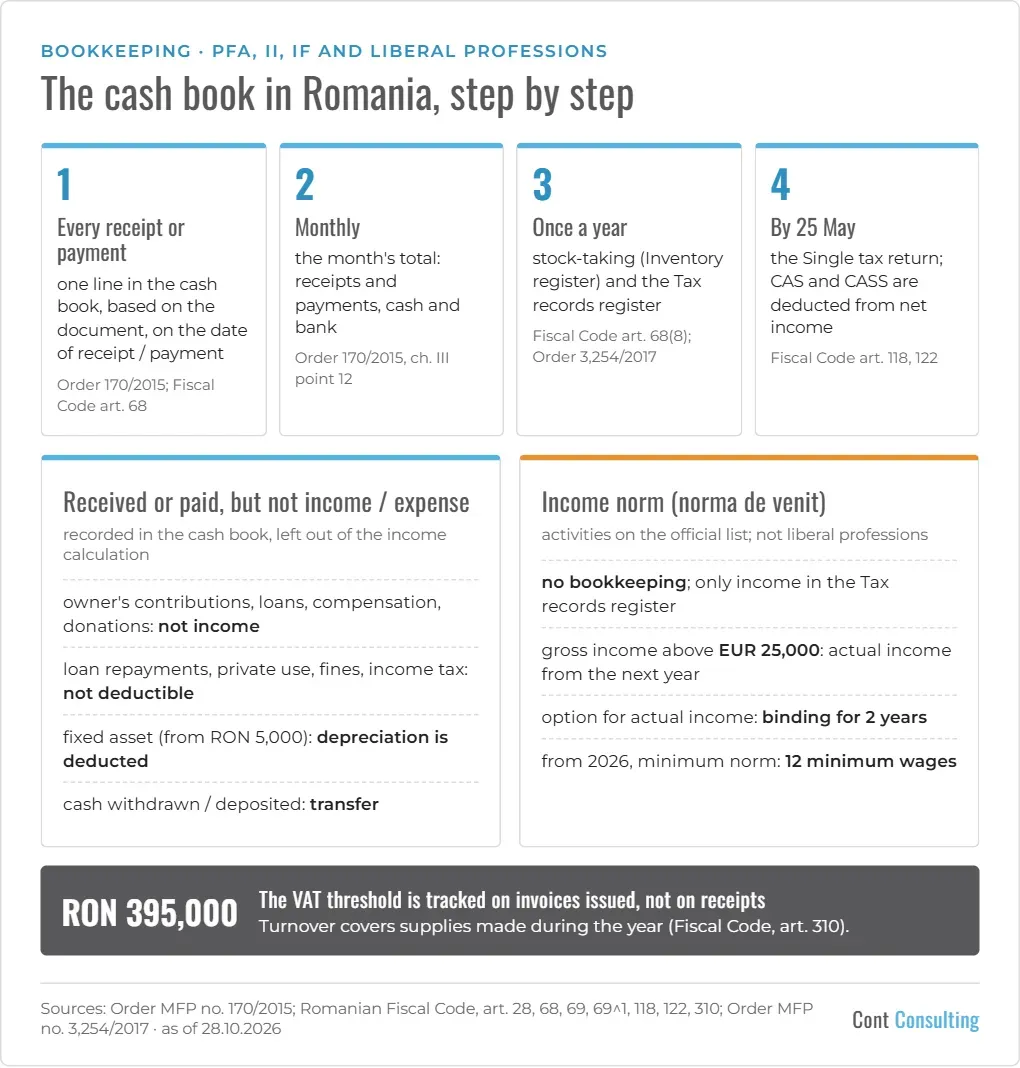
- Sole traders (PFA), individual enterprises (II), family enterprises (IF) and liberal professions taxed on actual income keep single-entry books. For a simple business, the cash book (Registrul-jurnal de încasări și plăți) is all you need during the year.
- Only amounts actually received or paid are recorded, on the date of receipt or payment, based on supporting documents; the book is totalled every month.
- Once a year: stock-taking (Inventory register), the Tax records register and the Single tax return, by 25 May.
- The RON 395,000 VAT threshold is tracked on invoices issued, not on receipts.
- Taxpayers on an income norm keep no books: they only record income in the Tax records register and may opt for taxation on actual income.
- A free Excel template of the cash book (Romanian / English) is available at the end.
Published on 28 October 2026.
In Romania, a self-employed person can work as a PFA (persoană fizică autorizată – authorised natural person, a sole trader), an II (întreprindere individuală – individual enterprise) or an IF (întreprindere familială – family enterprise), or practise a liberal profession. All of them, when their net income is determined on actual income and expenses (sistem real), keep single-entry books. If the business is simple – no fixed assets to depreciate and below the VAT threshold –, day-to-day bookkeeping means a single register: the cash book (Registrul-jurnal de încasări și plăți). Once a year, stock-taking and the Tax records register are added, and the Single tax return is filed on that basis. Below you will find the rules, what is different if you are taxed on an income norm, and a free Excel template.
Who keeps single-entry books
- Natural persons carrying out income-generating activities whose income is determined on an actual basis keep single-entry books or, if they choose, double-entry books (Accounting Law no. 82/1991, art. 1(5)).
- The PFA, the holder of an II and the representative of an IF keep single-entry books (Government Emergency Ordinance no. 44/2008, art. 15).
- The same applies to liberal professions – doctors, lawyers, notaries, financial auditors, tax advisers, chartered accountants, architects and other regulated professions – and to those earning income from intellectual property rights who have opted for the actual-income system (Order MFP no. 170/2015, ch. I).
- Single-entry bookkeeping does not involve annual financial statements (Order MFP no. 170/2015, ch. II point 11).
Which registers are kept
| Register | When it is completed | Who keeps it |
|---|---|---|
| Cash book – Registrul-jurnal de încasări și plăți (form 14-1-1/b) | for every receipt and payment; totalled monthly | everyone taxed on actual income |
| Inventory register – Registrul-inventar (form 14-1-2/b) | at the start of the business, at the end of each year and on closure | everyone taxed on actual income |
| Fixed-asset card – Fișa mijlocului fix (form 14-2-2) | when a fixed asset is bought | only those with fixed assets |
| Tax records register – Registrul de evidență fiscală | yearly, before the Single tax return is filed | actual income: in full; income norm: income only |
Only the forms the business actually needs are used (Order MFP no. 170/2015, ch. II point 2). Legal basis for the other rows: Order MFP no. 170/2015, ch. II point 8, ch. III points 9, 12, 13, 17; Fiscal Code, art. 68(8); Order of the Minister of Public Finance no. 3,254/2017.
The basic rule: record only what was received or paid
Gross income covers amounts received (Fiscal Code, art. 68(2)(a)), and an expense is deducted in the year in which it was paid (art. 68(4)(b)). The date in the cash book is the date of receipt or payment, not the invoice date.
Example. You issue an invoice on 15 December 2026 and the client pays it on 8 January 2027. The amount goes into the cash book – and into your 2027 income – on 8 January. Likewise, a supplier invoice received in December and paid in January is an expense of the year in which you paid it.
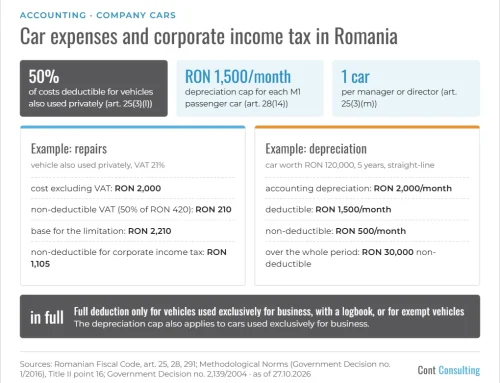
The exception is depreciable fixed assets – from 2026, those with an entry value of at least RON 5,000 (Fiscal Code, art. 28(2)(b), as amended by Government Emergency Ordinance no. 8/2026, which also applies to sole traders through art. 68(4)(d)): the payment is recorded in the cash book, but it is not a deductible expense; depreciation is deducted instead (art. 68(4)(d) and (7)(h)). A full depreciation example is given in our article on car expenses.
What goes into the cash book
The cash book covers all receipts and payments – including those that are not income or expenses, such as owner’s contributions, loans received and repaid, or amounts withdrawn –, in cash and through the bank, at the amount on the supporting document, VAT included (Order MFP no. 170/2015, ch. V section 2). Not everything recorded is income or an expense:
| Transaction | Recorded in the cash book | Income / deductible expense? |
|---|---|---|
| Business receipts (invoices, till receipts, fees) | yes | yes, gross income |
| Owner’s contributions, loans received, compensation, sponsorship and donations received | yes | not income (art. 68(3)) |
| Business payments (rent, materials, services, phone, fuel) | yes | yes, if the conditions of art. 68(4) are met; some are capped (para. (5)) |
| Return of owner’s contributions, repayment of loans, amounts for personal or family use, fines, penalties, income tax | yes, if paid from business money | no (art. 68(7)) |
| Social contributions (CAS and CASS) | yes, if paid from business money | not recorded as expenses; deducted in the Single tax return (art. 118(2)(b)) |
| Purchase of a fixed asset | yes | no; depreciation is deducted |
How to fill in the cash book
- One line per transaction, based on a supporting document: invoice, receipt, till receipt, bank statement, payment order (Order MFP no. 170/2015, ch. V section 2).
- The date is the date of receipt or payment.
- Transactions are entered in date order, with no empty lines and no erasures. On paper, a mistake is struck through with one line, the correct entry is written above it and signed, with the date of the correction (ch. III points 5–6). In Excel, our recommendation: do not delete lines in a closed month; correct with a new line and an explanation.
- Minimum columns: date, document (type and number), description, receipts (cash / bank), payments (cash / bank) (ch. V section 2).
- The amount is the one on the document, VAT included.
- Foreign-currency transactions are entered in lei, at the National Bank of Romania rate of the last banking day before the transaction, with the foreign-currency amount noted in the description (ch. III point 18).
- If you use a cash register, daily takings are entered on the basis of the daily closing fiscal report (Z report) (ch. III point 19).
- At the end of each month the book is totalled (ch. III point 12). A cash book kept on a computer is printed once a year or when the tax inspectors ask for it (ch. V section 2).
- Cash withdrawn from the bank for the business, or cash deposited into the bank, is neither income nor an expense. Our recommendation: one line, with the amount under cash receipts and bank payments (or the reverse) and the description “transfer”; these amounts are left out when income is calculated.
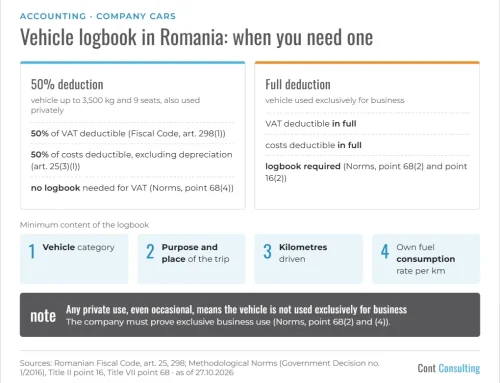
- Costs incurred both for the business and privately are deductible only for the business share (art. 68(5)(i)); for cars not used exclusively for business, 50% of the costs are non-deductible (art. 68(7)(k)).
- The cash book and documents are kept for 5 years from 1 July of the following year; documents for assets with a useful life of more than 5 years are kept for the whole useful life of the asset (ch. IV point 1^1).
- The cash book must be kept in Romanian and in lei (ch. III point 1) – which is why our template is bilingual.
Cash receipts and payments are also subject to separate caps – see our article on Law no. 70/2015.
What to do at year end
- Total the cash book for the whole year (in the template, the “Summary” sheet).
- Take stock and record the result in the Inventory register: assets used in the business, stocks, amounts receivable and payable (Order MFP no. 170/2015, ch. II points 8–9).
- Complete the Tax records register with total income and total deductible expenses. Not included: contributions, loans and other amounts that are not income, non-deductible expenses, CAS and CASS and, for VAT payers, output and input VAT (Order no. 3,254/2017, art. 3–5).
- File the Single tax return (Declarația unică) by 25 May of the following year (Fiscal Code, art. 122(3)). CAS and CASS due are deducted from net income when taxable income is calculated (art. 118(2)(b)).
- If the year ends with a loss, it is carried forward and offset against up to 70% of net income from the same source over the next 5 years (art. 118(4)).
The VAT threshold is not tracked on receipts
You can remain outside the VAT system as long as your annual turnover does not exceed RON 395,000 (Fiscal Code, art. 310(1)). Note: turnover is calculated on supplies of goods and services made during the calendar year (art. 310(2)), so it includes invoices not yet paid – not the amounts in the cash book. Once the threshold is exceeded, VAT registration must be requested no later than the date it is exceeded, and normal VAT applies from the transaction that exceeded it (art. 310(6)). Keep a separate record of invoices issued for this purpose.
If you are taxed on an income norm
- For activities on the list approved by the Ministry of Finance, net income is determined on the basis of an income norm (norma de venit), a fixed annual amount set by the regional public finance directorates (Fiscal Code, art. 69(1)–(2)). Liberal professions cannot be taxed on a norm. For 2026 income, the norm cannot be lower than 12 gross national minimum wages (art. 69(3)).
- You have no bookkeeping obligations. You only complete the income part of the Tax records register (art. 69(8); Order no. 3,254/2017, art. 1(2)).
- You can opt for taxation on actual income by completing the Single tax return accordingly, by 25 May. The option is binding for 2 years and is renewed automatically unless you ask to return to the norm (art. 69^1). From then on, everything above about the registers applies.
- If your gross income in a year exceeds the equivalent of EUR 25,000 (at the National Bank of Romania average annual rate), you must switch to actual income from the following year (art. 69(9)). This is why we recommend recording receipts anyway – the Excel template can be used with the receipts columns only.
- If you also carry out another independent activity that is not on the list, net income is determined on an actual basis (art. 69(7)).
- If you worked for only part of the year, the norm is reduced proportionally (art. 69(5)), and the Single tax return is still filed by 25 May (art. 122(2)–(3)).
Other situations, in brief
- Intellectual property rights. You can opt for the actual-income system; the option is binding for 2 years (Fiscal Code, art. 73(1)–(2)). If you do not opt, you only record income in the Tax records register or rely directly on the documents issued by the payer (Order no. 3,254/2017, art. 1(3)).
- Double-entry bookkeeping can also be chosen by natural persons (Law no. 82/1991, art. 1(5)).
Free Excel template
Download the cash book template (Excel, Romanian / English) – the official form (14-1-1/b, Order MFP no. 170/2015), with one sheet per month and the monthly total, an example sheet and a summary that adds up the months automatically and shows the cash and bank balance at the end of each month. Labels are in Romanian and English; the entries themselves must be made in Romanian. The template does not replace the Inventory register or the Tax records register.
If you would like us to keep your books and prepare your Single tax return, see our accounting services or book a meeting.
Note: This text is valid on the date of publication, is for information only and reflects the interpretation of Cont Consulting specialists. It does not replace the legal provisions in force.
Sources: Accounting Law no. 82/1991, art. 1(5); Government Emergency Ordinance no. 44/2008, art. 15; Order MFP no. 170/2015 (as amended by Order MF no. 1,447/2023); Romanian Fiscal Code (Law no. 227/2015), art. 28 (as amended by Government Emergency Ordinance no. 8/2026), 68, 69, 69^1, 73, 118, 122, 310; Order MFP no. 3,254/2017 – as in force on 28.10.2026.