
Updated on 26 October 2026.
We are often asked about cash payments and receipts, both between companies and with individuals. In Romania, they are governed by Law no. 70/2015 on strengthening financial discipline regarding cash receipts and payments, which has been amended several times in recent years. Below are the rules currently in force. The consolidated text of the law (in Romanian) is available on legislatie.just.ro.
Who must apply the law?
Legal entities, authorised self-employed individuals (PFA), sole proprietorships and family businesses, liberal professionals, individuals carrying out independent activities, associations and other entities with or without legal personality (art. 1 para. (1)).
The following do not apply these limits to the operations specific to their authorised activity: the State Treasury, credit institutions, electronic money issuers, authorised payment institutions, non-bank financial institutions, currency exchange offices and gambling operators (art. 1 para. (2)).
The limits also apply to foreign currency payments made in Romania, at the National Bank of Romania (BNR) exchange rate on the day of the transaction (art. 1 para. (3)).
A payment account is mandatory
From 1 January 2026, legal entities must hold a payment account in Romania or with the State Treasury throughout their activity. Newly established companies must open one within 60 working days of incorporation (art. 1 para. (1^2)–(1^3)). The fine for not having an account ranges from RON 3,000 to RON 10,000 (art. 12 para. (4)).
Between companies
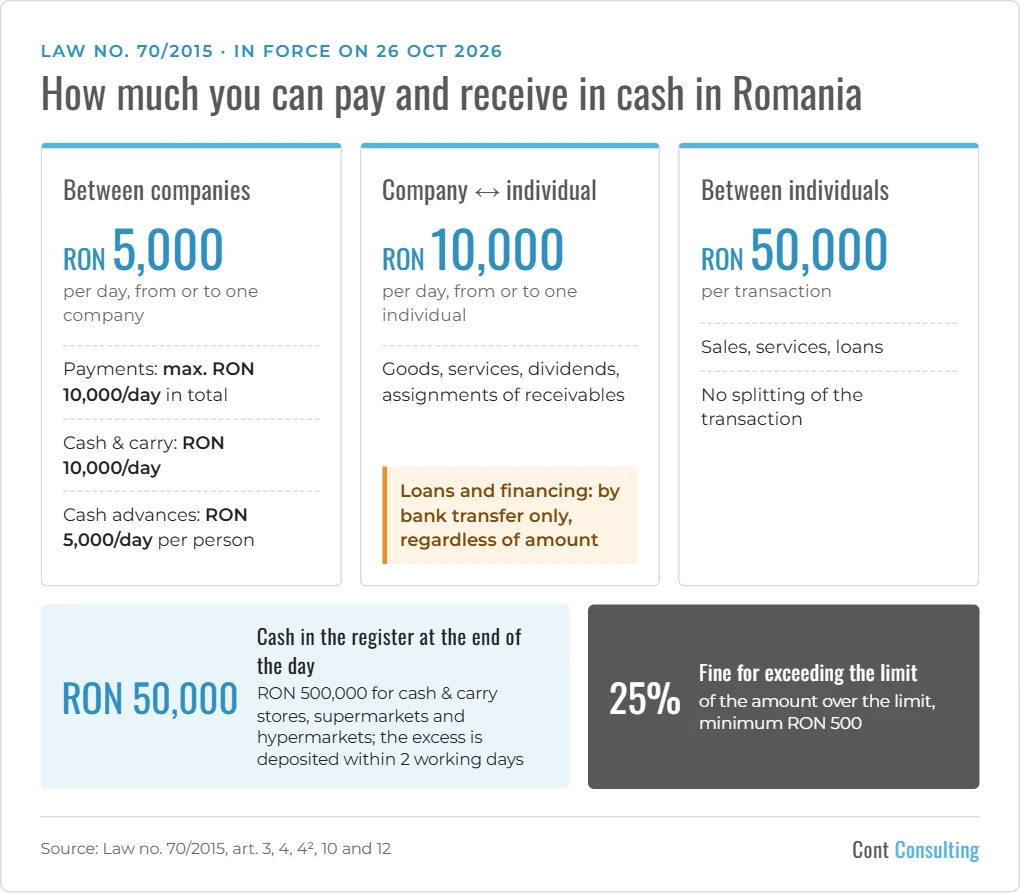
- cash receipts: up to RON 5,000 per day from one person (RON 10,000 for cash & carry stores);
- cash payments: up to RON 5,000 per day to one person, but no more than RON 10,000 per day in total (to cash & carry stores: RON 10,000 per day in total);
- payments from cash advances: up to RON 5,000 per day for each person who received the advance; on the date it is granted, the advance counts towards the daily payment limit (art. 3 para. (1) and (4)).
Splitting receipts or payments for invoices above RON 5,000 (RON 10,000 for cash & carry stores) is prohibited, as is splitting invoices. A larger invoice may be paid RON 5,000 (RON 10,000) in cash, with the difference paid only by non-cash payment instruments (art. 3 para. (2)–(3)).
Between companies and individuals
- supplies of goods, services, dividends, assignments of receivables or other rights: up to RON 10,000 per day to/from one person, without splitting (art. 4 para. (1)–(2)); exception: instalment sales, as provided by law (art. 4 para. (3));
- loans and other financing received or repaid: only by non-cash payment instruments, regardless of the amount (art. 4 para. (4)).
Organisers of weddings and christenings may ask the tax authority to approve a higher cash receipt limit (art. 4^1).
Between individuals
Sales of goods or rights, services and loans between individuals may be paid in cash up to RON 50,000 per transaction, without splitting (art. 10).
Cash register limit
At the end of each day, the cash held in the cash register may not exceed RON 50,000 (RON 500,000 for cash & carry stores, supermarkets and hypermarkets). The excess must be deposited into the bank account within two working days. The limit may be exceeded only by the amounts for salaries and other staff entitlements or for other operations with individuals, for 3 working days from the date set for their payment (art. 4^2 para. (2)).
Refunds for cancelled invoices
Between companies, up to RON 5,000 (RON 10,000 for cash & carry stores) may be refunded in cash, with the rest only by non-cash instruments. To individuals, up to RON 10,000 in cash; if the person declares on their own responsibility that they do not hold a bank account, the full amount may be refunded in cash (art. 9).
Operations without limits
The limits do not apply to: cash deposits into accounts and machines, payment of business travel expenses, cash payment of taxes, duties and fines owed to the state budget, cash withdrawals for salaries and other payments to individuals, and transfers through authorised payment institutions (art. 5).
Advantages for paying in cash
Granting customers any advantage for paying in cash is prohibited (art. 6).
Fines
- exceeding the limits, splitting, exceeding the cash register limit: 25% of the amount exceeding the limit, but no less than RON 500 (art. 12 para. (1));
- cash loans with individuals: 25% of the amount received or paid, but no less than RON 500 (art. 12 para. (3)). According to High Court of Cassation and Justice (ÎCCJ) Decision no. 51/2026 (HP), the amount refers to all cash operations carried out under the same unlawful resolution;
- granting advantages for cash payment (art. 6), splitting cash withdrawal requests at the bank to exceed the limit in art. 3 para. (1) letter c), and transfers to individuals’ accounts without supporting documents (art. 11): RON 15,000–20,000 (art. 12 para. (2));
- not having a payment account: RON 3,000–10,000 (art. 12 para. (4)).
Example: a company pays RON 8,000 in cash, in one day, to a supplier that is a legal entity. The limit is RON 5,000, so the excess is RON 3,000 and the fine is 25% × RON 3,000 = RON 750 (art. 1 para. (1), art. 3 para. (1) letter c) and art. 12 para. (1)).
Fines are imposed by the Ministry of Finance and the National Agency for Fiscal Administration (ANAF) (art. 13).
Note: This text is valid as of the date of its update, is for guidance only and represents an interpretation by the specialists of Cont Consulting, and is not intended to replace the legal provisions in force. We are not liable for any damages arising from the use of this material for legal purposes or as evidence in any potential litigation.