
Updated on 26 October 2026.
Since 25 August 2026, Law no. 50/1991 on the authorisation of construction works has been repealed and replaced by Law no. 169/2026 on the Code of spatial planning, urban planning and construction. A building permit remains the rule, but the Code provides for three situations in which it is no longer needed: works with no formalities at all, works based on a notification and works based on a siting approval (art. 245 para. (2), art. 294–300).
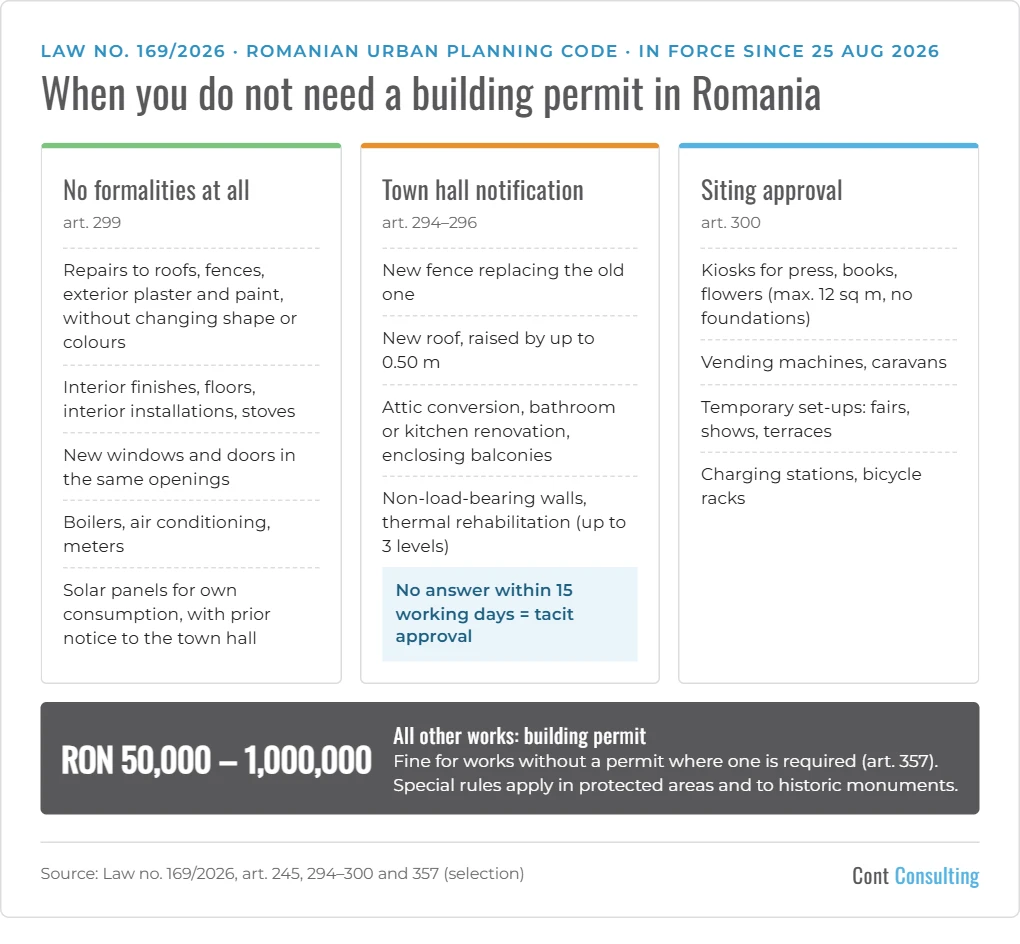
Works with no formalities at all
On existing buildings outside built-up protected areas and protection zones of historic monuments, the following may be carried out without a permit and without notification (art. 299 para. (2) letter a)):
- repairs to fences, roofs, roof coverings or terraces, if their shape and materials do not change (for roofs: shape and appearance);
- repairs and replacement of interior joinery; for exterior windows and doors, if the shape and size of the openings are kept, even if the material changes;
- repairs to exterior plaster, painting and cladding, if the facade elements and the colours of the building do not change;
- repairs, replacement or rehabilitation of facade elements, pavements, access stairs and exterior terraces, without changing their quality and architectural form;
- repairs or replacement of interior finishes and floors;
- repairs and replacement of heating stoves and chimneys;
- repairs or replacement of interior installations and repairs to utility connections, within the property boundaries;
- installing boilers and hot water systems, air conditioning units and meters;
- fire prevention and extinguishing installations, in order to obtain the fire safety permit;
- photovoltaic panels (prosumers) and solar panels for own consumption, on buildings, outbuildings or on the ground, with prior notice to the town hall;
- parcel lockers of up to 6 sq m on private land, with prior notice to the town hall.
The following also require no formalities (art. 299 para. (2) letter b)): front gardens, utility connections within the property, retaining walls and ground-floor access stairs, removable exterior terraces and pergolas within the property (outside protected areas), as well as funeral constructions, with the approval of the cemetery administration.
In rural areas, next to single-family houses, outbuildings without foundations, removable, on a wood or metal structure (covered terraces, pergolas, summer kitchens, sheds, toilets) may be built, of up to 20 sq m in total and 2.5 m in height, in compliance with the general urban plan and local urban planning regulations (art. 299 para. (2) letter c)). They are declared on the owner’s own responsibility and taxed as temporary constructions (art. 299 para. (12)).
Geotechnical drilling and investigations for studies and projects may be carried out without a building permit (art. 299 para. (9)).
Note: even without a permit, works must comply with urban planning and technical regulations, and the beneficiary is jointly liable with the designers and contractors. Acceptance on completion of the works is mandatory and is recorded in the building’s technical book and in the National Register of Constructions (art. 299 para. (3)–(5)).
Works based on a notification
For certain works, instead of a permit, a notification accompanied by a simplified technical design is filed with the town hall before the works begin (art. 294–295). Examples, outside protected areas (art. 294 para. (2)):
- new fences replacing existing ones;
- replacing the roof, including raising it by up to 0.50 m;
- converting the attic of a single-family house, without structural strengthening;
- renovating and extending the kitchen or bathroom, enclosing balconies uniformly in apartment blocks;
- re-partitioning with non-load-bearing walls and remodelling non-structural facades;
- energy rehabilitation of individual houses with up to 3 levels;
- change of use into retail or office space, if no works subject to a permit are needed;
- in rural areas: permanent outbuildings of up to 50 sq m and one ground-floor single-family house of up to 150 sq m gross floor area, under the conditions of the Code.
The town hall has 15 working days to request clarifications, require a permit or reject the notification with reasons; if it does not respond, the notification is tacitly approved. Works may begin 15 calendar days after this deadline and must be completed within 3 years (art. 296 para. (1), (5) and (6)).
Works based on a siting approval
Kiosks and stands for newspapers, books and flowers, vending machines and caravans of up to 12 sq m, placed directly on the ground, without foundations and with no utilities other than electricity, do not need a building permit, but need a siting approval from the competent authority (art. 300 letter f)). The same applies to temporary set-ups for fairs, shows or catering terraces (art. 300 letter h)).
What happens if you build without the required documents
Carrying out works without notification is punishable by a fine of RON 5,000 to RON 50,000, and carrying out works without a permit, where one is required, by a fine of RON 50,000 to RON 1,000,000, depending on the seriousness of the offence (art. 357 para. (1) letters a) and b), para. (4) letters a) and b)). Fines apply to both individuals and companies.
For a company, the tax side also matters: a building constructed without a permit may lead to disputes with the tax authority (ANAF) over VAT deduction. We have written about such a case, won at the administrative appeal stage (in Romanian): Limitation of the VAT deduction right for buildings without a permit.
The text of the Code: Law no. 169/2026, published in the Official Gazette no. 661 of 10 August 2026, available (in Romanian) on legislatie.just.ro.
Note: This text is valid as of the date of its update, is for guidance only and represents an interpretation by the specialists of Cont Consulting, and is not intended to replace the legal provisions in force. We are not liable for any damages arising from the use of this material for legal purposes or as evidence in any potential litigation.