
Summary
- A Romanian property developer sold an individual buyer, by notarial deed, a different parking space from the one in the preliminary contract. Both spaces are new buildings, subject to 21% VAT.
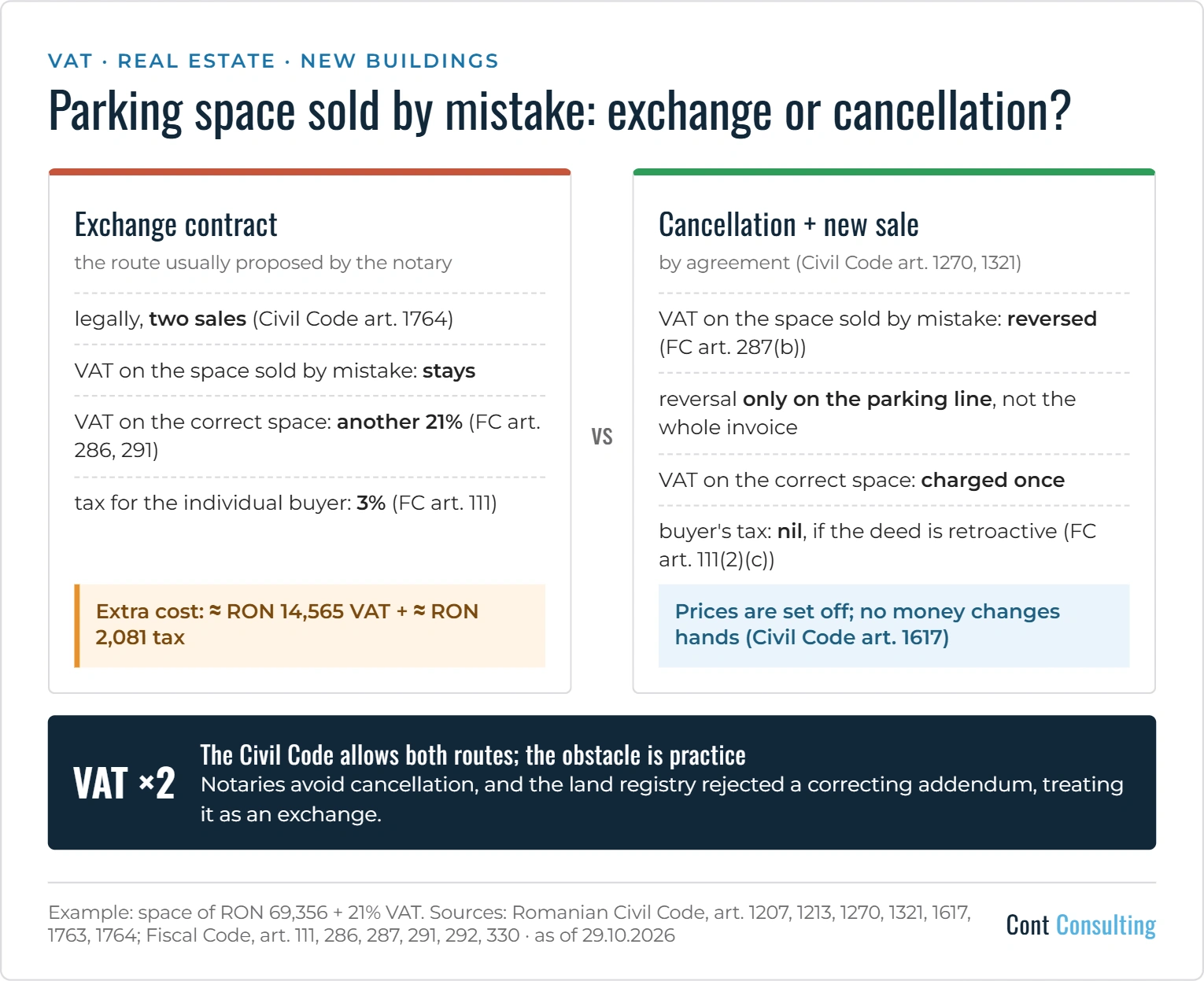
- The notary proposed an exchange contract. Legally, an exchange is two sales, so the developer charges VAT again on the space handed over, without being paid the price again.
- In our example, the extra tax cost is about RON 14,565 of VAT, plus the 3% tax the individual owes for the space he gives back.
- Cancelling the sale by mutual agreement and signing a new sale lets the developer reverse the VAT (Fiscal Code, art. 287(b)). The buyer owes no tax for a cancellation with retroactive effect (art. 111(2)(c)).
- The Civil Code allows both routes. The obstacle is practice: notaries avoid cancellation, and the land registry rejected a correcting addendum in a similar case, treating it as an exchange.
Published on 29 October 2026.
A property developer handed a buyer a different parking space from the one promised. Correcting it looks like a formality, but the route usually chosen at the notary, an exchange contract, means paying 21% VAT on a parking space a second time. Below we explain why, which route would be more tax-efficient, and why it is not used in practice.
The situation
The mistake happened when the spaces in the underground car park were renumbered.
- Preliminary contract: the buyer, an individual, reserved the space we call Y, for RON 69,356 plus 21% VAT.
- Notarial deed: by mistake, it names space X, at the same price. The buyer paid RON 83,920.74 including VAT in full, and his title is registered in the land book.
- Space X had been promised to another buyer, a VAT-registered company, which is still waiting for it.
- The building was completed in March 2026. The spaces are new buildings, so their sale is subject to VAT, not exempt (Fiscal Code, art. 292(2)(f)).
- The original invoice covers both the flat bought by the buyer and the parking space.
The developer has to reach the correct outcome: the buyer with space Y, the company with space X.
The notary’s route: an exchange contract
An exchange looks simple: the buyer gives back space X and receives space Y, with no money changing hands. For tax purposes, it is the most expensive route.
What an exchange is. Each party transfers one asset to acquire another (Civil Code, art. 1763). Each party is treated as the seller of the asset given and the buyer of the asset received (art. 1764(2)). For real estate, the deed must be signed before a notary (art. 1244).
VAT. Handing over space Y is a new supply of goods (Fiscal Code, art. 270(1)), taxed at 21% (art. 291(1)). The taxable amount is the consideration received, i.e. space X (art. 286(1)(a)). An invoice must be issued even if no money is paid.
- The VAT charged on space X in the mistaken sale stays paid.
- The developer charges another RON 14,564.76 of VAT on space Y.
- The buyer is not VAT-registered, so space X returns to the developer with no VAT to deduct.
The result: for a single parking space kept by the buyer, the state collects VAT twice. Either the buyer pays another RON 14,565, or the developer bears the cost. In the second case, the value of space X is treated as including VAT, and the tax is extracted from it: 69,356 × 21/121 ≈ RON 12,037, still an extra cost.
The buyer’s tax. The individual transfers space X to the developer, so he owes tax on the transfer of real estate. The rate is 3% for property held for up to 3 years (Fiscal Code, art. 111(1)(a)). It applies to the value in the deed, but not below the minimum value in the notaries’ market study (art. 111(4) and (4^1)). At the contract value, the tax would be about RON 2,081.
The more efficient route: cancelling the sale and signing a new one
The parties can cancel the sale of space X by mutual agreement, then sign the sale of space Y. A contract ends by agreement of the parties (Civil Code, art. 1270(2) and art. 1321).
The VAT is reversed. The taxable amount is reduced when the contract is cancelled in whole or in part by a written agreement between the parties (Fiscal Code, art. 287(b)). The developer issues an invoice with negative amounts and also sends it to the buyer (art. 330(2)).
- The reversal can be partial: only the line for space X, not the flat on the same invoice.
- A new invoice with 21% VAT is issued for space Y.
- The refund of the price for X and the price for Y are settled by set-off, if both debts are certain, liquid and due (Civil Code, art. 1617). No money changes hands.
This way, VAT is paid only once, on the space the buyer keeps.
The buyer pays no tax. The tax on transfers of real estate is not due for cancellation deeds with retroactive effect (Fiscal Code, art. 111(2)(c)). The notary has to draft the deed so that it qualifies. Even if it does not, the VAT saving remains, because art. 287(b) only requires a written agreement.
There is a third route. A mistake about the identity of the asset is a fundamental mistake (Civil Code, art. 1207(2) point 2). The contract can be adapted to what the mistaken party understood (art. 1213). In practice, an addendum replaces space X with space Y, with no second supply. For tax purposes, only the description on the original invoice is corrected (art. 330(1)(b)), with no extra VAT, because the price is the same.
The comparison in figures
The exchange costs about RON 16,645 more than the cancellation: RON 14,564.76 of VAT and about RON 2,081 of tax. The figures are for a space worth RON 69,356 excluding VAT; the sale of space X to the other buyer is the same under both routes and is not shown.
| What happens | Exchange contract | Cancellation + new sale |
|---|---|---|
| VAT from the mistaken sale of space X | stays: RON 14,564.76 | reversed: −RON 14,564.76 |
| VAT on space Y handed to the buyer | RON 14,564.76 | RON 14,564.76 |
| Total VAT for the space the buyer keeps | RON 29,129.52 | RON 14,564.76 |
| Tax owed by the buyer (art. 111) | about RON 2,081 (3%) | nil, if the deed has retroactive effect |
| Notarial deeds | one exchange contract | cancellation deed + sale contract |
| Original invoice (flat + space) | stays | reversed only for the line of space X |
| Money between the parties | only the extra VAT, if the buyer pays it | none, by set-off |
Why the exchange still wins: the practical obstacle
The law does not forbid cancellation or a correcting addendum. Both are provided for in the Civil Code. What stops them is the practice of notaries and land registry offices (OCPI).
- The addendum is rejected by the land registry. In a similar case, registration of an addendum replacing one parking space with another was refused. The reason: the registrar considered it, in substance, an exchange.
- Notaries avoid cancellation. It requires restoring the parties to their previous position, deleting and re-registering the title in the land book, then a new contract. In practice it is seen as hard to carry out.
- Notarial costs rise. Two deeds instead of one mean extra fees and land registry charges, which buyers are reluctant to accept.
The result is a paradox. The simplest route at the notary is the most expensive in tax terms, and the difference, around 21% of the price of the space, is paid by the developer or the buyer. Before choosing, compare the VAT difference (here, RON 14,565) with the fee and charges for the extra notarial deed.
What we recommend to developers
- Check the numbering before signing. Compare the space number in the preliminary contract with the plan and with the cadastral number in the land book extract.
- Discuss the tax side with the notary, not just the legal side. Ask expressly for cancellation by agreement, with retroactive effect, followed by a new sale. Show the notary the VAT calculation.
- Reverse only what is needed. If the invoice also covers the flat, reverse only the line for the parking space.
- Set off, do not transfer money. Record the set-off in the notarial deed and in minutes signed by both parties. The invoices are issued anyway.
- If you keep the exchange, agree in writing who bears the extra VAT and the buyer’s tax, before signing.
We can help you work out the cost of each route and prepare the invoices and accounting entries: see our tax consultancy services.
Note: This text is valid on the date of publication, is for information only and reflects the interpretation of Cont Consulting’s specialists. It does not replace the legal provisions in force. The case is real, but identifying details have been removed.
Sources: Romanian Civil Code (Law no. 287/2009), art. 1207(2) point 2, art. 1213, art. 1244, art. 1270(2), art. 1321, art. 1617, art. 1763, art. 1764(2); Romanian Fiscal Code (Law no. 227/2015), art. 111(1)(a), (2)(c), (4) and (4^1), art. 270(1), art. 286(1)(a), art. 287(b), art. 291(1), art. 292(2)(f), art. 330(1)(b) and (2) – as in force on 29.10.2026.