
Summary
- Regulation (EU) 2026/2359 amends the EU social security coordination rules (Regulations 883/2004 and 987/2009). It entered into force on 1 November 2026, but the rules that matter most for employers apply from 2 November 2028.
- The A1 certificate must be requested before the employee starts working in another Member State. Exceptions: business trips and activities of up to three consecutive working days within 30 days (not in construction).
- An employee hired specifically to be posted must have been insured in the sending country for at least three months before being hired.
- After 24 months of posting to one country, a new posting to that country is possible only after a break of at least two months. A posted worker may be replaced, as long as the total does not exceed 24 months.
- The period during which a jobseeker keeps unemployment benefit while looking for work in another Member State rises from three to six months, also from 2 November 2028.
Published on 29 October 2026.
Companies that send employees to work temporarily in another EU country will face stricter rules on the A1 certificate and on the length of postings from 2028. We go through them one by one, with the date each applies from and what is worth preparing now. The examples refer to Romanian employers, but the rules are the same across the EU.
What has changed and when
Regulation (EU) 2026/2359 was published in the Official Journal of the European Union on 27 October 2026. It amends the two regulations that decide in which country social contributions are paid when a person works in more than one EU country: Regulation (EC) No 883/2004 and the implementing Regulation (EC) No 987/2009.
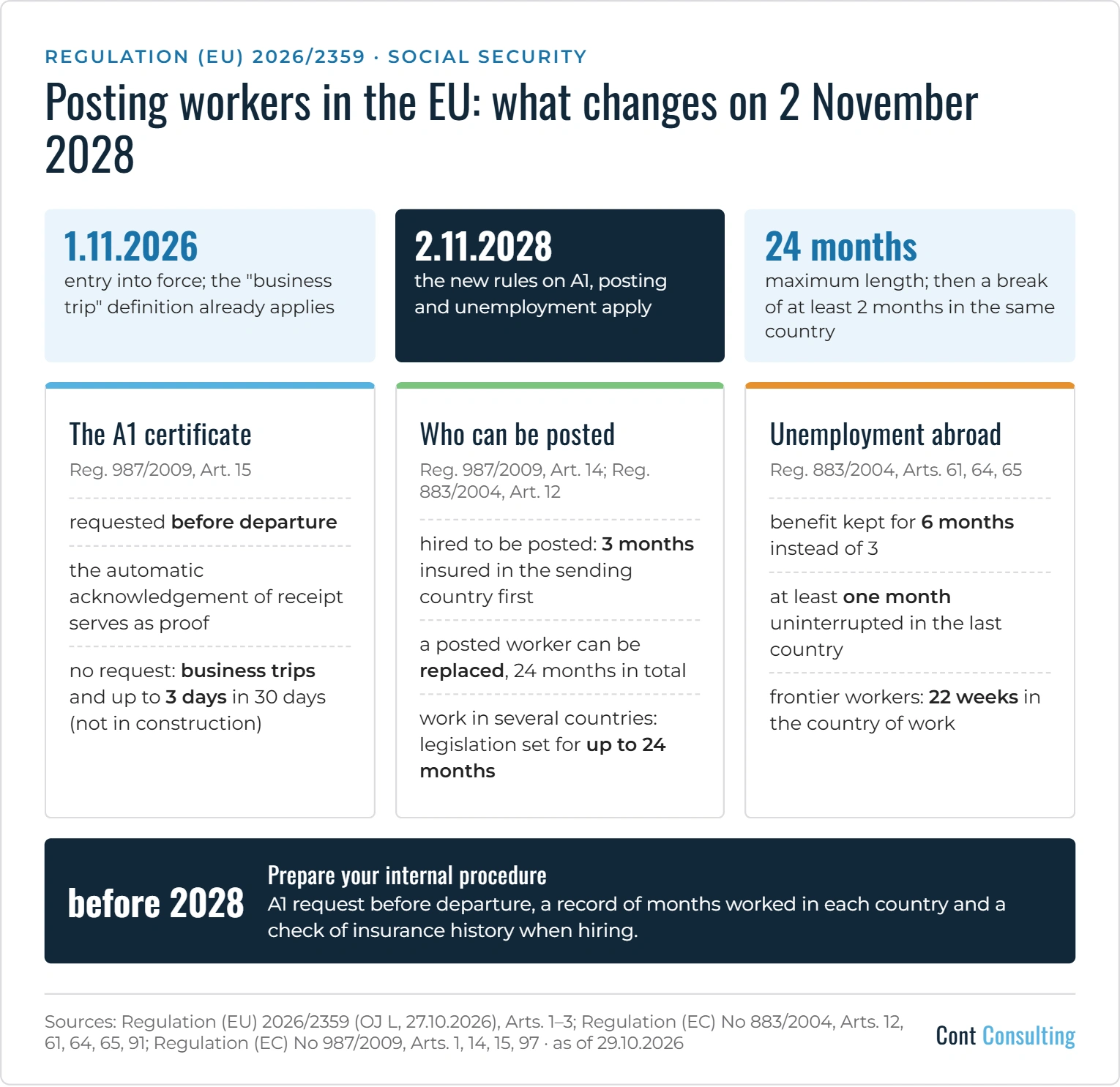
The regulation entered into force on 1 November 2026 (Article 3), but it applies in stages:
- from 1 November 2026, among other things, the new definitions apply, such as the definition of a “business trip” (Article 1(2)(eb) of Regulation 987/2009);
- from 2 November 2028, the new rules on posting, the A1 certificate, persons working in several countries and unemployment benefits apply (Article 91 of Regulation 883/2004 and Article 97 of Regulation 987/2009, as amended).
Watch the date for unemployment benefits. Some published commentaries give 1 January 2027 for the six-month rule. In the official text, 1 January 2027 relates to Article 64 of Regulation 987/2009, which deals with lump sums for healthcare costs, not unemployment. The six-month rule (Article 64 of Regulation 883/2004) applies from 2 November 2028.
The A1 certificate is requested before departure
The A1 certificate proves that the posted employee remains insured in the sending country, so contributions are paid there and not in the country where the work is done. In Romania it is issued by the National Public Pension Fund (CNPP), and the application can be filed online through the RODPA1 platform.
Today, the employer informs the competent institution “wherever possible” in advance. From 2 November 2028, the new Article 15 of Regulation 987/2009 changes the rule:
- the notification and the A1 request must be made before the activity starts in the other country (paragraph 1);
- if the certificate is not issued immediately, the institution sends an automatic acknowledgement of receipt, which proves that the request has been filed (paragraph 1a);
- during an inspection in the country where the employee works, the employer shows the A1, the acknowledgement of receipt or proof that the activity is exempt; the employer is responsible for these documents (paragraph 1c).
No prior request is needed (paragraph 1b) for:
- business trips, meaning temporary activities linked to the employer’s business interests, excluding the provision of services or the delivery of goods: business meetings, conferences, seminars, training courses;
- activities lasting no more than three consecutive working days within a period of 30 consecutive days, except in the construction sector.
Example: an accountant attending a conference in Vienna is on a business trip. A technician who spends a week installing equipment for a customer in Germany is providing a service, so an A1 is needed before departure, even if the internal document calls it a “business trip”.
Employees hired specifically to be posted: the three-month condition
A person hired in order to be posted can remain insured in the sending country only if, for at least three months before being hired, they were already subject to that country’s social security legislation (Article 14(1) of Regulation 987/2009, applicable from 2 November 2028).
The previous employer does not matter: someone who worked under an employment contract in Romania for another company meets the condition. By contrast, a person coming from another country, or who was not insured in the last three months, cannot be posted straight away under the usual rules. For them the general rules apply, which usually means the legislation of the country where they work.
Successive postings: a two-month break after 24 months
The maximum length of a posting remains 24 months (Article 12(1) of Regulation 883/2004). What is new (Article 14(1a) of Regulation 987/2009):
- all periods worked in the same country are added up, even with interruptions of up to two months;
- after a total of 24 months, a new posting to the same country is possible only after at least two months from the end of the previous period;
- in specific circumstances, the authorities of the two countries may agree an exception (Article 16(1) of Regulation 883/2004).
In practice, a break of a few weeks between two contracts with the same customer no longer restarts the count.
A posted worker can be replaced
Today, an employee cannot be posted to replace another posted employee. The new Article 12(3) of Regulation 883/2004 allows a replacement when the first employee does not complete the activity. The condition is that the total activity of all persons in the other country does not exceed 24 months.
Example: an 18-month project in Austria. The posted employee leaves the company after 10 months, and the colleague replacing them can be posted for no more than 14 months.
Employees working in several countries
For people who normally work in two or more countries, the applicable legislation is determined for a maximum of 24 months, based on the activity expected over the next 12 calendar months. At the end, the situation is reassessed (Article 14(10) of Regulation 987/2009).
Where the employer’s seat matters, it is the place where the company’s main decisions are taken and its central administration is exercised. It is identified through an overall assessment, under criteria to be detailed by the Administrative Commission (Article 14(5a)).
Unemployment benefit in another Member State
These rules also apply from 2 November 2028.
- Six months instead of three: a jobseeker who goes to look for work in another Member State keeps the benefit for six months, within the total length of the entitlement. The institution may extend the period until the end of the entitlement (Article 64(1)(c) and (3) of Regulation 883/2004).
- One month in the last country: the last country of work takes periods from other countries into account only if the person worked there for at least one uninterrupted month. Otherwise, the country where the person previously worked for at least one month pays (Article 61).
- 22 weeks for frontier workers: people who worked in one country and lived in another receive the benefit from their country of residence if they did not work 22 uninterrupted weeks in the country where they worked (Article 65(2)).
- Working while receiving benefit from another country: the person remains subject to the legislation of the country paying the benefit (Article 13(4a)).
Other benefits
The regulation introduces an EU definition of long-term care benefits (Article 1(vb) of Regulation 883/2004) and special rules for family benefits that replace income during child-raising periods (Article 68b). It does not change the amounts or the national conditions for granting benefits.
What companies can do now
- List the postings that will continue after 2 November 2028 and calculate how many months each employee has worked in each country.
- Set up an internal procedure: the A1 request is filed before departure and the acknowledgement of receipt is kept.
- Check the insurance history of people you hire to post abroad: three months in the sending country, immediately before hiring.
- For short trips, keep the programme, invitation or agenda, so you can prove it was a business trip or an activity of no more than three days.
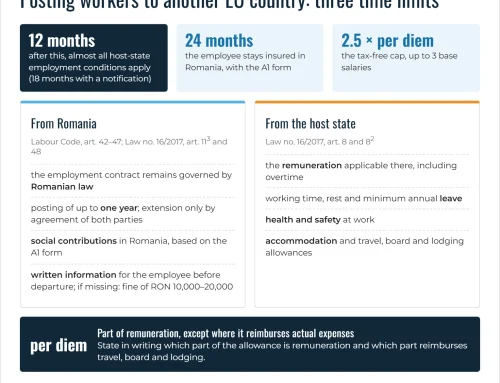
The A1 certificate concerns social contributions. Working conditions in the host country (pay, working time, allowances) are governed separately, in Romania by Law No 16/2017. We explained them in our article on posting workers to another EU country. For payroll and allowances for posted employees, see our payroll services.
Note: This text is valid at the date of publication, is for information only and reflects the interpretation of Cont Consulting’s specialists. It does not replace the legal provisions in force.
Sources: Regulation (EU) 2026/2359 of the European Parliament and of the Council of 7 October 2026 (OJ L, 2026/2359, 27.10.2026), Articles 1–3; Regulation (EC) No 883/2004, Article 1(vb), Article 12, Article 13(4a), Article 16(1), Article 61, Article 64(1)(c) and (3), Article 65, Article 68b, Article 91; Regulation (EC) No 987/2009, Article 1(2)(eb), Article 14(1), (1a), (5a), (10), Article 15, Article 64, Article 97 – as amended by Regulation (EU) 2026/2359.