

Updated on 27 October 2026.
When a Romanian company sends employees to work temporarily in another EU country, the employment contract remains governed by Romanian law, but certain employment conditions must be at least those of the host state. The rules come from Directive 96/71/EC, as amended by Directive (EU) 2018/957, and from Romanian Law no. 16/2017.
When Law no. 16/2017 applies
Law no. 16/2017 on the posting of employees in the framework of the transnational provision of services applies to Romanian companies that send employees to work temporarily in another EU/EEA member state or in Switzerland, in one of the following situations (art. 3(b) and art. 5(2)):
- the employee works there on behalf and under the direction of the company, to perform a contract with a recipient of services in that state;
- the employee is sent to an establishment or company in the same group;
- an employee of a temporary work agency is hired out to a user undertaking there.
In our interpretation, what counts is the actual situation, not the label used in internal documents: if the employee works in another state to perform a contract with a client there, Law no. 16/2017 applies even if the company calls the trip an “assignment” (delegare). The law does not use the Labour Code concepts of assignment or posting; it describes the factual situations (art. 2(1)(c) and art. 5(2)).
Not every trip abroad falls under this law: staff of international transport companies who are not in one of the situations above remain under the Labour Code rules on assignment (art. 9), and drivers carrying out bilateral transport operations are not considered posted (art. 53).
Assignment or posting: what the Labour Code says
- The employer may change the place of work unilaterally by assigning or posting the employee; the employee keeps their job and contractual rights (art. 42).
- Assignment (delegare): up to 60 calendar days in 12 months; extensions of up to 60 days each require the employee’s consent (art. 44(1)).
- Posting (detașare): up to one year; exceptionally, it may be extended by 6 months at a time, by agreement of both parties (art. 46(1)–(2)). The employee may refuse it only exceptionally, for serious personal reasons (art. 46(3)).
- In both cases, the employee is entitled to travel and accommodation costs and to an allowance (art. 44(2) and art. 46(4)).
Host-state conditions that must be observed
Whatever the law applicable to the contract, posted workers are entitled to the conditions of the state where they work regarding (Law no. 16/2017, art. 8):
- maximum working time and minimum rest periods;
- minimum paid annual leave;
- the remuneration applicable there, including overtime (not just the minimum wage);
- the conditions for hiring out workers;
- health and safety at work;
- protection of pregnant women, women who have recently given birth, children and young people;
- equal treatment and non-discrimination;
- accommodation conditions, where the employer provides accommodation;
- allowances or reimbursement of travel, board and lodging expenses, under the host state’s rules.
After 12 months
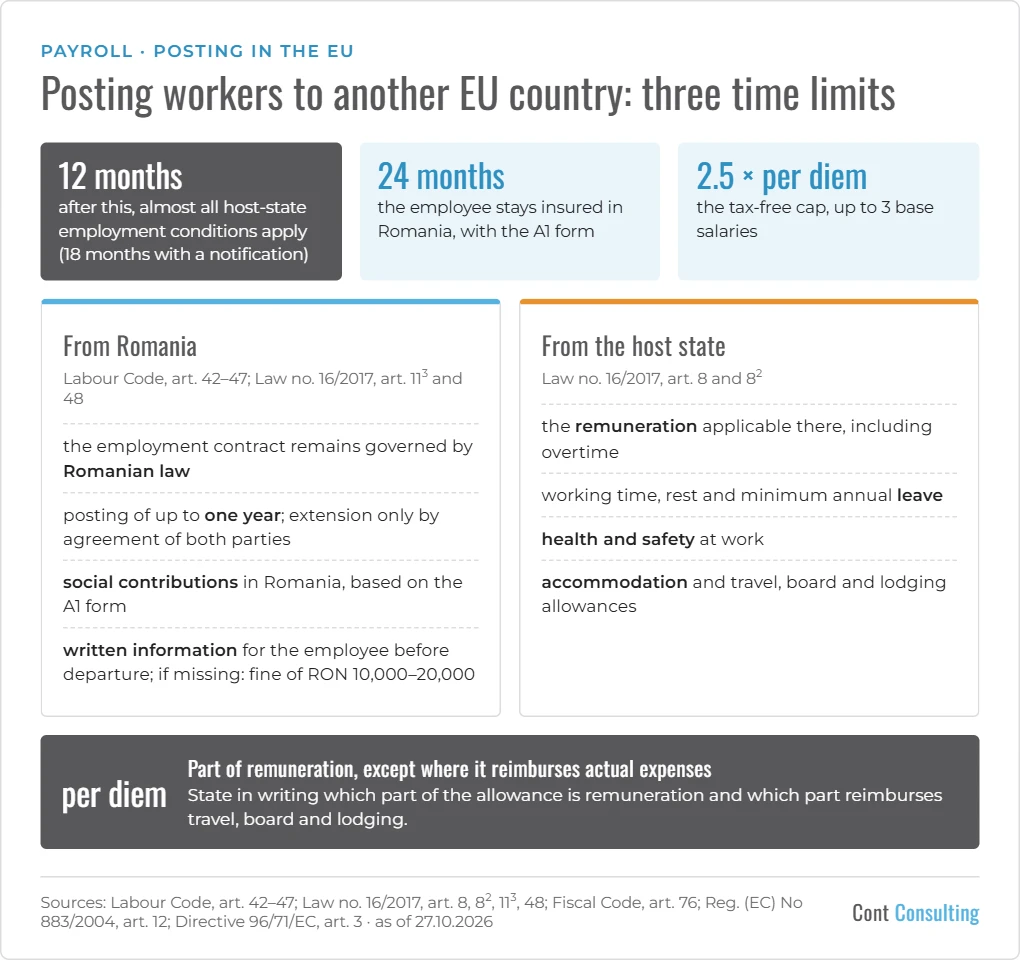
If the posting lasts more than 12 months, the employee is entitled to almost all host-state employment conditions, except the rules on concluding and terminating the contract (including non-competition clauses) and supplementary occupational pension schemes. The period can be extended to 18 months by a reasoned notification to the host-state authority (Law no. 16/2017, art. 82).
Is the per diem part of remuneration?
An allowance specific to the posting counts as part of remuneration, except for amounts that reimburse expenses actually incurred (travel, board and lodging). If the applicable terms do not show which part is reimbursement, the whole allowance is treated as reimbursement of expenses (Directive 96/71/EC, art. 3(7)). Make clear in your documents which amount is remuneration and which is reimbursement. Law no. 16/2017 says the same: the allowance specific to transnational posting is part of remuneration, except for travel, board and lodging expenses (art. 11(1) and art. 2(1)(g) and (h)).
In Romania, the per diem for work trips abroad is not taxable up to 2.5 times the statutory per diem for public sector staff, within a limit of 3 base salaries for the job (Fiscal Code, art. 76(2)(k)).
Informing the employee
Before the posting, the employer informs the employee in writing about the elements of remuneration in the host state, the total remuneration for the posting (with the allowance shown separately), travel, board and lodging expenses and how they are reimbursed, and the host state’s official website on posting (Law no. 16/2017, art. 113(1)).
The information must also include the details required by art. 18(1) of the Labour Code (art. 113(2)). For postings of up to 7 consecutive days, the information on host-state remuneration and the link to the official website are not mandatory (art. 113(3)). Failure to inform the employee is punishable by a fine of RON 10,000 to 20,000 (art. 48(4)).
Who carries out checks
The host-state conditions (art. 8) are checked by the host state’s authorities; the rest of the employment relationship is checked by the Romanian territorial labour inspectorate (art. 22(3) and (4)). If Romanian law provides more favourable conditions than the host state, Romanian law takes precedence (art. 12(2)).
Social security: the A1 form
A posted employee remains insured in Romania if the expected duration of the work does not exceed 24 months and they are not sent to replace another person (Regulation (EC) No 883/2004, art. 12(1)). This is proved with the A1 form.
Our recommendations
- Before departure, find out the remuneration and rules of the host state from its official website on posting.
- State in writing which part of the allowance is remuneration and which part reimburses expenses.
- Apply for the A1 form before departure.
- Keep track of the posting’s duration: the rules change after 12 months.
We can help calculate pay and per diem: see our payroll services.
Note: This text is valid on the date of its update, is for information only and reflects the interpretation of Cont Consulting specialists. It does not replace the legal provisions in force.
Sources: Romanian Labour Code (Law no. 53/2003), art. 42–47; Law no. 16/2017 on the posting of employees in the framework of the transnational provision of services, art. 2, 3, 5, 53, 8, 82, 9, 11, 113, 12, 22 and 48; Romanian Fiscal Code (Law no. 227/2015), art. 76(2)(k); Directive 96/71/EC, art. 3(7) (consolidated version of 30.07.2020); Regulation (EC) No 883/2004, art. 12 – as in force on 27.10.2026.