
Updated on 26 October 2026.
We are often asked this question, and three different situations are frequently confused: temporary inactivity registered with the Trade Register, a company being declared inactive by the tax authority (ANAF), and the cancellation of VAT registration. One can trigger another, but the rules differ. From 2026 the consequences are more serious: a company that is not reactivated within 1 year is dissolved.
1. Temporary inactivity at the Trade Register
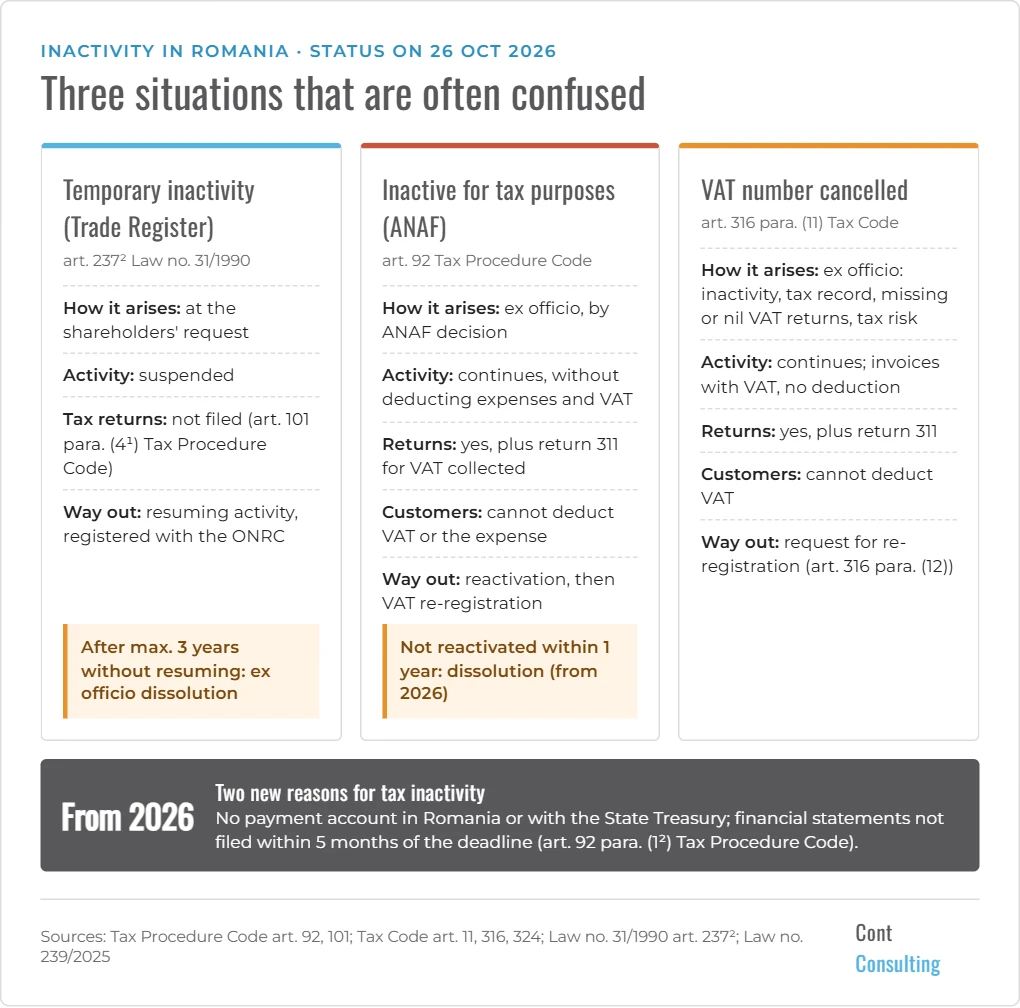
It is requested by the shareholders at the Trade Register Office (ONRC) when the company suspends its activity. The period may not exceed 3 years from registration. If the activity is not resumed when it expires, the ONRC finds ex officio that the company is dissolved (art. 237^2 para. (1) letter b) of Companies Law no. 31/1990).
During temporary inactivity, the company is not required to file tax returns, starting from the 1st day of the month following the registration of the inactivity with the Trade Register. This ends when the activity resumes or after 3 years, and returns for the activity carried out before the suspension must still be filed (art. 101 para. (4^1), (4^3) and (4^4) of the Tax Procedure Code).
Temporary inactivity registered with the Trade Register is also a reason for declaring the company inactive for tax purposes (art. 92 para. (1) letter d) of the Tax Procedure Code).
2. A company declared inactive by ANAF
ANAF declares a legal entity inactive if (art. 92 para. (1) of the Tax Procedure Code):
- it files no tax return during a calendar half-year;
- it evades tax audits by declaring tax domicile details that do not allow it to be found;
- the tax authority finds that it does not operate at its declared tax domicile;
- it has temporary inactivity registered with the Trade Register;
- the company’s term of existence has expired;
- it no longer has statutory bodies (for example, a director);
- the right to use the registered office premises has expired.
From 1 January 2026, two more reasons were added (art. 92 para. (1^2) of the Tax Procedure Code, introduced by Law no. 239/2025):
- the company has no payment account in Romania or with the State Treasury;
- it has not filed its annual financial statements within 5 months of the legal deadline.
The declaration is made by a decision communicated to the company, which is entered in the Register of inactive/reactivated taxpayers, published on the ANAF website. For third parties, the decision takes effect from the day following its entry in the register (art. 92 para. (4) and (11)–(13) of the Tax Procedure Code).
What it means for the company. The company may continue its activity, but it pays all taxes and contributions without the right to deduct the expenses and the VAT on purchases made during the period of inactivity (art. 11 para. (6) of the Tax Code). Its VAT registration is cancelled from the date it is declared inactive (art. 316 para. (11) letter a) of the Tax Code). The company continues to invoice with VAT and declares and pays the VAT collected through return 311 (art. 324 para. (10) of the Tax Code).
What it means for its customers. Those who buy from an inactive company cannot deduct the VAT or the expense (art. 11 para. (7) of the Tax Code). More details, including the CJEU ruling on this issue: VAT deduction for purchases from inactive suppliers.
3. Reactivation
The company is reactivated if (art. 92 para. (5)–(7^1) of the Tax Procedure Code):
- it has filed all tax returns;
- it has no outstanding tax liabilities;
- in addition, depending on the reason for inactivation: the tax authority finds that it operates at its declared tax domicile; it is no longer in the situation that led to inactivation (for example, the registered office has been extended, a director has been appointed); it has a payment account or has filed its financial statements.
Reactivation does not automatically restore the VAT number. VAT registration must be requested separately, and the decision takes effect from the date it is communicated (art. 316 para. (12) letter a) of the Tax Code). After re-registration, the company deducts the VAT on purchases made while its VAT number was cancelled, in the first VAT return filed (art. 11 para. (6) of the Tax Code).
4. New from 2026: dissolution after 1 year of inactivity
If a company declared inactive is not reactivated within 1 year, it is dissolved (art. 92 para. (4^1)–(4^3) of the Tax Procedure Code). For companies governed by Law no. 31/1990 (SRL, SA, etc.), the procedure is laid down in art. VIII of Law no. 239/2025:
- the ONRC publishes the list of companies at least 5 days in advance, then the registrar finds the dissolution by a ruling;
- if the company has no debts to the state budget and no one requests the appointment of a liquidator within 20 days, it is struck off ex officio;
- if it has debts, the registrar appoints a liquidator ex officio.
For companies declared inactive before 18 December 2025 that have debts to the state budget, ANAF must request their dissolution if they are not reactivated within 1 year of the entry into force of Law no. 239/2025, i.e. by 18 December 2026 (art. VII para. (6) of Law no. 239/2025).
5. Cancellation of the VAT number for other reasons
The VAT registration may also be cancelled without the company being inactive (art. 316 para. (11) of the Tax Code), for example if:
- the directors, majority shareholders or sole shareholder, or the company itself, have entries in the tax record (cazier fiscal);
- it has not filed any VAT return for 6 months or 2 consecutive quarters;
- it has filed VAT returns with no purchases and no supplies for 6 months or 2 consecutive quarters;
- it presents a high tax risk.
In these cases too, the company invoices with VAT, pays the VAT collected through return 311 and does not deduct VAT on purchases (art. 11 para. (8) and art. 324 para. (10) of the Tax Code). Its customers cannot deduct the VAT on invoices issued after its entry in ANAF’s register of cancelled VAT registrations (art. 11 para. (9) of the Tax Code).
What you can do
- Regularly check whether your company and your suppliers appear in the Register of inactive taxpayers.
- File your tax returns and financial statements on time and keep an active payment account.
- Extend the registered office agreement before it expires.
- Make sure correspondence is received at the registered office: uncollected letters from ANAF can lead to inactivation.
- If you have been declared inactive, do not issue invoices without VAT; fix the cause, pay the arrears, request reactivation and then VAT re-registration, before 1 year has passed.
Note: This text is valid as of the date of its update, is for guidance only and represents an interpretation by the specialists of Cont Consulting, and is not intended to replace the legal provisions in force. We are not liable for any damages arising from the use of this material for legal purposes or as evidence in any potential litigation.