
Updated on 26 October 2026.
In short: the Romanian Tax Code still denies the VAT deduction for purchases from suppliers declared inactive. In 2017, the Court of Justice of the European Union ruled that such a refusal, applied automatically and definitively, is contrary to the VAT Directive. The Tax Code has not been amended since that judgment, so the tax authority (ANAF) still applies the rule, and a company can defend its right of deduction only through an administrative appeal and then in court.
What the Tax Code provides
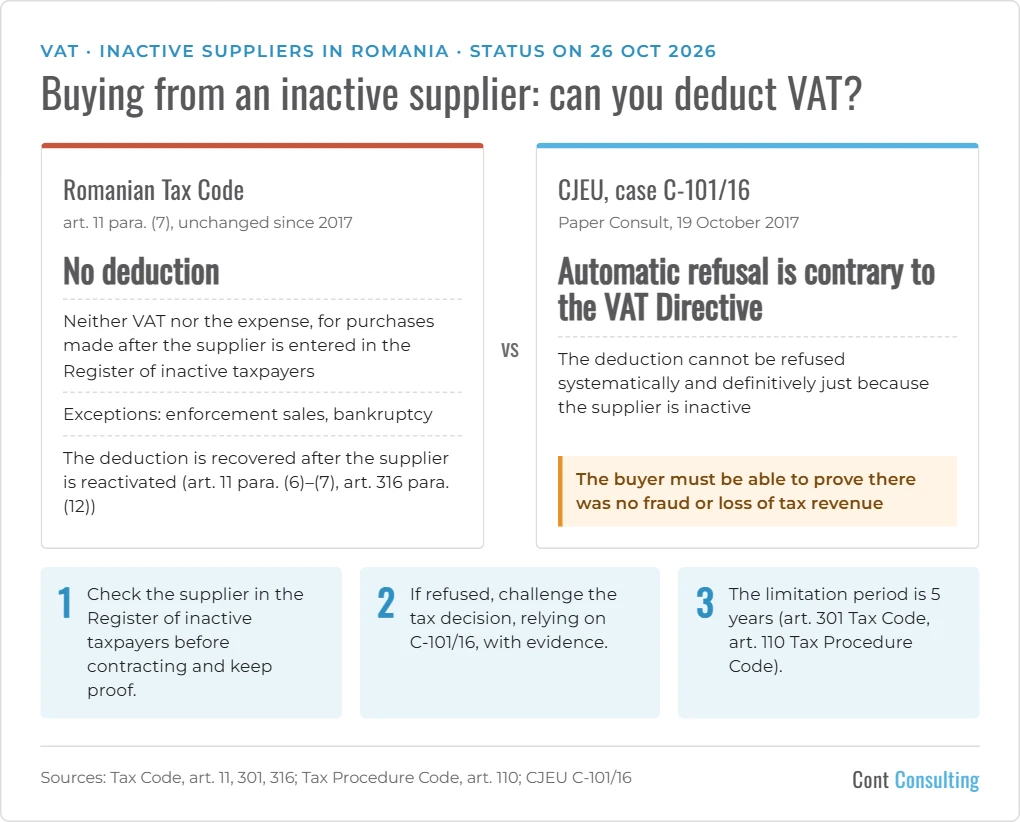
Companies that buy goods or services from a supplier after it has been entered as inactive in the Register of inactive/reactivated taxpayers are not entitled to deduct the expenses and the VAT related to those purchases (art. 11 para. (7) of the Tax Code). Exceptions: goods bought in enforcement proceedings and purchases from suppliers in bankruptcy.
The right of deduction is recovered if the supplier is reactivated and registers again for VAT purposes. The supplier then issues invoices with VAT for the period of inactivity, and the buyer deducts the VAT in the first VAT return filed after the supplier’s reactivation or in a later one (art. 11 para. (6)–(7) and art. 316 para. (12) of the Tax Code). The expenses become deductible for profit tax from the quarter of reactivation, and for previous years through an amended return (art. 11 para. (7)).
These rules have been in force since 1 January 2017 (Government Emergency Ordinance no. 84/2016) and have not been amended after the CJEU judgment.
What the CJEU decided
In case C-101/16, SC Paper Consult SRL, judgment of 19 October 2017, delivered at the request of the Cluj Court of Appeal, the Court held that Directive 2006/112/EC precludes national legislation such as the Romanian one, which systematically and definitively refuses the right of deduction solely because the supplier has been declared inactive, without allowing the buyer to prove that there was no fraud or loss of tax revenue – even though the list of inactive taxpayers is public on the internet.
The judgment does not mean that the deduction is granted automatically. The buyer must be able to prove that the transaction was real, that it did not take part in and was not aware of any fraud, and that the state did not lose VAT (for example, that the supplier declared and paid the tax).
What you can do
- Check suppliers in the Register of inactive taxpayers before contracting and keep proof of the check.
- If ANAF refuses the deduction for purchases from an inactive supplier, the tax decision can be challenged, relying on judgment C-101/16 and on evidence that there was no fraud or loss of tax revenue.
- The right of deduction can also be exercised later, but only within the 5-year limitation period laid down in the Tax Procedure Code (art. 301 para. (2) of the Tax Code, art. 110 para. (1) of the Tax Procedure Code), not 10 years, as some 2017 materials claimed.
On what it means to be declared inactive and how to get out of this situation (in Romanian): I have been declared inactive. What do I do?
Note: This text is valid as of the date of its update, is for guidance only and represents an interpretation by the specialists of Cont Consulting, and is not intended to replace the legal provisions in force. We are not liable for any damages arising from the use of this material for legal purposes or as evidence in any potential litigation.