
Published on 26 October 2026.
A case from our practice: a company paying profit tax, with quarterly filing, bought in Q1 2026 a piece of equipment eligible for the reinvested profit tax exemption. It recorded an accounting loss in Q1 and Q2, and a profit in Q3. Can it apply the exemption when calculating profit tax at 30 September 2026?
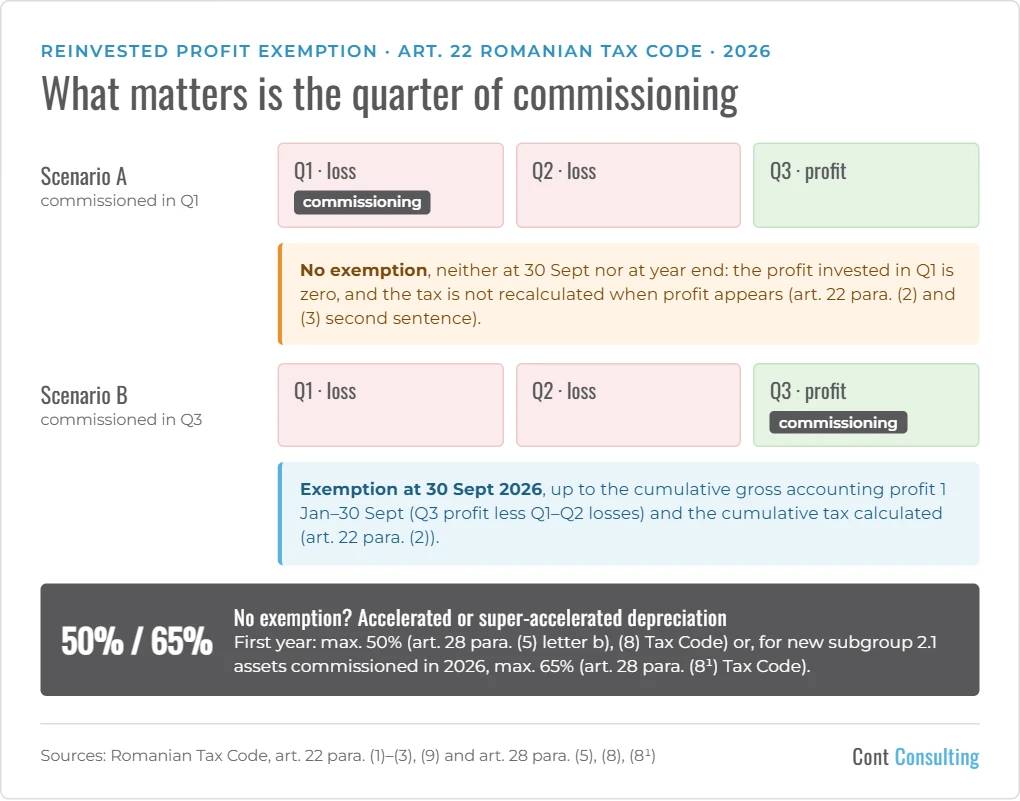
In short: no, if the equipment was put into operation in Q1. For the exemption, what matters is the quarter in which the asset is put into operation, not the quarter of purchase.
What the Romanian Tax Code says
Profit invested in technological equipment, assets used in production and processing, technological upgrades, computers and peripherals, cash registers, software and software user rights, acquired or produced and put into operation, is exempt from tax (art. 22 para. (1) of the Tax Code).
The invested profit is the cumulative gross accounting profit from the beginning of the year, earned up to the quarter in which the assets are put into operation. The exemption is granted up to the profit tax calculated cumulatively from the beginning of the year up to the quarter of commissioning (art. 22 para. (2) of the Tax Code).
For the situation in this case, the law has an express rule: where an accounting loss is recorded in the quarter in which the assets are put into operation, and an accounting profit is recorded in the following quarter or at year end, the profit tax related to the invested profit is not recalculated (art. 22 para. (3) second sentence of the Tax Code).
Applying the rules to the case
- The equipment was put into operation in Q1, and at 31 March 2026 the company had a cumulative accounting loss. The invested profit is zero, so there is no tax against which the exemption could be granted.
- The Q3 profit cannot be used for an asset put into operation in Q1. The incentive is not carried forward to later quarters or to year end (art. 22 para. (3) second sentence).
- Profit tax at 30 September 2026 and at the annual adjustment is calculated without the exemption for this equipment.
When the answer would be different
- The equipment was only put into operation in Q3 (for example, after installation, with a commissioning report dated July–September). The exemption then applies at 30 September 2026, up to the cumulative gross accounting profit for 1 January–30 September, i.e. the Q3 profit less the Q1–Q2 losses, and up to the tax calculated cumulatively to that date (art. 22 para. (2)).
- There was a cumulative gross accounting profit at 31 March. The exemption then applied in Q1, up to that profit.
This is why the date of commissioning must be checked in the documents: the acceptance and commissioning report and the fixed asset record.
The alternative: accelerated or super-accelerated depreciation
If the exemption does not apply, the company can recover the cost of the equipment faster through depreciation:
- accelerated depreciation: up to 50% of the tax value in the first year of use, for technological equipment (machines, tools and working installations), computers and peripherals (art. 28 para. (5) letter b) and para. (8) of the Tax Code);
- super-accelerated depreciation: up to 65% of the tax value in the first year, for new assets in subgroup 2.1 – Technological equipment, acquired or produced and put into operation in 2026 (art. 28 para. (8^1) of the Tax Code, introduced by Government Emergency Ordinance no. 8/2026).
The ban on combining the exemption with accelerated or super-accelerated depreciation applies only to the assets for which the exemption is applied (art. 22 para. (9) of the Tax Code). Moreover, for 2026, taxpayers applying the exemption for technological equipment or computers may still opt for accelerated depreciation, but not for super-accelerated depreciation.
Conclusion
For the reinvested profit exemption, the decisive moment is the quarter in which the asset is put into operation. If the company has a cumulative accounting loss in that quarter, the exemption is lost for that asset, even if a profit appears later in the same year. When planning an investment, it is worth aligning the commissioning date with the cumulative result for the quarter. We can help you with this planning – see Tax and Accounting Consulting.
The general rules of the exemption, the qualifying assets and the step-by-step calculation are explained in Reinvested profit tax exemption in Romania in 2026: qualifying assets and calculation.
Note: This text is valid as of the date of its publication, is for guidance only and represents an interpretation by the specialists of Cont Consulting, and is not intended to replace the legal provisions in force. We are not liable for any damages arising from the use of this material for legal purposes or as evidence in any potential litigation.