
Updated on 26 October 2026.
The Romanian micro-enterprise income tax is optional (art. 48 para. (1) of the Tax Code). From 1 January 2026 there is a single rate of 1% (art. 51 para. (1), as amended by Government Emergency Ordinance (GEO) no. 89/2025). The revenue ceiling has dropped to EUR 100,000, and GEO no. 8/2026 changed several calculation and exit rules in February. Below are the conditions in force and the situations in which a company moves to profit tax.
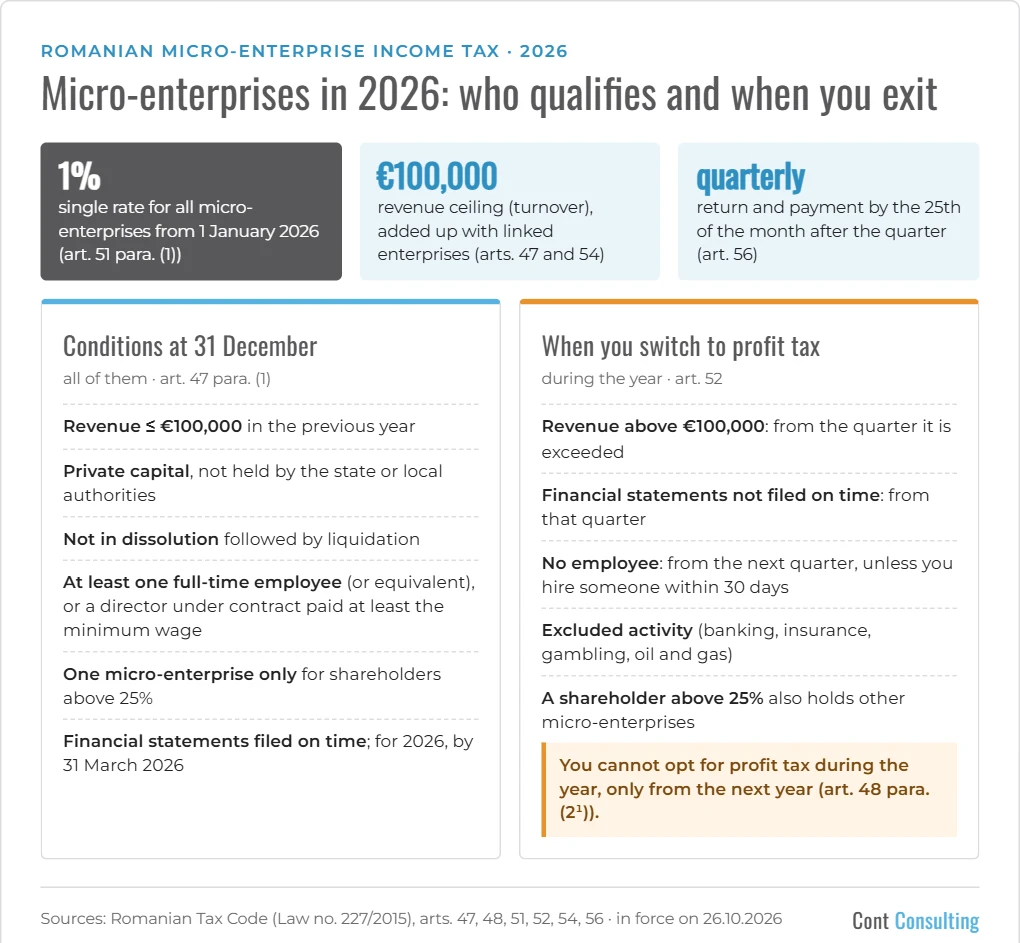
Who can pay micro-enterprise tax in 2026
A Romanian legal entity is a micro-enterprise if, on 31 December of the previous year, it meets all of the following conditions (art. 47 para. (1)):
- its revenue did not exceed EUR 100,000 (letter c)). The revenue counted is the turnover (art. 54 para. (1)), added up with that of linked enterprises, i.e. companies connected by a direct or indirect holding above 25% or by the right to appoint the director (art. 47 para. (1^1)). The euro equivalent is calculated at the exchange rate at the end of the financial year in which the revenue was recorded. For 2026, the ceiling is checked against revenue at 31 December 2025 (art. 54 para. (3));
- its share capital is not held by the state or by local authorities (letter d));
- it is not in dissolution followed by liquidation, registered with the trade register or a court (letter e));
- it has at least one employee (letter g)). An employee means a full-time individual employment contract. The condition is also met by several part-time contracts that add up to one full-time position, or by a management or mandate contract paid at least the national gross minimum wage (art. 51 para. (4));
- shareholders holding more than 25% have only one micro-enterprise (letter h)). If they hold more than 25% in several qualifying companies, they choose by 31 March which one stays a micro-enterprise. The others pay profit tax (art. 47 para. (4));
- it filed its annual financial statements on time (letter i)). For 2026, this condition is considered met if the financial statements were filed by 31 March 2026 inclusive (art. 48 para. (2)).
Regardless of revenue, companies in banking, insurance and reinsurance, capital markets (with an exception for certain secondary insurance intermediaries), gambling, and oil and gas exploration and production cannot be micro-enterprises (art. 47 para. (3)).
Newly established companies
A new company can pay micro-enterprise tax from its first year if, on registration, it meets the conditions on capital (letter d)) and shareholders (letter h)), and hires an employee within 90 days. If it does not hire within that period, it owes profit tax from the quarter following the one in which the 90 days expire (art. 48 para. (3)).
Returning to the micro-enterprise regime after leaving it
Until 25 February 2026, art. 48 para. (2) allowed the option only for companies that had “not been liable to micro-enterprise income tax after 1 January 2023”. The current wording of the paragraph, rewritten by GEO no. 8/2026, no longer contains this condition. However, art. 48 para. (2^2), which applies to HoReCa companies, still refers to it, and by the date of this update we have not found an official ANAF position. If your company left the micro-enterprise regime after 1 January 2023 and wants to return, we recommend reviewing your situation before notifying the option.
Rate and tax base
The tax is 1% (art. 51 para. (1)). It applies to revenue from any source, from which the following are deducted, among others: revenue relating to the cost of finished goods inventory and services in progress, revenue from own production of fixed assets, subsidies, foreign exchange gains, trade discounts granted after invoicing (account 709), dividends received from Romanian legal entities and the bonus granted by the tax authority (art. 53 para. (1)). Trade discounts received after invoicing (account 609) and, in certain cases, reserves are added to the base (art. 53 para. (2)).
When a company moves to profit tax during the year
A micro-enterprise cannot opt for profit tax during the year, only from the following year (art. 48 para. (2^1)). It must, however, move to profit tax in the following situations:
- its revenue exceeds EUR 100,000, cumulated from the start of the year, from the quarter in which the ceiling is exceeded (art. 52 para. (1)). The exchange rate used is the one at the end of the previous financial year (art. 52 para. (5)). Revenue from the sale of fixed assets or land is added if, during the year, more than one asset from the same subgroup or more than one plot of land is sold (art. 54 para. (1)). For linked enterprises, their revenue is also added (art. 52 para. (5^1));
- it did not file its financial statements on time for the previous year, from the quarter in which the condition is no longer met (art. 52 para. (2));
- it no longer has an employee, from the quarter following the one in which the contract ended. If the company had only one employee, it remains a micro-enterprise if it hires another within 30 days, under an indefinite contract or one of at least 12 months (art. 52 para. (3)). A suspension of the contract shorter than 30 days, recorded for the first time in that year, does not affect the condition (art. 48 para. (3^1)). Neither does the employee’s sick leave, if it does not exceed 30 days in total over the year (art. 48 para. (3^3));
- it starts an excluded activity (banking, insurance, capital markets, gambling, oil and gas), from that quarter (art. 52 para. (4));
- a shareholder holding more than 25% comes to hold other micro-enterprises: the shareholders decide which company leaves the regime, from that quarter, and notify ANAF (art. 52 para. (7)).
Temporary inactivity
A company in temporary inactivity registered with the trade register remains liable to micro-enterprise tax for the whole period of inactivity (art. 48 para. (2^3)). When it resumes activity, it remains a micro-enterprise if it meets the conditions on capital, shareholders and financial statements, and hires an employee within 30 days of registering the resumption (art. 48 para. (3^2)).
Filing and payment
The tax is calculated and paid quarterly, by the 25th of the month following the quarter (art. 56 para. (1)). The micro-enterprise income tax return is filed by the same deadline (art. 56 para. (2)).
What changed compared to 2025
- Revenue ceiling: EUR 250,000 in 2025 (art. 54 para. (3)), EUR 100,000 from 2026 (art. 47 para. (1) letter c)).
- Rate: in 2025, 1% or 3% depending on revenue and activity; from 2026, 1% for all micro-enterprises (art. 51 para. (1)).
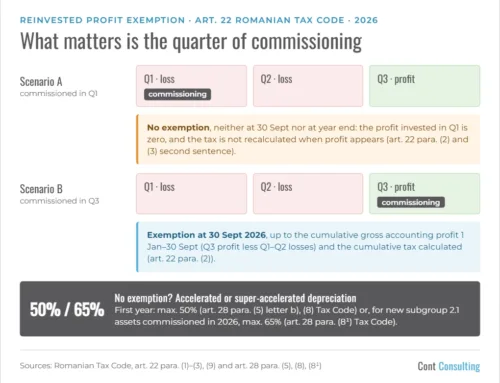
If your company has moved to profit tax, it may apply the reinvested profit exemption for equipment and software put into use: see Tax exemption of reinvested profit. To check how your company qualifies, see our Accounting services.
Note: This text is valid on the date of the update, is for information only and reflects the interpretation of Cont Consulting’s specialists. It does not replace the legal provisions in force.
Sources: Romanian Tax Code (Law no. 227/2015), arts. 47, 48, 51, 52, 53, 54, 56, consolidated version on legislatie.just.ro, checked on 26.10.2026.