
Updated on 26 October 2026.
Paid annual leave is a guaranteed right of every employee in Romania, and neither the employee nor the employer can limit it. Below are the Labour Code rules in force in 2026 and what changed after the March 2026 decision of the High Court of Cassation and Justice on untaken leave.
The right to annual leave
The right to paid annual leave is guaranteed to all employees and cannot be assigned, waived or limited (art. 144 of the Labour Code). A clause by which the employee gives up their leave has no effect.
When calculating the leave an employee is entitled to, the following periods count as time worked (art. 145(4)):
- sick leave (temporary incapacity for work);
- maternity leave, paternity leave and maternity risk leave;
- leave to care for a sick child and carer’s leave;
- absences for family emergencies, up to 10 working days a year (art. 1522).
Even if the employee was on sick leave for the whole year, they keep the right to annual leave for that year. The employer must grant it within 18 months starting with the following year (art. 145(6)).
Unpaid leave is not among the periods that count as time worked (art. 145(4)). In our interpretation, no annual leave accrues during unpaid leave, because the employment contract is suspended by agreement of the parties and no work is performed (art. 54). The Labour Code does not say so expressly, so the collective or individual employment contract may set a different rule.
Length of the leave
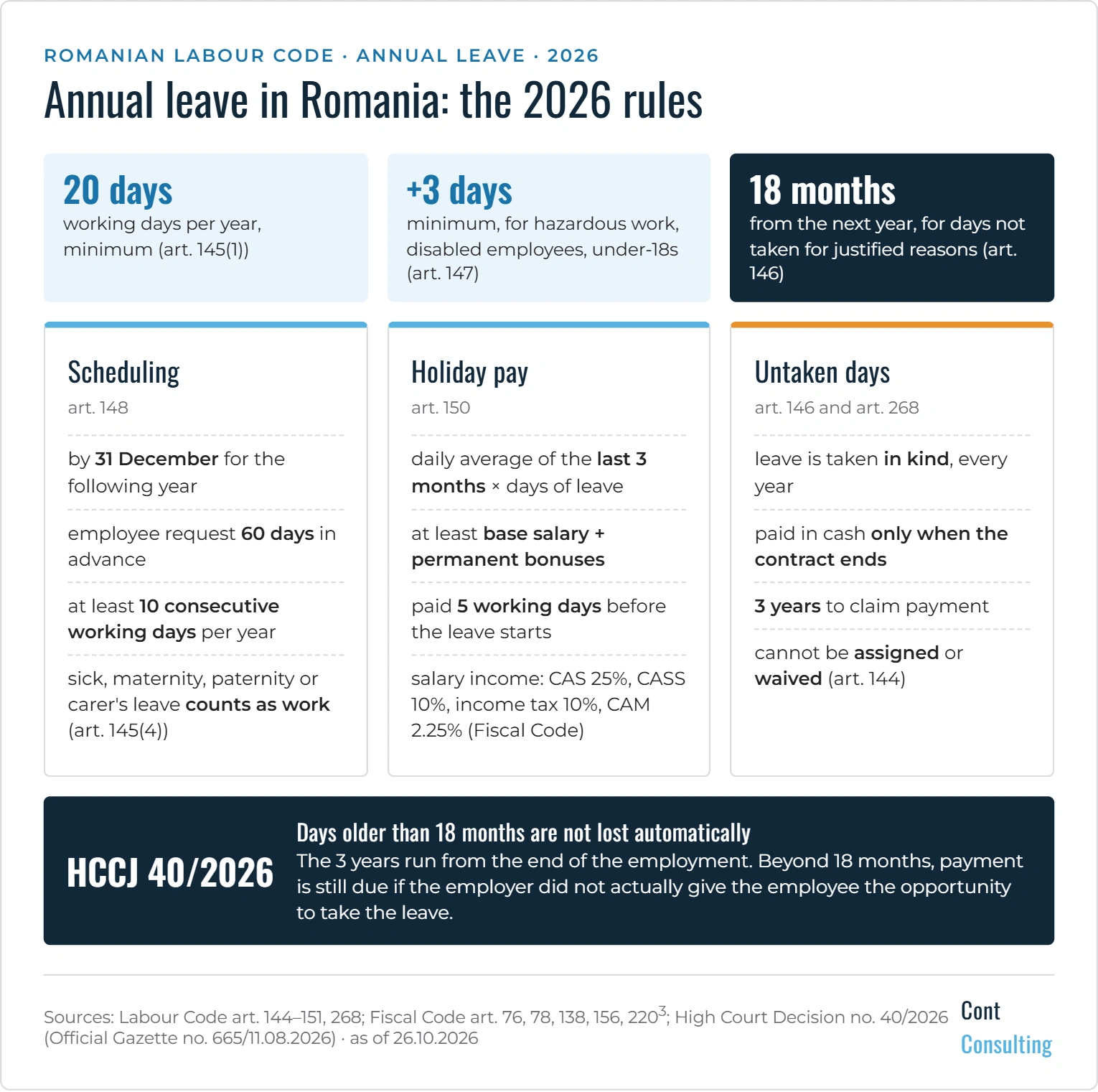
The minimum is 20 working days a year (art. 145(1)). The actual length is set in the individual employment contract, in line with the law and the applicable collective agreement (art. 145(2)). Public holidays on which no work is done and paid days off granted by the collective agreement are not counted as leave (art. 145(3)).
Employees working in hard, dangerous or harmful conditions, blind employees, other employees with disabilities and young people under 18 are entitled to additional leave of at least 3 working days (art. 147).
Scheduling the leave
Leave is scheduled by the end of each year for the following year (art. 148):
| Type of schedule | Who is consulted | Rule |
|---|---|---|
| Collective | the trade union or the employees’ representatives | periods of at least 3 months, by staff category or workplace |
| Individual | the employee | a fixed date or a period of no more than 3 months |
Within these periods, the employee may ask to take the leave at least 60 days in advance. If the leave is split, the employer must ensure that each employee has at least 10 consecutive working days of leave in a year.
The employee must actually take the leave in the scheduled period, except where the law provides otherwise or where, for objective reasons, the leave cannot be taken (art. 149).
Holiday pay
For the days of leave, the employee receives holiday pay that cannot be lower than the base salary, allowances and permanent bonuses set in the individual employment contract (art. 150(1)).
Holiday pay is the daily average of these salary entitlements over the last 3 months before the month in which the leave is taken, multiplied by the number of days of leave (art. 150(2)). It is paid at least 5 working days before the leave starts (art. 150(3)).
Interrupting the leave
The employee may ask to interrupt the leave for objective reasons. The employer may recall the employee only in case of force majeure or for urgent interests; in that case it bears all the costs of the employee and their family for the return, as well as any damage suffered (art. 151).
If sick leave, maternity leave, maternity risk leave or leave to care for a sick child begins during annual leave, the annual leave is interrupted. The remaining days are taken after that situation ends or are rescheduled (art. 145(5)).
Untaken leave
Leave is taken every year. If the employee cannot take it for justified reasons, the employer must grant it, with the employee’s agreement, within 18 months starting with the following year (art. 146(1) and (2)). Example: leave not taken in 2026 must be granted by 30 June 2028.
Untaken leave is paid in cash only when the employment contract ends (art. 146(3)). Until then, paying for leave in cash is not allowed.
What the High Court decided in 2026
In Decision no. 40/2026 (a preliminary ruling on a point of law, published in Official Gazette no. 665 of 11 August 2026 and binding on the courts), the High Court of Cassation and Justice held that:
- The 3-year limitation period for claiming payment of untaken leave (art. 268(1)(c) of the Labour Code) runs from the end of the employment, not from the end of the year for which the leave was due.
- For days older than the 18-month carry-over period, the right to payment remains if the employer did not actually give the employee the opportunity to take the leave.
- The right no longer exists if the employee had the opportunity to take the leave and chose not to.
For employers, this means untaken leave is not automatically “lost” after 18 months. It is worth keeping evidence that employees could actually take their leave: the annual schedule, approved requests, and messages reminding them of their remaining days.
Tax and social contributions
Holiday pay and the cash payment for untaken leave made when the contract ends are salary income. The Fiscal Code treats as salary income all income obtained under an employment contract, whatever period it relates to and whatever it is called (art. 76(1) of the Fiscal Code). In 2026 the same rates apply as for salary:
| Contribution / tax | Borne by | Rate | Legal basis (Fiscal Code) |
|---|---|---|---|
| Social security contribution (CAS) | employee | 25% | art. 138(a) |
| Health insurance contribution (CASS) | employee | 10% | art. 156 |
| Income tax | employee | 10%, after deducting contributions and, where applicable, the personal deduction | art. 78(2)(a) |
| Work insurance contribution (CAM) | employer | 2.25% | art. 2203(1) |
For special or particular working conditions, the employer also owes an additional CAS of 4% or 8% respectively (art. 138(b) and (c)).
If you need help with leave scheduling, holiday pay calculations or untaken leave, see our payroll and human resources services.
Note: This text is valid at the date of the update, is for information purposes and represents the interpretation of Cont Consulting’s specialists. It does not replace the legal provisions in force.
Sources: Romanian Labour Code (Law no. 53/2003, republished), art. 54, 144–1522 and 268; Decision no. 40/2026 of the High Court of Cassation and Justice (Official Gazette no. 665 of 11.08.2026); Fiscal Code (Law no. 227/2015), art. 76, 78, 138, 156 and 2203. Consolidated text checked on 26.10.2026.