
Updated on 27 October 2026.
Under the Romanian Labour Code, the rule is the open-ended employment contract (art. 12(1)). A fixed-term contract is an exception: it can be concluded only in the cases and on the conditions set by law (art. 12(2) and art. 82(1)).
When you can use a fixed-term contract
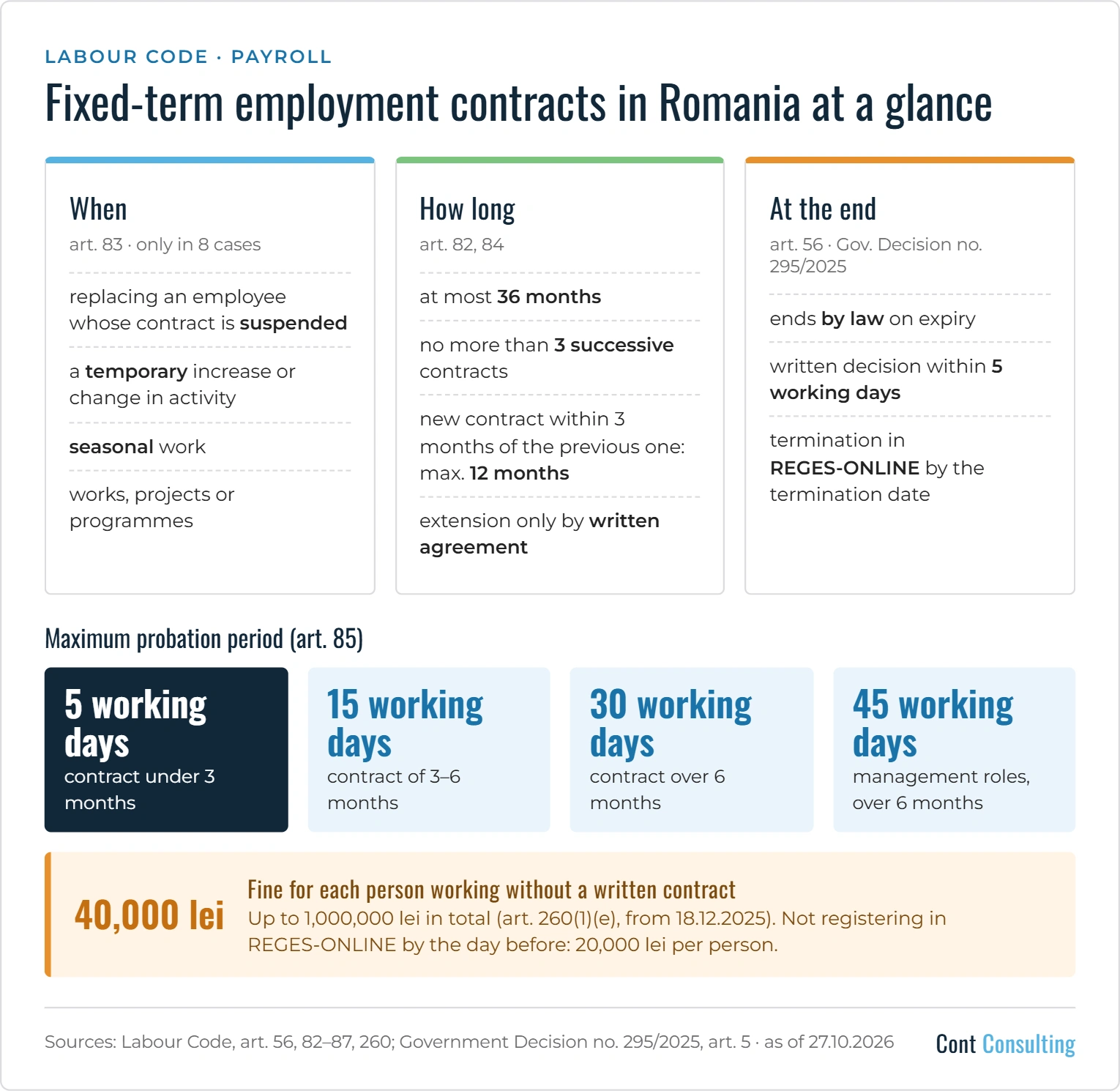
Only in the cases listed in art. 83:
- replacing an employee whose contract is suspended, except an employee on strike;
- a temporary increase and/or change in the structure of the employer’s activity;
- seasonal work;
- hiring under legal provisions meant to temporarily favour certain groups of unemployed people;
- hiring a person who, within 5 years of being hired, will meet the conditions for an old-age pension;
- filling an elected position in a trade union, employers’ organisation or NGO, for the term of office;
- hiring pensioners who may lawfully combine their pension with a salary;
- other cases expressly provided for by special laws, or for works, projects or programmes.
The list is exhaustive. Keep the documents showing which case applies, for example the suspension of the replaced employee’s contract or the project contract.
Form of the contract
- The contract must be in writing and state its duration expressly (art. 82(2)).
- The contract must be registered in REGES-ONLINE, the electronic employee register, no later than the day before work starts (art. 16(2) of the Labour Code; Government Decision no. 295/2025, art. 5(1)(a)).
- Employing someone without a written contract is fined 40,000 lei per person, up to 1,000,000 lei in total. Not registering the contract in REGES-ONLINE by the day before work starts is fined 20,000 lei per person, up to 200,000 lei (art. 260(1)(e) and (e1)).
- If you are replacing an employee whose contract is suspended, the contract ends when the reasons for the suspension end (art. 84(2)). We recommend naming the position and the employee being replaced in the contract, so it is clear when it ends.
How long it can last
| Rule | What the law says | Legal basis |
|---|---|---|
| Maximum duration | 36 months | art. 84(1) |
| Successive contracts between the same parties | no more than 3 | art. 82(4) |
| Contract concluded within 3 months after a fixed-term contract ends | counts as a successive contract and cannot exceed 12 months | art. 82(5) |
| Extension | after the initial term, by written agreement of the parties, for the duration of a project, programme or work, in the cases under art. 83 | art. 82(3) |
Example: if you rehire the same person on a fixed-term contract two months after the previous one expired, the new contract is a successive contract and can last at most 12 months. An extension must be registered in REGES-ONLINE no later than the day before it takes effect (Government Decision no. 295/2025, art. 5(3)).
Probation period
| Contract duration | Maximum probation period |
|---|---|
| under 3 months | 5 working days |
| 3 to 6 months | 15 working days |
| over 6 months | 30 working days |
| over 6 months, management positions | 45 working days |
Legal basis: art. 85. During or at the end of the probation period, either party can end the contract by written notice, without a notice period and without giving reasons (art. 31(3)).
The employee’s rights
- A fixed-term employee may not be treated less favourably than a comparable permanent employee solely because of the contract’s duration, unless different treatment is justified on objective grounds (art. 87).
- The employee must be informed about vacancies, current or upcoming, that match their qualifications, and must have equal access to them. The information is given by a notice posted at the employer’s premises, with a copy sent to the trade union or employee representatives (art. 86).
End of the contract
- The contract ends by law when its term expires (art. 56(1)(i)). The employer records the termination in a written decision within 5 working days and communicates it to the employee within 5 working days (art. 56(2)). The termination must be registered in REGES-ONLINE no later than the termination date (Government Decision no. 295/2025, art. 5(1)(f)).
- If the employer dismisses the employee before the term on the grounds in art. 61(c) and (d), art. 65 or 66, the notice period is at least 20 working days (art. 75(1)).
- If the employee resigns, the notice period is the one in the employment contract or collective agreement, but no more than 20 working days for non-management positions and 45 for management positions (art. 81(4)).
- The rules on collective redundancies do not apply to these contracts, except for dismissals made before the contracts expire (art. 74(6)).
What we recommend
- State in the contract which case under art. 83 applies and keep the evidence.
- Keep track of the contracts with each employee: no more than 3 successive contracts, at most 36 months, and 12 months for contracts concluded within 3 months of the previous one.
- Register the contract, any extension and the termination in REGES-ONLINE on time.
- Issue the decision recording the termination within 5 working days after the term expires.
We can help with employment contracts and REGES-ONLINE: see our payroll services.
Note: This text is valid on the date of its update, is for information only and reflects the interpretation of Cont Consulting specialists. It does not replace the legal provisions in force.
Sources: Romanian Labour Code (Law no. 53/2003, republished), art. 12, 16, 31, 56, 74, 75, 81–87 and 260, as amended, including by Law no. 239/2025; Government Decision no. 295/2025, art. 5 – as in force on 27.10.2026.