

Updated on 27 October 2026.
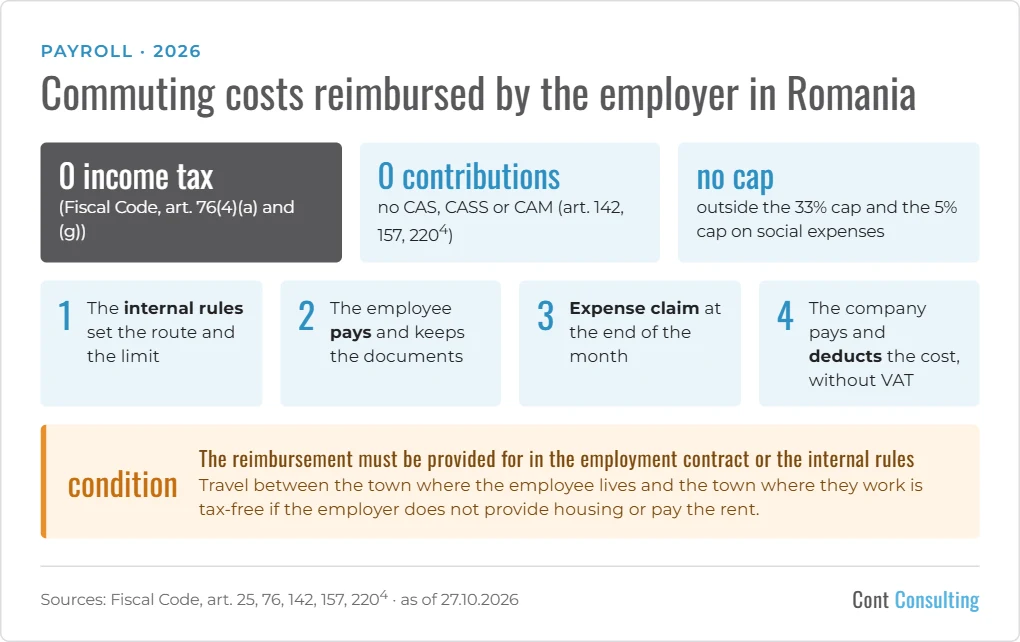
In Romania, an employer can reimburse employees for the cost of travelling to and from work without the amount being subject to income tax or social contributions, provided the reimbursement is set out in the employment contract or the internal rules. The Fiscal Code sets no cap on these amounts.
Two tax-free situations
| Situation | Legal basis (Fiscal Code) |
|---|---|
| Travel to and from work, provided for in the employment contract or the internal rules | art. 76(4)(a) |
| Travel between the town where the employee lives and the town where they work, if the employer does not provide housing or pay the rent | art. 76(4)(g) |
These amounts do not count towards the monthly cap of 33% of base salary in art. 76(41), which applies to other benefits (for example meals, accommodation and voluntary pension contributions).
The 2015 Fiscal Code removed the limit in the former Code (Law no. 571/2003), which capped the reimbursement at the price of a monthly pass.
Social contributions
The amounts are not included in the base for pension contributions (CAS, art. 142(b) and (f)), health contributions (CASS, art. 157(2)) or the work insurance contribution (CAM, art. 2204(2)).
For the company
- The cost is deductible for corporate income tax, like any expense incurred for the business (art. 25(1)). It is not one of the social expenses capped at 5% (art. 25(3)(b)).
- The VAT on the employee’s receipts or tickets cannot be deducted: the purchase is the employee’s, not the company’s.
How to set up the reimbursement
- Set out in the internal rules or the employment contract who is reimbursed, for which route and up to what limit (for example the price of a pass or a number of kilometres).
- The employee pays for the travel (tickets, a pass or fuel for their own car) and keeps the documents. For fuel, we recommend that the employee asks for the receipt without the company’s tax code, because the purchase is theirs.
- At the end of the month, the employee submits an expense claim with the supporting documents.
- The company pays the amount, within the set limits, and records it as an expense, without deducting VAT.
We can help with internal rules and payroll: see our payroll services.
Note: This text is valid on the date of its update, is for information only and reflects the interpretation of Cont Consulting specialists. It does not replace the legal provisions in force.
Sources: Romanian Fiscal Code (Law no. 227/2015), art. 25, 76, 142, 157 and 2204 – as in force on 27.10.2026.