
Published on 27 October 2026.
Can you set up a joint-stock company (SA) in Romania that raises money from individuals and companies on a regular basis by selling shares? The answer depends on the mechanism chosen and on how the shares are offered.
In short: yes, and the SA is the right form. The legal mechanism, however, is not a free “sale” of shares by the company, but an issue of new shares through successive share capital increases, respecting the pre-emption right of existing shareholders. If the shares are offered to the public, capital markets rules also apply, under the supervision of ASF, the Financial Supervisory Authority. How the offer is structured determines the costs and formalities.
What the law requires for an SA
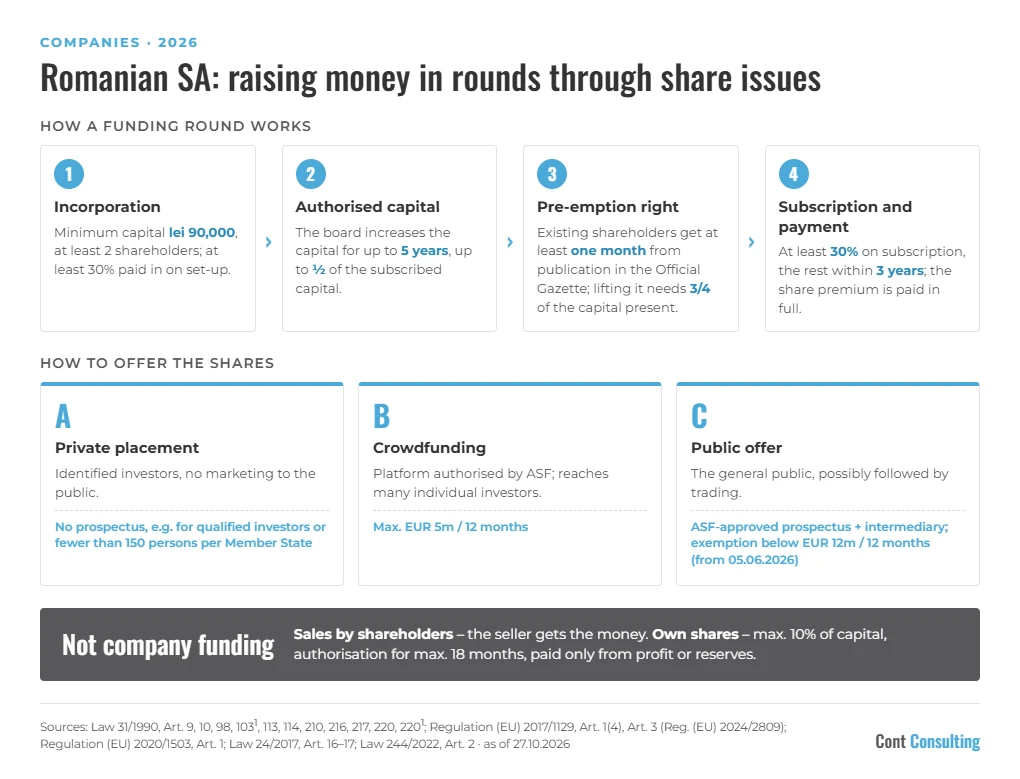
- Minimum share capital of lei 90,000 (Art. 10(1) of Companies Law 31/1990) and at least 2 shareholders (Art. 10(3)).
- An SA is set up either by full and simultaneous subscription of the capital by the signatories of the articles of association, or by public subscription (Art. 9(1)). For a public subscription, the founders draw up an issue prospectus, signed in authenticated form and filed with the Trade Register (Art. 18(1) and (2)).
- With simultaneous subscription, at least 30% of the subscribed capital is paid in on incorporation, and the rest, for cash contributions, within 12 months of registration (Art. 9(2)(a)).
- Shares are registered shares only and may be issued on paper or in dematerialised form, recorded in the shareholders’ register (Art. 91).
In practice, we recommend incorporation by simultaneous subscription by the founders, with investors coming in later through capital increases.
The mechanism: successive capital increases
Issuing new shares. Share capital may be increased by issuing new shares in exchange for new cash and/or in-kind contributions (Art. 210(1)). The money paid by investors goes into the company and funds its business.
Delegation to the board of directors. Capital increases are a matter for the extraordinary general meeting (Art. 113(f)), but this power may be delegated to the board of directors or the management board, through the articles of association or an extraordinary general meeting resolution (Art. 114(1)). Periodic rounds then run faster.
Authorised capital is the right tool for periodic share issues (Art. 2201):
- the board may be authorised to increase the capital up to a set nominal value, for up to 5 years from registration of the company when the authorisation is in the articles, or from registration of the amendment when the general meeting grants it later (paragraphs (1) and (2));
- the authorised capital may not exceed half of the subscribed share capital existing at the time of the authorisation (paragraph (3));
- the board may also be given the power to restrict or lift the shareholders’ pre-emption right, with the quorum and majority of Art. 217(3) (paragraph (4)).
The pre-emption right. New shares are first offered to existing shareholders, pro rata to their holdings (Art. 216(1)). The exercise period may not be shorter than one month from publication of the resolution or decision in Part IV of the Official Gazette; after it expires, the shares may be offered to the public (Art. 216(2)). A capital increase made in breach of these rules is voidable (Art. 216(3)).
For new investors to come in directly, the pre-emption right may be restricted or lifted only by a resolution of the extraordinary general meeting, based on a written report of the board setting out the reasons and how the issue price is determined. The resolution is passed with shareholders holding three quarters of the subscribed capital present, by a majority of the votes of those present, and is published in the Official Gazette (Art. 217).
Paying for the shares and the share premium. Shares issued for cash contributions are paid at least 30% of their nominal value on subscription and in full within 3 years of publication of the resolution; any share premium is paid in full on subscription (Art. 220(1) and (3)). Through the share premium, investors in later rounds pay a price above nominal value that reflects the company’s higher value, and the initial shareholders are protected.
What does not work as funding
- Selling own shares. The company may buy back and later resell its own shares only under strict conditions: authorisation by the extraordinary general meeting for up to 18 months, at most 10% of the subscribed capital, fully paid-up shares only, payment only from distributable profit or available reserves (Art. 1031(1)). It is not a funding route.
- Sales by existing shareholders. Shares are transferred by a declaration in the shareholders’ register signed by the transferor and the transferee (Art. 98(1)). The price goes to the selling shareholder, not to the company.
When the shares are offered to the public
A communication to persons, in any form, presenting enough information about the offer and the shares to enable an investor to decide to buy them is an offer of securities to the public (Art. 2(d) of Regulation (EU) 2017/1129). In that case:
- the shares may be offered to the public only after a prospectus has been published (Art. 3(1) of Regulation (EU) 2017/1129), approved by ASF, the competent authority in Romania (Art. 16(1) of Law 24/2017);
- a public offer for sale is made through an intermediary or a syndicate of intermediaries (Art. 17 of Law 24/2017);
- responsibility for the information in the prospectus lies at least with the issuer or its management bodies, the offeror or the guarantor, as the case may be (Art. 11(1) of Regulation (EU) 2017/1129).
No prospectus is needed, for example, for an offer addressed solely to qualified investors or to fewer than 150 natural or legal persons per Member State other than qualified investors (Art. 1(4)(a) and (b) of the Regulation). From 5 June 2026, offers below EUR 12,000,000 per issuer or offeror, calculated over 12 months, that are not subject to notification to other Member States are also exempt (Art. 3(2), as amended by Regulation (EU) 2024/2809); Member States may opt for a EUR 5,000,000 threshold instead (Art. 3(2a)). In Law 24/2017 and ASF Regulation 5/2018, in their current form, Romania has not opted for the EUR 5,000,000 threshold, so the EUR 12,000,000 threshold applies. ESMA has not yet published the updated list of national thresholds, so we recommend confirming with ASF before the offer. Whether each round falls under an exemption must be analysed separately, before launch. A public offer made in breach of these rules exposes the company and its management to ASF sanctions.
Crowdfunding. Shares may also be offered through an authorised crowdfunding platform, for offers of up to EUR 5,000,000 over 12 months (Art. 1(2)(c) of Regulation (EU) 2020/1503). ASF authorises and supervises the providers of these services (Art. 2(1) of Law 244/2022). The same route is open to the shares of an SRL, if its articles allow them to be transferred freely (Art. 3(2) and (3) of Law 244/2022).
Three ways to structure the offer
| Route | What it involves | Main requirements |
|---|---|---|
| A. Private placement | An issue to identified investors, without marketing to the public. The simplest and fastest. | The Law 31/1990 formalities: resolution or decision to increase the capital, lifting the pre-emption right, Trade Register filing, publication in the Official Gazette. Falling under a prospectus exemption. |
| B. Crowdfunding | The shares are offered through an authorised platform. Reaches many investors, including individuals. | Contract with an authorised provider; at most EUR 5,000,000 over 12 months; key investment information sheet. |
| C. Public offer | The shares are offered to the general public, possibly with admission to trading. Investors can resell easily. | ASF-approved prospectus; authorised intermediary; higher costs and reporting. |
Recommended steps
- Define the investor profile (how many, individuals or professional investors) and the amount to be raised over the next 12 months.
- Choose the route: private placement, crowdfunding or public offer.
- Draft the articles of association with: a board of directors, authorised capital, delegation of capital increases and, where relevant, of restricting or lifting the pre-emption right.
- Set the pricing policy (nominal value and share premium) and the investor documents (information memorandum, subscription form).
- For each round: the decision to increase the capital, publication in the Official Gazette, the pre-emption period (unless lifted), subscription and payment, updating the shareholders’ register and registering the increase with the Trade Register.
Conclusion
An SA that raises money from investors in rounds is built through its articles of association: authorised capital, powers delegated to the board and clear rules on the pre-emption right. The choice between private placement, crowdfunding and a public offer is made before the first round, because the prospectus, the intermediary and the role of ASF depend on it. We analyse the tax aspects (share premiums, dividends, gains on share transfers) separately. We can help – see Tax and Accounting Consulting.
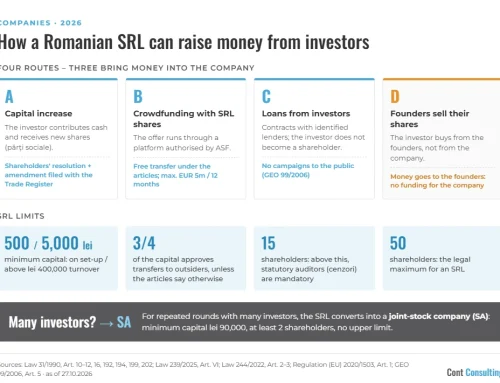
If there are only a few investors, an SRL may be enough: read How a Romanian SRL can raise money from investors: capital increase, crowdfunding or loans.
Note: This text is valid as of the date of its publication, is for guidance only and represents an interpretation by the specialists of Cont Consulting, and is not intended to replace the legal provisions in force. We are not liable for any damages arising from the use of this material for legal purposes or as evidence in any potential litigation.