
Published on 27 October 2026.
Can a Romanian limited liability company (SRL) raise money from investors – individuals and companies – the way a joint-stock company (SA) does, without the costs of an SA? It is one of the questions entrepreneurs looking for investors ask most often.
In short: yes, if there are only a few investors. Money can come in through a share capital increase with new shareholders, through crowdfunding with SRL shares (părți sociale) or through loans from identified investors. Taking investors into an SRL has two limits, though: at most 50 shareholders, and SRL shares cannot be negotiable securities. For repeated rounds with many investors, the right form remains the joint-stock company.
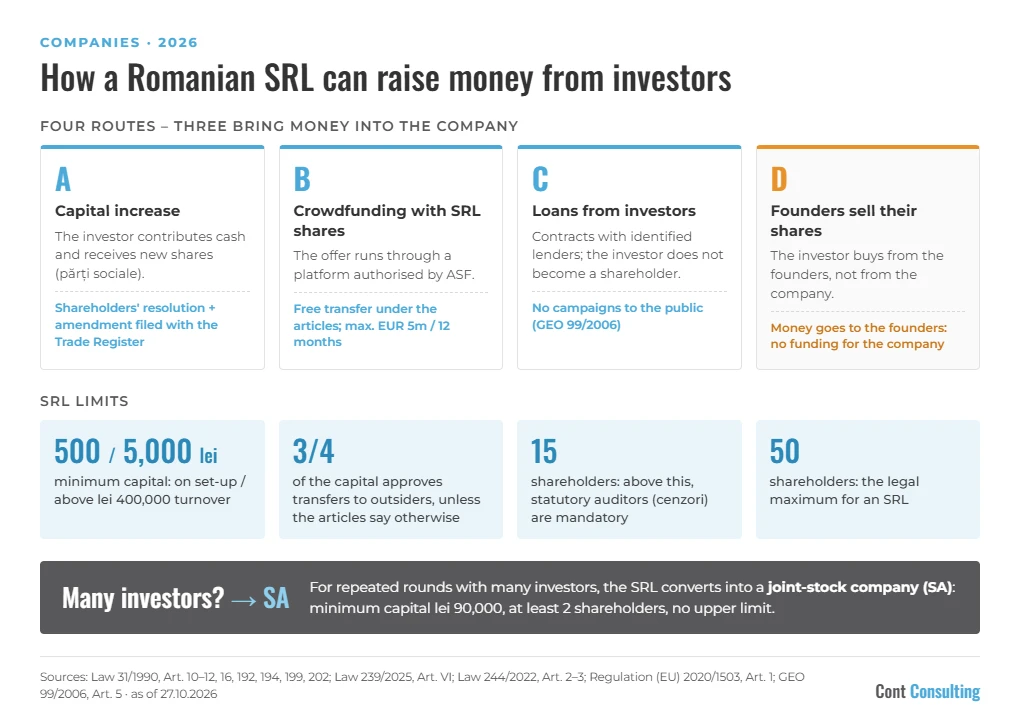
The SRL rules that matter to investors
- Minimum share capital is lei 500 for newly set-up SRLs and lei 5,000 for those with net turnover above lei 400,000 in the previous financial year (Art. VI(1) and (2) of Law 239/2025).
- No more than 50 shareholders (Art. 12 of Companies Law 31/1990).
- SRL shares are equal and cannot be represented by negotiable securities (Art. 11 of Law 31/1990).
- Admitting a new shareholder and increasing the capital means amending the articles of association, decided by the general meeting (Art. 194(1)(d)). The meeting decides by an absolute majority of shareholders and of shares, unless the articles provide otherwise (Art. 192(1)). Unanimity for amending the articles has not been required since 26 November 2022 (Art. 192(2), repealed by Law 265/2022).
- Transfers of shares to outsiders need the approval of shareholders holding at least three quarters of the capital, unless the articles provide otherwise (Art. 202(2)). The articles can therefore set a more flexible regime.
- Statutory auditors (cenzori) become mandatory above 15 shareholders (Art. 199(3)); below that, the meeting may appoint statutory auditors or a financial auditor (Art. 199(2)).
- Contributions may be in cash or in kind. Contributions in receivables are not allowed in an SRL, and work or services cannot be contributed to share capital (Art. 16(2)–(4)).
Four ways money can come in
| Route | How it works | What to know |
|---|---|---|
| A. Capital increase with new shareholders | The investor contributes cash and receives new shares. The money goes into the company. | General meeting resolution and an amendment registered with the Trade Register. At most 50 shareholders. |
| B. Crowdfunding with SRL shares | The shares are offered to investors through an authorised platform. | The articles must allow free transfer of the shares. The 50-shareholder limit still applies. |
| C. Loans from investors | Contracts with identified persons, with interest and maturity. The investor does not become a shareholder. | No offer or marketing to the public. The amounts are company debt. |
| D. Founders sell their shares | The investor buys part of the founders’ shares. | The money goes to the founders, not the company: it does not fund the company. |
Crowdfunding. SRL shares may be used in crowdfunding if they carry no restrictions that effectively prevent their transfer (Art. 3(2) of Law 244/2022). The articles must allow them to be transferred to outsiders without the shareholders’ approval (Art. 3(3)). The offer can only be made through an authorised crowdfunding service provider; in Romania, authorisation and supervision lie with ASF, the Financial Supervisory Authority (Art. 2(1) of Law 244/2022). Regulation (EU) 2020/1503 applies to offers of up to EUR 5,000,000, calculated over 12 months (Art. 1(2)(c)).
Loans. The company may borrow from identified individuals or companies under individually negotiated contracts. However, taking deposits or other repayable funds from the public is prohibited for anyone who is not a credit institution (Art. 5(1) of Government Emergency Ordinance 99/2006), and the National Bank of Romania decides whether an activity falls under this ban (Art. 5(5)). Loans must therefore not be sought through campaigns aimed at the public.
SRL or SA?
| Criterion | SRL | SA |
|---|---|---|
| Minimum share capital | lei 500 on set-up; lei 5,000 if net turnover in the previous year exceeds lei 400,000 | lei 90,000; at least 30% paid in on incorporation, the rest (cash contributions) within 12 months |
| Shareholders | at most 50 | at least 2, no upper limit |
| Transfer of holdings | SRL shares, not negotiable securities; to outsiders with approval of 3/4 of the capital, unless the articles provide otherwise | registered shares, transferred by declaration in the shareholders’ register |
| Control | statutory auditors mandatory above 15 shareholders | 3 statutory auditors and one alternate or, instead, a financial audit |
| Suited to | a few identified investors | repeated rounds with many investors |
The lei 90,000 capital of an SA is not an expense: it is the company’s own money, used in the business (Art. 9(2)(a) and Art. 10(1) of Law 31/1990). The extra yearly cost of an SA is mainly that of the statutory auditors (Art. 159(1)) or of the financial audit (Art. 160(12) and (3)). An SA may have a sole director, except where its financial statements are subject to a statutory audit, in which case it needs at least 3 directors (Art. 137(1) and (2)).
How to prepare the SRL for investors
The articles of association, before the first investor:
- voting majorities for capital increases and admitting new shareholders, so that a minority shareholder cannot block funding rounds;
- the transfer regime for shares: free (required for crowdfunding) or subject to approval by a lower majority, combined with a right of first refusal for existing shareholders;
- a contractual pre-emption right for existing shareholders when new shares are subscribed, pro rata to their holdings, with an exercise period and the option to waive it;
- management and control: the directors, possibly statutory auditors or a financial auditor (mandatory above 15 shareholders), the shareholders’ right to information;
- a dividend policy communicated to investors.
The investment agreement, for each investor or round:
- the amount invested, the number of shares and their price: the nominal value plus, where relevant, a share premium, so that later investors pay for the increase in the company’s value;
- use of the funds and reporting to investors;
- anti-dilution protection, tag-along and drag-along;
- the investor’s exit: transfer to shareholders, to third parties or buy-back.
A funding round, step by step:
- The general meeting decides the capital increase: the number of new shares, their value and who subscribes them.
- The investor pays the cash contribution into the company’s account.
- The amendment and the updated articles are filed with the Trade Register, together with proof of payment.
- The capital increase and the new shareholder are registered in the Trade Register.
- The capital increase and, where relevant, the share premium are recorded in the accounts.
At reconvened general meetings, resolutions still need a double majority: of the shareholders present and of the shares they represent (High Court of Cassation and Justice Decision 9/2026 – appeal in the interest of the law, Official Gazette 866 of 16 October 2026).
Points to watch
- Loans convertible into shares. Contributions in receivables are not allowed in an SRL (Art. 16(3) of Law 31/1990), so converting a loan into a shareholding must be checked in advance with the Trade Register. The simple route: the investor contributes cash directly.
- Offering to the public. Marketing SRL shares or loans to the public outside an authorised platform should be avoided.
- Founders’ dilution. Each round reduces the founders’ percentage; check the absolute majority and three-quarters thresholds every time an investor comes in.
- The 15 and 50 shareholder thresholds. Above 15 shareholders, appoint statutory auditors; the limit of 50 cannot be exceeded. If you are getting close to it, convert the SRL into an SA by a resolution of the general meeting.
Conclusion
An SRL can take in investors without becoming an SA if there are few of them and the articles are prepared from the start: voting majorities, share transfers, pre-emption rights. When the number of investors grows, the company converts into a joint-stock company. The tax aspects (contributions, share premiums, dividends, interest, gains on transfers) depend on the chosen structure and we analyse them separately. We can help with the articles, the investment agreement and the formalities – see Tax and Accounting Consulting.
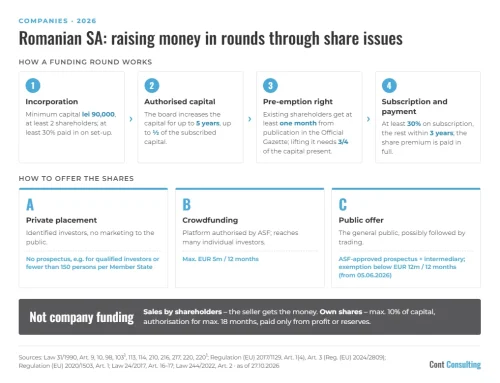
If you are planning a joint-stock company with periodic share issues, read Raising capital in rounds through share issues in a Romanian SA. The steps for setting up an SRL are explained in Establishment of LLC – information, documents and necessary steps.
Note: This text is valid as of the date of its publication, is for guidance only and represents an interpretation by the specialists of Cont Consulting, and is not intended to replace the legal provisions in force. We are not liable for any damages arising from the use of this material for legal purposes or as evidence in any potential litigation.