
Updated on 26 October 2026.
The limited liability company (SRL) is the most common form of doing business in Romania, because it is easy to register and has low monthly administration costs. The vast majority of companies registered in Romania have this legal form.
Legal requirements for the founders of an SRL
The organisation of companies in Romania is governed by Companies Law no. 31/1990. It sets a number of requirements that the founders of this type of company (called shareholders, or “asociați”, in an SRL) must meet:
- full legal capacity – founders must have full capacity to exercise their rights, which as a rule means being at least 18 years old;
- the right to be a founder – a person may not be a founder if a final court decision has banned them from acting as a founder, as an additional penalty for offences against property by breach of trust, corruption offences, embezzlement, forgery of documents, tax evasion, money laundering and terrorist financing offences (Law no. 129/2019) or offences under the Companies Law (art. 6 para. (2) of Law no. 31/1990);
- minimum 1 shareholder, maximum 50 (art. 12 of Law no. 31/1990);
- the minimum share capital is RON 500 for newly established SRLs; if the company reported net turnover above RON 400,000 in the previous financial year, the minimum share capital is RON 5,000 (art. VI of Law no. 239/2025, in force since 18 December 2025). There is no maximum. The company must pay in at least 30% of the subscribed capital within 3 months of registration, but before carrying out any operations on its behalf, and the rest within 12 months for cash contributions or within 2 years for contributions in kind (art. 9^1 para. (2) of Law no. 31/1990). The share capital is the upper limit of the shareholders’ personal liability towards third parties, and its size matters in relations with suppliers and banks;
- the company is managed by one or more directors, who may be shareholders or persons from outside the company.
SRLs that are already registered must increase their share capital to the legal minimum, by amending their articles of association, within 2 years of the entry into force of Law no. 239/2025. For increases made by 31 December 2026 solely for this purpose, the fee for publication in the Official Gazette, Part IV, is reduced by 50%. If the deadline is missed, the court may order the dissolution of the company at the request of any interested person or of the National Trade Register Office (ONRC) (art. VI paras. (6)–(8) of Law no. 239/2025).
How an SRL is organised
In an SRL, the General Meeting of Shareholders takes the important decisions, the director (or directors) runs the business and represents the company, and control may be exercised by one or more statutory auditors (“cenzori”) or by a financial auditor. Appointing statutory auditors is mandatory if the company has more than 15 shareholders (art. 199 paras. (2)–(3) of Law no. 31/1990).
Liability in an SRL
The shareholders are liable up to the amount of the share capital, while the directors are liable for properly carrying out the duties set by the shareholders and for the sound management of the business towards third parties. In certain cases a court may extend the shareholders’ liability, if it is shown that they fraudulently took company assets or acted with the aim of defrauding creditors.
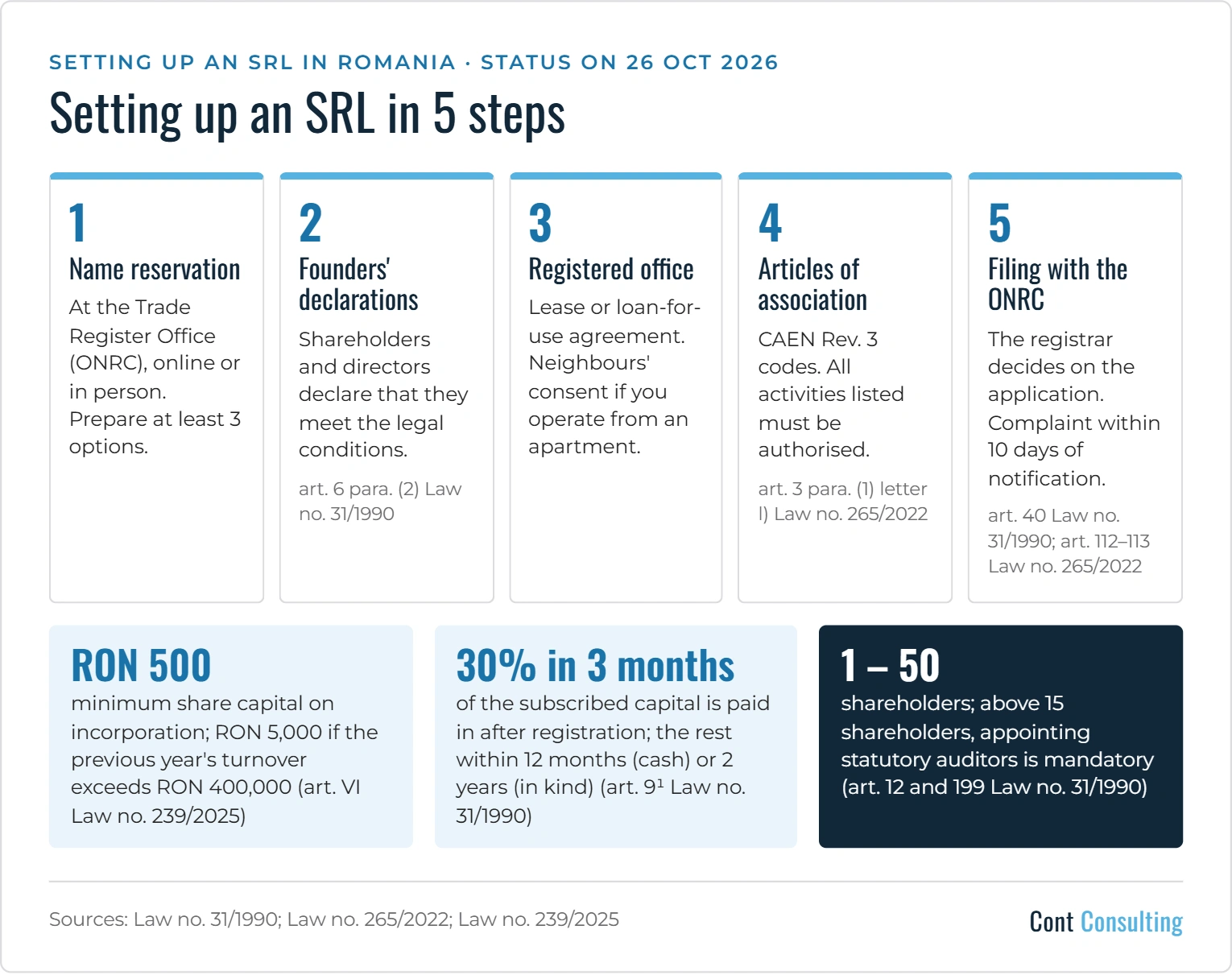
Setting up an SRL – the necessary steps
a) Reserving the company name
The first step in creating a business is choosing the name the company will bear. This depends on various factors, both the founders’ personal choices and legal requirements.
Most entrepreneurs want the company name to also be the brand they intend to sell or be known by on the market. This is a worthy goal, but often it cannot be achieved, and that is not a problem. There are countless examples on the market where a brand has one name and the company selling it has another. Moreover, the law does not require the company name to match the brand.
The name is reserved with the Trade Register Office (ONRC) in the county where the future company will have its registered office. Before doing so, we recommend preparing a list of several possible names (at least three), so that you have alternatives if your first choice is not available.
To be accepted by ONRC, a company name must:
- be written in Latin characters;
- not be confusingly similar to other companies or previously reserved names;
- not contain obscene or offensive words or expressions.
Company names must be distinct from one another, as required by law. “Tricks” some people use to get around this rule (adding articles to words, reversing the word order, adding or removing adverbs, prepositions or symbols such as @) are not allowed and are usually rejected by the ONRC examiners.
Name availability can be checked and the name reserved online on the ONRC website (submitting online forms requires a qualified electronic signature), by email or post, or at the ONRC counters.
Special care is needed when adding words such as “national” or “Romania” to the name, as this requires special approvals from the General Secretariat of the Government or other state institutions.
Checking name availability and reserving the name are included in the Start-up services package offered by our firm. For details about the services included and the price, please send us a message using the contact form on the website.
b) Preliminary declarations of shareholders and directors
The declaration of good standing is one of the documents required to register an SRL with the Trade Register. Future shareholders and directors sign, before a notary or directly at the Trade Register Office, a declaration on their own responsibility stating that they meet the legal conditions for these roles. The conditions are set out in art. 6 para. (2) of Law no. 31/1990: persons who lack legal capacity, or who have been banned by a final court decision from acting as founders as an additional penalty for one of the following offences, may not be founders:
- offences against property by breach of trust;
- corruption offences;
- embezzlement;
- forgery of documents;
- tax evasion;
- money laundering and terrorist financing offences (Law no. 129/2019);
- offences under the Companies Law.
We recommend that the future founders and directors check, before filing the application, that they have no entries in the tax record and no outstanding debts to the state budget, as these may cause difficulties later on, for example when registering for VAT.
c) Choosing the registered office
The registered office is a key element of the company’s identity, because official correspondence is sent to this address.
The registered office can be:
- a home – house or apartment. If business activities will be carried out at a registered office located in an apartment that is not commercial space, the consent of the neighbours and the approval of the owners’ association are required;
- rented commercial premises;
- the office of a law firm, without carrying out commercial activity there;
- a coworking space or an office hub.
The right to use the premises as a registered office is proven by a lease, sub-lease or loan-for-use agreement between the owner and the legal representative of the company being registered. The agreement may be concluded for a fixed or an indefinite term.
If the agreement is for a fixed term, the company must extend the right to use the registered office before it expires; otherwise it risks being declared inactive for tax purposes or being dissolved.
We recommend choosing commercial premises, an office or a coworking space where mail can be received between 08:00 and 16:00. State institutions send written notices by registered letter with acknowledgement of receipt via the Romanian Post, which delivers them during these hours. If nobody is found, the postman leaves a notice in the mailbox, and these are often lost.
One of the aspects the Romanian tax authority (ANAF) checks is whether the company actually operates at its declared registered office; it is even one of the risk criteria assessed when granting a VAT number. Failing to receive correspondence may be seen as not meeting this criterion and may lead to the company being declared inactive and losing its VAT number (details here, in Romanian).
d) Drafting the articles of association – choosing the CAEN codes
Another important decision is setting the company’s main activity and its secondary activities.
CAEN (NACE in EU terminology) stands for the “Classification of Activities in the National Economy”, the system used to classify the economic activities carried out by companies.
Since 1 January 2025 the CAEN Rev. 3 version applies (Order of the National Institute of Statistics no. 377/2024). The codes in the articles of association must be chosen from this version.
As a rule, every company has a single main activity, describing its predominant economic activity. If the company will also carry out other activities, these must be included among the authorised secondary activities in the articles of association.
Important: all activities listed in the articles of association must also be authorised; the articles of association can no longer include unauthorised activities. Authorisation is obtained from ONRC by filing the standard declaration on own responsibility regarding compliance with the operating conditions (art. 3 para. (1) letter l) of Law no. 265/2022), either at registration or later, when a new activity is added.
The authorisation procedure can become more complex when certain CAEN codes are subject to restrictions or additional requirements, such as prior approvals or permits.
e) Filing the registration application with the Trade Register Office
The company is registered with the Trade Register Office for the area where its registered office will be located.
The registration formalities are carried out by the shareholders or directors appointed in the articles of association, or by a representative.
The following documents are filed together with the registration application:
- Proof of the name reservation;
- The articles of association;
- The lease or loan-for-use agreement for the registered office;
- The declaration of good standing;
- The identity documents of the shareholders and directors;
- The declaration of beneficial owners;
- The standard declaration on own responsibility regarding compliance with the operating conditions for the activities, and the documents for tax registration, on the ONRC forms;
- Proof of any prior approvals or permits required by law;
- The power of attorney, if the formalities are carried out by someone other than the shareholders/directors: a special or general power of attorney in notarised form (or, where applicable, a lawyer’s mandate) – art. 3 para. (1) letter e) of Law no. 265/2022;
- The fee for publishing the registration in the Official Gazette. Publication of the registration or of later changes in the Official Gazette makes them enforceable against third parties.
The application and the documents listed above are numbered and filed, with a table of contents at the front. Documents are drafted in Romanian. If one of the founders or directors is a foreign citizen who does not speak Romanian, ONRC accepts documents drafted bilingually – in Romanian and in that person’s language – without an authorised translation.
The application is decided by the registrar of the Trade Register Office, by a decision (“încheiere”) (art. 40 para. (1) of Law no. 31/1990). If the file is incomplete, the registrar may request additional documents; if these are not submitted, the application is rejected.
The registrar’s decision may be challenged by a complaint filed within 10 calendar days of its communication. The complaint is filed with the Trade Register Office, which forwards it to the court (arts. 112–113 of Law no. 265/2022).
The company acquires legal personality on the date of its registration with the Trade Register.
Cont Consulting offers complete consulting services before the registration of a company and handles all the registration formalities on behalf of its clients. Details about these services can be found here.
To make the registration process easier, we have prepared a form to which our clients can attach all the necessary documents. The form can be accessed here (in Romanian).
Note: This text is valid as of the date of its update, is for guidance only and represents an interpretation by the specialists of Cont Consulting, and is not intended to replace the legal provisions in force. We are not liable for any damages arising from the use of this material for legal purposes or as evidence in any potential litigation.