
Updated on 27 October 2026.
Since 27 April 2026, hiring workers from outside the European Union, the European Economic Area and Switzerland has been governed by Government Emergency Ordinance (GEO) no. 32/2026, which replaced Title I of Government Ordinance no. 25/2014 (art. 55). The full procedures have been running since 8 August 2026; until then, the platform was used only to register employers and for testing (art. 48). Below are the steps for employers. For payroll matters (NIF, contributions, form 112), see our article on foreign employees.
Who the new rules apply to
- The full procedure (agency or authorised employer, shortage occupations, quota) applies to workers with a D/AM2 long-stay visa: permanent, seasonal and cross-border workers (art. 1(3) and art. 10; GEO no. 194/2002, art. 272).
- The D/AM1 visa is obtained on a single application filed directly by the employer, for: highly qualified workers, activities requested by ministries, teaching, scientific or artistic activities, professional athletes, and citizens of the Republic of Moldova, Ukraine and Serbia employed full time (GEO no. 194/2002, art. 271(1)).
- Employers hiring foreigners in the categories in art. 1321(1)(a)–(h) and (j)–(m) of GEO no. 194/2002 (for example long-term residents, family members of Romanian citizens, students, beneficiaries of protection) do not need to register on the platform (art. 4(2)). For them, the employer sends a copy of the contract to the General Inspectorate for Immigration (IGI) within 10 days of the start of work and reports changes or termination within 5 working days (art. 1321(6)–(7)).
Step 1: registering on workinromania.gov.ro
- The employer registers on the platform (art. 4(1)) and is automatically entered in the Register of Employers of Foreigners (art. 41(1)).
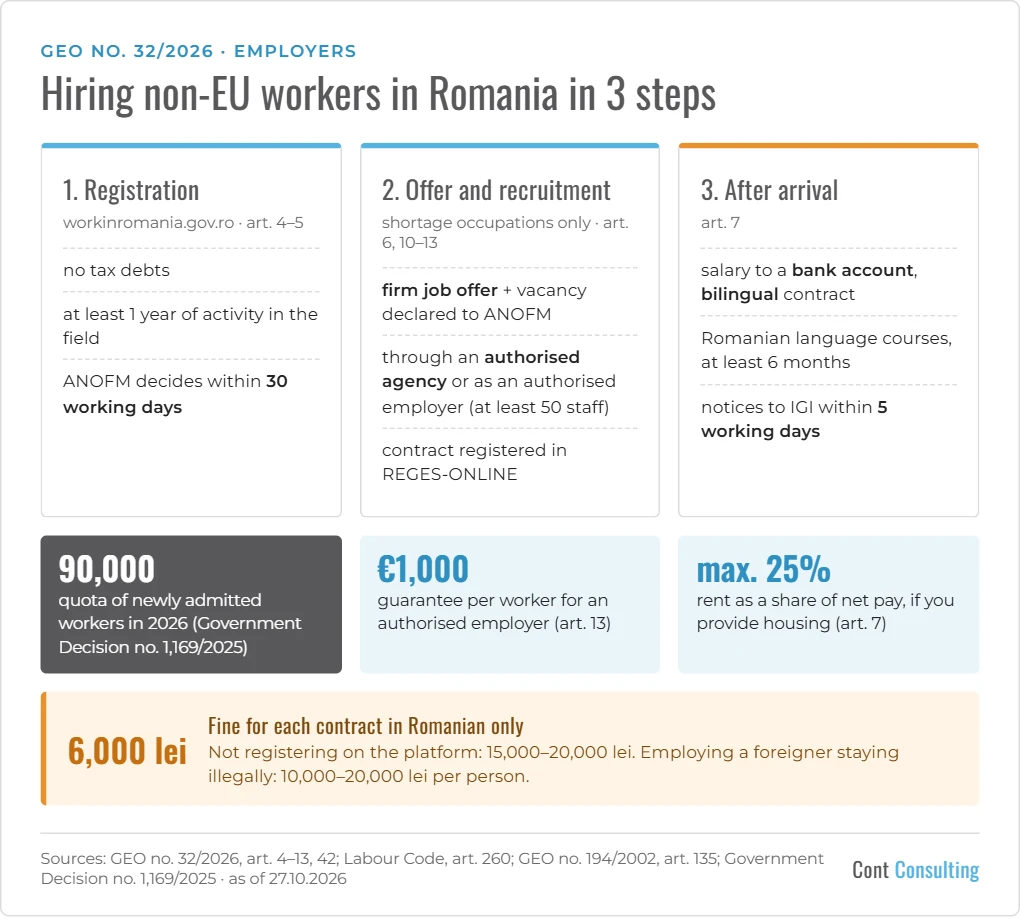
- Conditions (art. 5(1)): no debts to the general consolidated budget; for companies, at least one year of actual activity in a field compatible with the shortage occupation (not required for D/AM1); no penalties in the last 6 months for employing foreigners staying illegally, undeclared work or breaching the REGES-ONLINE rules; no specified criminal convictions of the company or its representatives, directors and shareholders.
- The National Employment Agency (ANOFM) approves or rejects the registration within 30 working days (art. 5(6)).
- The number of D/AM2 workers may not exceed the average number of employees in the previous year; individuals may employ up to three foreigners (art. 6(4)–(7)).
- Registration is suspended for 6 months, for example if debts arise or if more than 20% of the foreign workers lose their right of residence within any six consecutive months (art. 8(1)).
Step 2: the firm job offer and the agency
- The firm job offer sets out the job, duration, working hours, gross and net pay, allowances, leave and health and safety conditions, and states clearly whether the employer provides housing, meals and transport (art. 6(1)–(2)). The vacancy must be declared to ANOFM (art. 6(3)).
- For D/AM2, the employer signs a service contract with an authorised placement agency (art. 10). The agency may not take any money from the worker; only the employer pays for its services (art. 23(4) and (6)).
- Exception: an authorised employer approved by ANOFM may hire without an agency, only for shortage occupations and only for itself (art. 11). Conditions include 24 months of uninterrupted activity in the field, an average of at least 50 employees in the previous year and a guarantee of EUR 1,000 per foreign worker (art. 12(1), art. 13(2)).
- The employment contract is registered in REGES-ONLINE and attached to the single application; pay must be at least the guaranteed gross minimum earnings (GEO no. 194/2002, art. 272(5)).
Step 3: after the worker arrives (art. 7)
- pay the salary into the worker’s bank account;
- make the contract in Romanian and in the worker’s language or an international language the worker understands, including the terms of the firm offer;
- provide health and safety training in a language the worker understands;
- provide Romanian language courses for at least 6 months, at least 6 hours a week;
- notify the agency and IGI within 5 working days if the worker is absent without reason for more than 3 consecutive working days, if the contract ends or if the worker is in danger;
- keep the documents for at least 5 years after the employment ends;
- if you provide housing, rent may not exceed 25% of net pay (para. (2)).
Fines
| Breach | Fine |
|---|---|
| Not registering on the platform (art. 4(1)) | 15,000–20,000 lei (art. 42(3)(a)) |
| Cash pay, contract not bilingual, untranslated health and safety training, no Romanian courses (art. 7(1)(a)–(d), (g), (h)) | 5,000–10,000 lei per worker (art. 42(2)(a)) |
| Missing notices, documents or record keeping (art. 7(1)(e), (f), (i)) | 15,000–30,000 lei (art. 42(3)(b)) |
| Contract made only in Romanian | 6,000 lei per contract (Labour Code, art. 260(1)(e6)) |
| Employing a foreigner staying illegally | 10,000–20,000 lei per person, plus additional penalties (GEO no. 194/2002, art. 134 item 17, art. 135) |
What we recommend
- Check in Order no. 1,073/2026 whether the occupation you need is a shortage occupation.
- Pay or reschedule any budget debts before registering on the platform.
- Choose an authorised agency or check whether you qualify as an authorised employer.
- Prepare the bilingual contract, translated health and safety training and Romanian courses before the worker arrives.
- Decide internally who sends the notices to IGI and the agency within 5 working days.
We can help with hiring and payroll: see our payroll and HR services.
Note: This text is valid on the date of its update, is for information only and reflects the interpretation of Cont Consulting specialists. It does not replace the legal provisions in force.
Sources: GEO no. 32/2026, art. 1, 4–13, 23, 41, 42, 48, 53, 55; GEO no. 194/2002, art. 271, 272, 1321, 134, 135 (as amended by GEO no. 32/2026); Labour Code, art. 260; Ministry of Labour Order no. 1,073/2026; Government Decision no. 1,169/2025 – as in force on 27.10.2026.