
Updated on 27 October 2026.
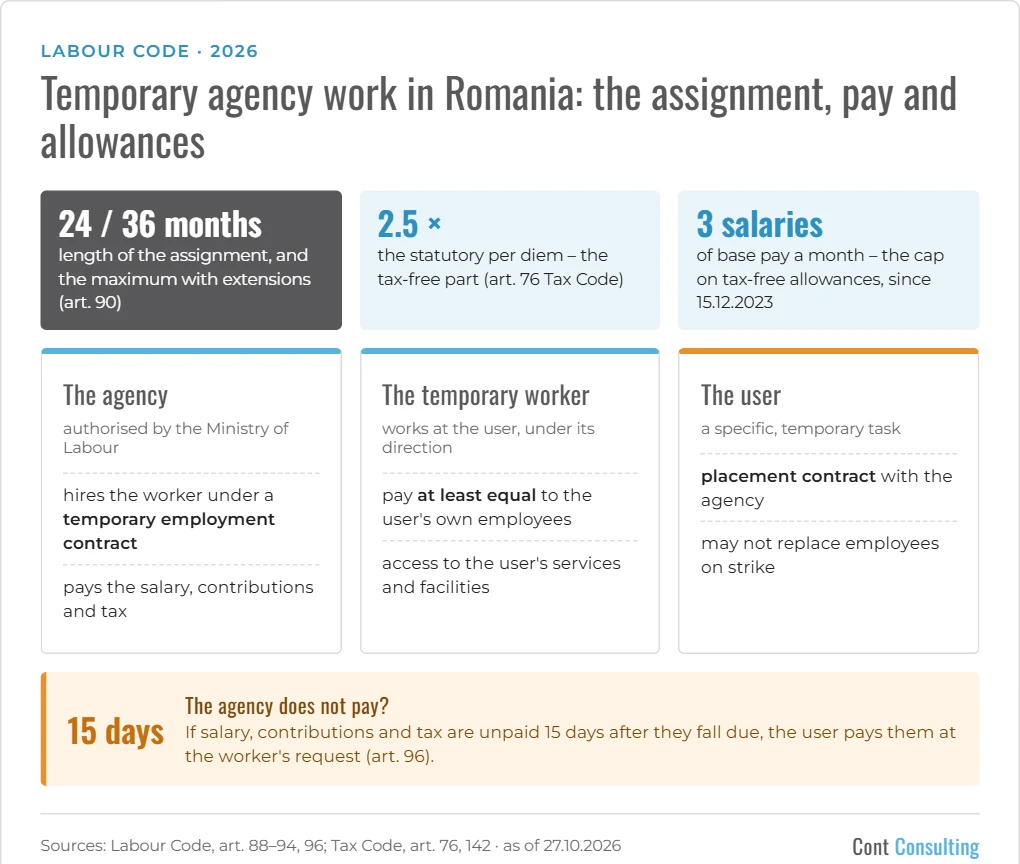
Temporary agency work in Romania involves three parties: the temporary work agency, which employs the worker; the temporary worker; and the user, where the worker works under the user’s supervision and direction (art. 88 of the Labour Code). The agency must be authorised by the Ministry of Labour (art. 88(3)).
The assignment
- A user may use an agency only for a specific, temporary task (art. 89) and may not use it to replace employees who are on strike (art. 93).
- An assignment lasts up to 24 months and may be extended, but not beyond 36 months in total (art. 90).
The contracts
- The placement contract is made in writing between the agency and the user and covers, among other things, the length of the assignment, the job, working conditions, equipment, the agency’s fee and the worker’s pay (art. 91(1)–(2)). Any clause that prevents the user from hiring the worker after the assignment is void (para. (3)).
- The temporary employment contract is made in writing between the agency and the worker, for the length of the assignment, and sets out the assignment conditions, the user and the pay (art. 94).
Pay
- Pay for each assignment may not be lower than that of a user’s employee doing the same or similar work (art. 92(3)). If the user has no such employee, the pay set by the collective agreement applicable at the user is taken into account (para. (4)).
- Pay may not be lower than the gross minimum base salary under art. 160(3) (art. 96(2), as amended by Law no. 283/2024).
- The agency pays the salary and withholds and pays the contributions and tax (art. 96(1) and (3)). If it does not pay them within 15 days of the due date, the user pays them at the worker’s request and then recovers them from the agency (para. (4)–(5)).
- The temporary worker has access to the user’s services and facilities on the same terms as other employees; the user provides protective equipment unless agreed otherwise (art. 92(1)–(2)).
Travel allowances: how much is tax-free
Travel and posting allowances received for work in another town, in Romania or abroad, are not taxed and are not included in the social security contribution base up to a ceiling (art. 76(2)(k) and (4)(h), art. 142(g) of the Tax Code):
- in Romania: 2.5 times the allowance set by Government decision for public sector staff;
- abroad: 2.5 times the per diem set by Government decision for Romanian staff sent abroad;
- in both cases, up to 3 base salaries for the job, calculated separately for each month: the 3 salaries are divided by the working days in the month and multiplied by the days of travel in that month.
The 3-base-salary cap applies from 15.12.2023 (Government Emergency Ordinance no. 115/2023). Anything above the ceiling is taxed as salary. Transport and accommodation are not included in the ceiling.
Example. Base salary 5,000 lei, a month with 22 working days, 30 days of travel in that month: the monthly cap is 3 × 5,000 / 22 × 30 = 20,454.55 lei. The tax-free allowance is the lower of this amount and 2.5 × the statutory per diem × the days of travel.
What we recommend
- Check that the temporary work agency is authorised.
- Ask the user for the pay of its own employees in similar jobs and include the pay in the placement contract.
- Track the length of assignments: 24 months, up to 36 with extensions.
- Calculate the tax-free allowance ceiling every month for each worker.
- For work in another country, also check that country’s posting rules.
We can help with payroll and contracts: see our payroll and HR services.
Note: This text is valid on the date of its update, is for information only and reflects the interpretation of Cont Consulting specialists. It does not replace the legal provisions in force.
Sources: Romanian Labour Code (Law no. 53/2003), art. 88–94 and 96, as in force on 27.10.2026; Law no. 12/2015; Law no. 283/2024; Romanian Tax Code, art. 76(2)(k) and (4)(h), art. 142(g); Government Emergency Ordinance no. 115/2023.