
Updated on 27 October 2026.
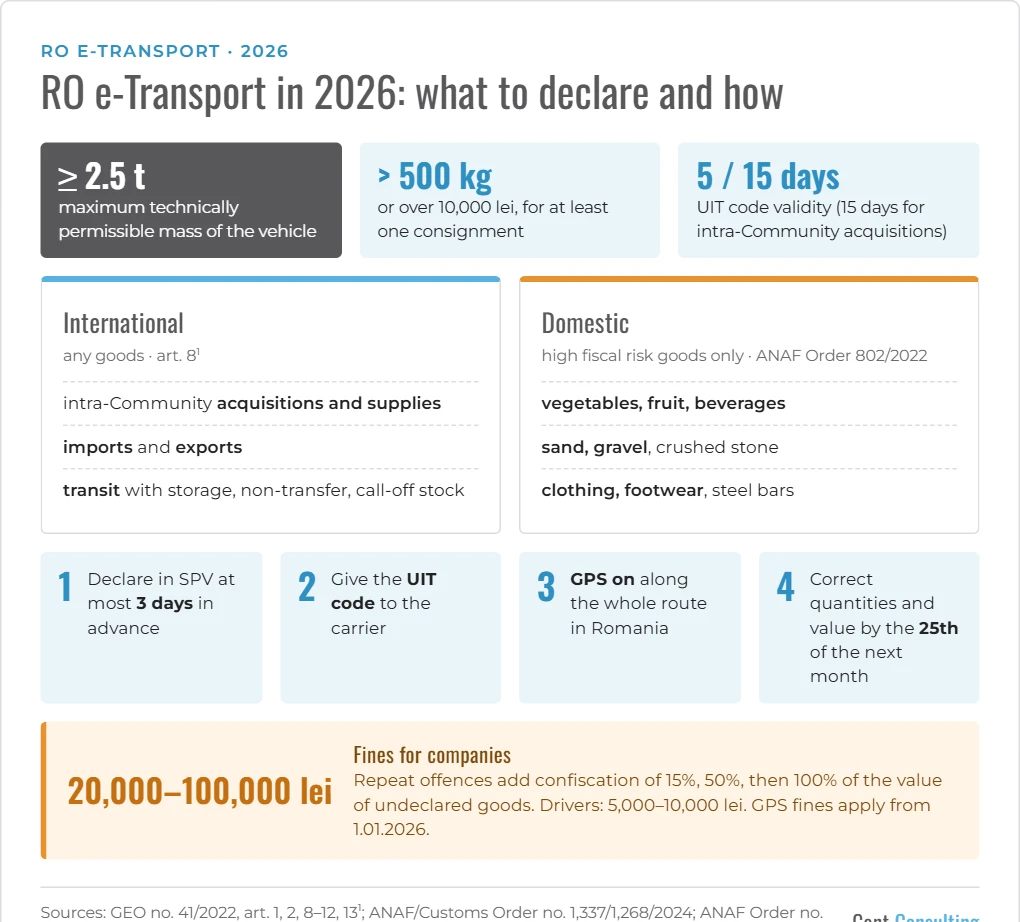
Romania’s RO e-Transport system, set up by Government Emergency Ordinance (GEO) no. 41/2022, monitors two types of road transport: international transport of goods, whatever the goods, and transport within Romania of goods with high fiscal risk (art. 1(2)). For each declared transport, the system generates a UIT code that travels with the goods to their destination.
Which transports must be declared
International transports (art. 2 item 9 and art. 81 of GEO no. 41/2022), for any kind of goods:
- intra-Community acquisitions, from the border to the place of unloading;
- intra-Community supplies, from the place of loading to the border;
- imports and exports;
- transit with storage or with a new consignment formed in Romania;
- non-transfer operations and call-off stock.
Domestic transports are declared only for goods with high fiscal risk listed in ANAF Order no. 802/2022: vegetables (CN 0701–0714), fruit (CN 0801–0814), beverages (CN 2201–2208), goods under CN 2505 and 2517 (sand, gravel, crushed stone), clothing (CN 6101–6117, 6201–6212, 6214–6217), footwear (CN 6401–6405) and iron or steel bars (CN 7213 and 7214). This covers transport between different companies, transfers between a company’s own locations and returns (art. 2 item 9 (e), (f) and (i)). Excise goods moving under duty suspension with an e-AD are exempt.
Thresholds. Monitoring applies to vehicles with a maximum technically permissible mass of at least 2.5 tonnes, carrying goods with a total gross weight of over 500 kg or a total value of over 10,000 lei for at least one consignment (art. 1(4) of ANAF/Romanian Customs Order no. 1,337/1,268/2024). The thresholds also apply to international transports.
If a consignment contains both high-risk goods and other goods, all goods in the consignment must be declared (art. 12).
Who must declare
| Operation | Who declares |
|---|---|
| Import / export | the consignee in the import customs declaration / the consignor in the export declaration |
| Intra-Community acquisition | the buyer in Romania |
| Intra-Community supply or domestic supply | the supplier in Romania |
| Transit with storage | the warehouse keeper |
| Transfer between own locations | the company that holds the goods |
Legal basis: art. 8(1) and art. 81 of GEO no. 41/2022. Declarations are made in the ANAF online portal (SPV), directly or through an authorised representative, using the free Ministry of Finance application or the API (art. 2 of the procedure approved by Order no. 1,337/1,268/2024).
The UIT code
- A transport can be declared at most 3 calendar days before the declared start date, and no later than entry into Romania, the place of import or the moment the vehicle sets off (art. 11(1)).
- The UIT code is valid for 5 days, or 15 days for intra-Community acquisitions, transit with storage, non-transfer operations and call-off stock (art. 11(2)).
- The declarant passes the UIT code to the carrier before entry into Romania or departure (art. 8(2)); the driver shows it during checks together with the transport documents (art. 10(1)).
- After departure the data can no longer be changed (art. 11(3)), with two exceptions: the vehicle must be updated whenever it changes (art. 8(11)), and the description, quantities and value of the goods can be corrected after the code expires, until the 25th of the month after the transport ends (art. 11(5)).
- If the system is down, the declaration must be made by the end of the next working day after it is restored (art. 8(12) and (13)).
Vehicle GPS position
The carrier must transmit the vehicle’s position along the whole monitored route, through the vehicle’s own devices or through the free Ministry of Finance application installed on a telecommunications device such as a mobile phone (art. 82). The driver must switch the device on before the transport starts in Romania and switch it off only after delivery or after leaving the country (art. 83). Fines for these obligations were suspended until 31 December 2025 (GEO no. 29/2025) and apply from 1 January 2026.
Fines
| Offence (art. 131(1)) | Fine for companies | Fine for individuals |
|---|---|---|
| (a), (b): undeclared transport, UIT code used after expiry, declared quantities different from those carried | 20,000–100,000 lei | 10,000–50,000 lei |
| (c): UIT code not passed to the carrier, data changed after departure, consignment declared incompletely | 20,000–100,000 lei | 10,000–50,000 lei |
| (e): the carrier does not transmit the GPS position | 20,000–100,000 lei | 10,000–50,000 lei |
| (d): the driver does not show the UIT code or does not switch on the GPS device (fine for the driver) | 5,000–10,000 lei | |
For offences (a) and (b), a second offence within 12 months of the first penalty also leads to confiscation of 15% of the value of the undeclared goods, a third to 50%, and a fourth or later offence to 100% (art. 131(5)–(8)). Confiscation does not apply when the missing declaration is found after the transport has ended and the operation is recorded in the supporting documents and in the accounts (art. 131(9)). To determine how many offences there have been, inspectors check a central electronic register of penalties (art. 14(3) and Order no. 1,659/1,622/101/2025).
What we recommend
- For each customer and supplier, check whether the goods are on the high-risk list and whether the transport exceeds the thresholds.
- Agree in the contract or transport order who declares and when the UIT code is sent to the carrier.
- For intra-Community acquisitions, ask the supplier for the vehicle details before departure.
- Check every month, by the 25th, that the declared data match the invoices and goods received.
- If you run your own vehicles, make sure they transmit their GPS position and that drivers know how to switch the device on and off.
We can help you declare transports in RO e-Transport and reconcile them with your accounts: see our consultancy services.
Note: This text is valid on the date of its update, is for information only and reflects the interpretation of Cont Consulting specialists. It does not replace the legal provisions in force.
Sources: GEO no. 41/2022, art. 1, 2, 8, 81, 82, 83, 9–12, 131, 14, as in force on 27.10.2026; GEO no. 29/2025; ANAF/Romanian Customs Order no. 1,337/1,268/2024 (Official Gazette no. 597/27.06.2024); ANAF Order no. 802/2022; ANAF/Customs/Ministry of Internal Affairs Order no. 1,659/1,622/101/2025 (Official Gazette no. 634/07.07.2025).